

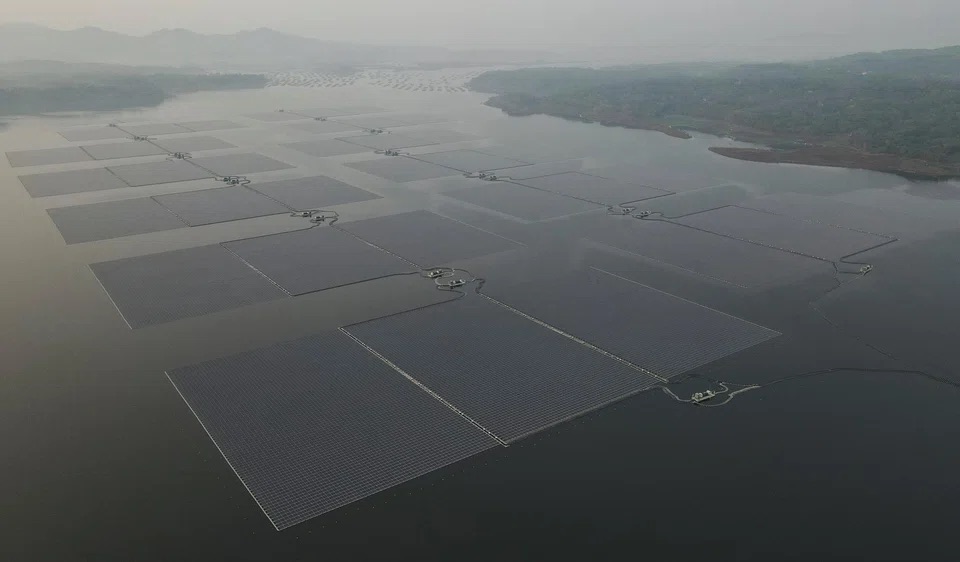
Beyond financing, other avenues include leveraging Chinese technological solutions
One of the longstanding barriers to accelerating Asean’s energy transition is the high cost of financing, whether due to perceived investment risks, a lack of bankable green projects or macroeconomic factors.
Ma Jun, the former chief economist of the People’s Bank of China and a key architect of the country’s green finance ecosystem, is championing yuan-denominated debt as a relatively underutilised way to lower the cost of capital.
Speaking in an exclusive interview with The Business Times, he highlighted this as the key opportunity to enhance green collaboration between Asean and China.
Beyond financing, other avenues include leveraging Chinese green technological solutions, whether in the power, waste or water sectors, and attracting Chinese companies in the green sector to invest in South-east Asian markets.
The yield advantage
The strategy relies on diverging global monetary policies. The Chinese central bank has been easing its monetary policy to support economic growth, keeping its interest rates lower than the US Federal Reserve, as well as several Asean central banks.
The world’s second-largest economy has a benchmark interest rate of 3 per cent, compared with roughly 3.75 per cent in the US. In South-east Asia, regional benchmarks remain significantly higher, with Indonesia at 5.75 per cent and the Philippines at 4.75 per cent.
“Issuers from Asean countries can go to the China market... which will reduce funding costs and make their projects more financially viable,” said Dr Ma.
Even where benchmark interest rates are lower than in China, such as Malaysia’s 2.75 per cent policy rate, effective lending rates in China are typically lower because intense competition among Chinese banks, supported by ample liquidity, compresses lending margins.
He cited a recent example of Pakistan issuing its inaugural nearly 1.8 billion yuan (US$258 million) sovereign panda bond as a successful proof of concept.
The bond had a historically low coupon rate of 2.5 per cent and saw a subscription rate of more than five times the amount that was offered. Proceeds from this bond would be used to finance green and sustainable infrastructure projects.
Borrowing in a foreign currency may require issuers to hedge to mitigate currency risks. But Dr Ma argued that it is still cheaper to borrow in yuan even after factoring in hedging costs.
The yuan makes the most economic sense for those involved in green or transition projects as they would likely have Chinese vendors, given China’s stronghold in the green energy supply chain.
“If you want to use part of the proceeds to buy Chinese equipment, this lower financing costs will help you. Because if you borrow, let’s say in US dollars, which is at a 6 per cent interest rate, you still need to convert into renminbi and buy the Chinese currency. Now I’m offering the option of borrowing at 3 per cent with renminbi to buy Chinese equipment,” he added.
Yet, the Chinese debt market is a relatively untapped avenue for many Asean corporates.
While there is no widely published data set on the proportion of yuan-denominated debt by Asean issuers, a report from the International Capital Market Association indicated that only 11 per cent of international bonds from Asian issuers were yuan-denominated in 2024.
Bonds denominated in the US dollar remained the most prevalent at 67 per cent.
Dr Ma attributed this slow adoption to the newness of the market, noting that it often takes just one inaugural issuance to pave the way.
“It’s a marketing thing, and I think very quickly we’ll see this idea of raising money in China being spread... (after) a first mover has done it. So we need a couple of first movers in Asean countries – they would tell their fellow issuers that this is an opportunity,” he added.
There are also lingering concerns that an over-reliance on Chinese financing could deepen economic dependence on China and increase exposure to geopolitical risks – a phenomenon known as debt-trap diplomacy.
Critics have often brought up Sri Lanka as an example of debtor nations having to give up critical sovereign assets when they become unable to pay off their loan.
However, Dr Ma noted that there are fewer geopolitically charged tensions between China and Asean.
The solution for emerging markets is actually to improve their investment environment to attract more private-sector capital.
“They invest in the name of a private company rather than in the name of a lender lending to the host government. So, the government will not be the borrower,” said Dr Ma.
“That’s why private-sector investment becomes increasingly important for these markets in driving their economic growth, including the green economy growth.”
Chinese green technology
Dr Ma laid out several areas – renewable energy and battery storage, hydrogen, electric vehicles and waste treatment – where the private sectors in both Asean and China can collaborate to accelerate the region’s energy transition.
Besides the obvious of leveraging China’s solar panels and battery storage solutions to decarbonise South-east Asia’s power sector, Dr Ma said the region can also deploy Chinese technologies that enable the production, transport, storage and usage of hydrogen.
Given the challenges in negotiating and then building out a cross-border power grid that Asean is aiming to with a regional power grid, hydrogen can act as a moving grid in the meantime.
“One of the possibilities is you produce hydrogen in Malaysia and Indonesia (both of which have) a lot of sunshine, a lot of cheap solar power turning into hydrogen, then shipped to places where you need it, including Singapore,” he said.
Another area is generating power using biomass, which is an abundant resource in the region. By deploying proven technologies, Asean can convert its abundant, untreated waste – which is currently regarded as pollution – into economic value, gradually replacing coal-fired power generation.
Dr Ma said these technologies are already proven to be financially viable and bankable, and therefore ready to be deployed in South-east Asia through private-sector players, without the need for governments to borrow or provide guarantees.
However, companies operating in South-east Asia that depend on Chinese technologies have also been caught in the crossfire of rising tensions between the US and China.
The US had previously imposed tariffs on solar manufacturers in Asean over concerns that Chinese companies were shifting production to South-east Asia to avoid tariffs on imports from China.
Further collaboration on green technologies between Asean and China could expose local companies to similar geopolitical headwinds.
However, once US trade policies stabilise, Dr Ma said he hopes countries importing from Asean will not regard goods with at least 40 per cent value added in the region as Chinese products seeking to bypass trade restrictions.
He also noted that Chinese investment in the region is not driven solely by exports to the US market.
“Increasingly, we see very rapid growth of domestic demand for solar installation, wind power, battery consumption, in your local manufacturing of EVs. So I think increasingly the US components in the China-Asean collaboration will become less important,” he added.
Source: Businesstimes
Share:

<p>Time: November 2025<br /> By: WTO and International Trade Group, Legal Department – VCCI</p>
