

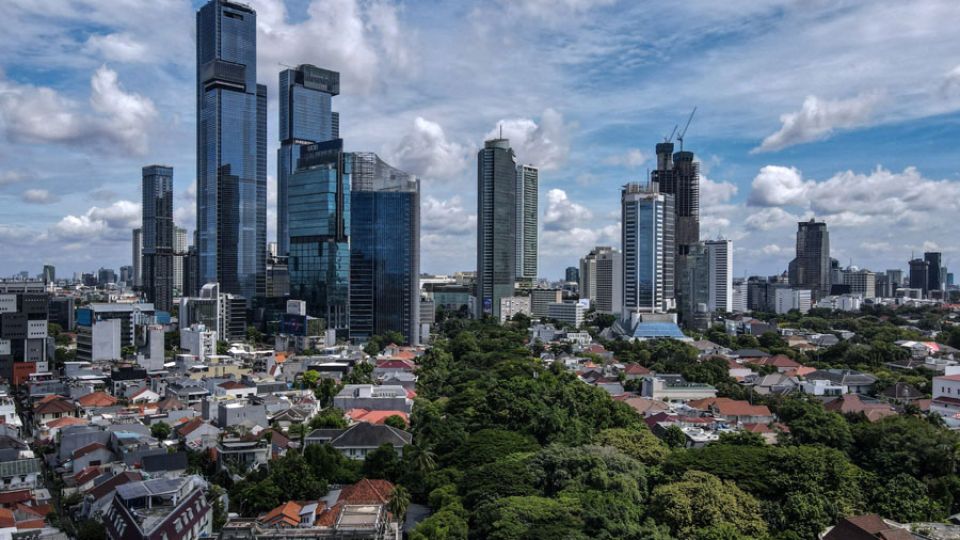
In its latest report titled “Indonesia Economic Prospects” published in June, the World Bank highlighted that the country’s decreasing medium- and high-skilled employment has further eroded the supply of jobs capable of supporting middle-class livelihoods.
Middle- and high-skill jobs in Indonesia have steadily disappeared in recent years as the country struggles to create better-paying employment amid weak hiring demand, according to a recent World Bank report. The trend has fueled rising educated unemployment while putting downward pressure on wages for middle- and upper-income workers.
Analysts warn that the shift signals Indonesia risks being trapped in lower-value segments of global supply chains that rely heavily on low-skilled labor, while higher-skilled, higher-paying jobs are increasingly captured by competing countries.
In its latest report titled “Indonesia Economic Prospects” published in June, the World Bank highlighted that the country’s decreasing medium- and high-skilled employment has further eroded the supply of jobs capable of supporting middle-class livelihoods.
Between 2018 and 2025, wages in medium- and high-skilled employment fell by about 1 and 2 percent per year. In contrast, low-skilled occupations gained about 1.7 percent a year.
“The divergence has steadily eroded the share of middle-class workers, falling from 14.5 percent in 2018 to 7.1 percent in 2025. The share of middle-class population, using official definition, has followed the same trajectory, declining since 2018,” reads the report.
Furthermore, the limited formal employment opportunities have increasingly pushed higher-skilled and educated individuals into informal employment.
The share of formal wage employment among tertiary-educated workers dropped to 67.8 percent last year, from 74.1 percent recorded in 2018. In the upper-secondary graduates category, it fell nearly 7 percentage points to around 30 percent.
While tertiary-educated workers still managed to move into higher-tier informal roles, workers with lower education had no such option, landing almost entirely in low-tier informal work.
“This reversal of the conventional trajectory, in which rising education should move workers into formal jobs, indicates a broader scarcity of better jobs in Indonesia which is driven by weak employer demand, forcing better educated workers into positions that underutilize their skills,” the report noted.
The World Bank also stated that a growing share of educated workers is being absorbed into arrangements with lower job security, weaker social protection and limited earning ceilings, making it harder to build stable welfare gains.
Public policy expert Yayat Supriatna said that new jobs for skilled workers in Indonesia are shrinking due to a weakening manufacturing sector, as reflected by multiple factory relocations recorded over the past few years. Meanwhile, trade, logistics and transportation industries, which are primarily driven by informal employment, are on the rise.
Growing uncertainties in Indonesia’s investment climate have also stunted the development of technology and skill-based sectors in the country, he added.
“The downstreaming program, for example, can actually create [jobs] in the domestic market, but they are limited by [lack of] capital and investor [support],” he told The Jakarta Post on June 23.
Mohammad Faisal, executive director of the Center of Reform on Economics (CORE) Indonesia, viewed the World Bank’s figures as an alarming trend, showing that Indonesia’s competitive advantage is shifting from middle- to low-cost labor.
With the rise of global value chains that enable production to be spread across multiple countries, he argued that Indonesia might have become less competitive, leaving it with supply chain segments that only rely on low-skilled workers, while higher-skilled jobs move to competing countries.
“This is not aligned with the national programs aimed at boosting economic growth, consumption and purchasing power. To increase purchasing power, we need to create jobs,” he told the Post on June 17.
The shift toward capital-intensive industries is also reducing demand for middle-skilled positions, especially as the risks of job replacement increase amid accelerating technological advancements such as artificial intelligence, he added.
Faisal stressed the need to push investments in Indonesia to also create higher quality jobs alongside low-skilled ones.
“Job creation isn’t just about quantity of workers [that can be absorbed], but also involves considering the quality of employment,” he said.
Arif Novianto, labor researcher and a lecturer at Tidar University, explained that the diverging trend had reflected structural issues within Indonesia’s labor market.
He said that Indonesia is experiencing a “jobless growth”, a situation where job creation is not keeping up with the country’s accelerating economic growth.
In the first quarter, Indonesia surpassed expectations with 5.61 percent year-on-year (yoy) gross domestic product growth, marking the highest rate since the third quarter of 2022.
“Jobs are mostly being created within sectors with low productivity, such as agriculture, informal services, accommodations and food and beverages. Meanwhile, sectors that absorb middle to higher skill jobs are seeing slower growth or stagnation,” he told the Post on June 17.
The World Bank’s findings also indicate a “hollowing out of middle-skilled jobs”, he added, which had forced individuals with higher educations to seek jobs in the informal sector, while some others remained unemployed.
This could eventually push up the number of educated unemployment and exert downward wage pressure on the middle-to-upper class.
“This is not only about the gap [of decent jobs], but also spending power and household consumption, because decent workers typically serve as the driver of domestic consumption,” Arif said.
In the long term, he warned the trend could lead to underemployment and weaken the motivation to improve skills as the wage premium associated with higher education continued to decline.
“Indonesia has long relied on low-cost job creation. Now, the challenge is to encourage more advanced industrialization, middle to higher manufacturing technology and ensuring higher formalization,” he said.
Source: Asianews
Share:



<p>Time: November 2025<br /> By: WTO and International Trade Group, Legal Department – VCCI</p>
