

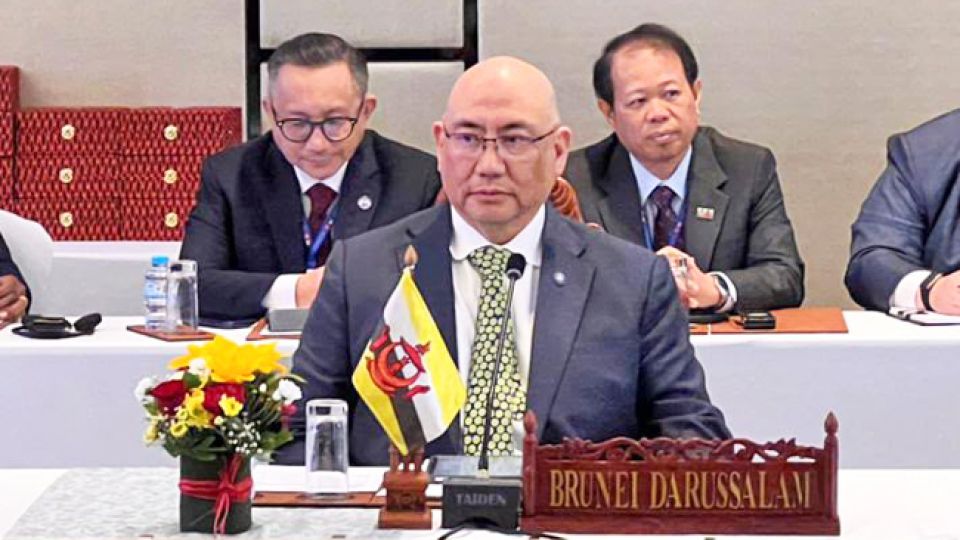
Brunei Darussalam highlighted the need to ensure that funding mechanisms remain open and accessible to all member states regardless of their circumstances or level of development.
The 22nd ASEAN Ministerial Meeting on Science, Technology and Innovation (AMMSTI-22) was held on June 26, 2026, in Vientiane, Laos, preceded by the 89th Meeting of the ASEAN Committee on Science, Technology and Innovation (COSTI-89) and related Dialogue Partner meetings from June 22 to 25, 2026. ASEAN member states engaged in open, strategic and forward-looking discussions on sustainable innovation, digital integration and public-private partnerships.
During the meeting led by Minister of Transport and Infocommunications Dato Seri Paduka Mohd Riza bin Dato Paduka Haji Mohd Yunos, Brunei Darussalam shared its views on the region’s future direction and priorities for the implementation of ASEAN Plan of Action on Science, Technology and Innovation (APASTI), amongst others: first, emphasised the importance of identifying and investing in regional priority areas, including the need to map and inventorise national innovation strengths and talent across ASEAN member states. Second, it underscored the importance of ensuring that future annual deliverables are designed to promote strong and inclusive collaboration across ASEAN’s Pillars, recognising that member states are at different stages of innovation maturity and that more advanced members can play a role in strengthening the capacities of others.
Finally, Brunei Darussalam highlighted the need to ensure that funding mechanisms remain open and accessible to all member states regardless of their circumstances or level of development, citing the ASEAN Science, Technology and Innovation Fund (ASTIF) Call 2026 and the development of shared regional research infrastructure as examples of collaborative models that should be further strengthened in the future.
Brunei Darussalam also shared proposed specific guidance on the 2026 Priority Economic Deliverables. On artificial intelligence (AI) in health, Brunei Darussalam emphasised the need to develop regional standards to ensure that innovation advances hand-in-hand with public trust and safety. On space cooperation, the minister urged more advanced member states to share their experience and support the development of regional space capabilities, including through people-to-people development in space technology, as well as strengthened collaboration development of related space agencies. Brunei Darussalam’s guidance to the meeting was for APASTI to remain practical, inclusive and measured by outcomes that reach every member state, so that ASEAN can grow into a region that is more resilient, more sustainable and more competitive, together.
Chaired by Deputy Prime Minister and Minister of Education and Sports of Laos Associate Professor Dr Thongsalith Mangnomek, the meeting focused on leveraging science, technology and innovation to address focus areas such as climate change, strengthen food security and accelerate the region’s transition towards renewable energy. Ministers also took stock of progress on the 2026 Priority Economic Deliverables led by the Philippines: the Regional Programme for STI on AI (Phase 1 – Health S&T) and the ASEAN Declaration on Space Cooperation. The meeting also endorsed the launch of the ASTIF Call 2026, themed ‘ASEAN Grand Challenge: AI-Enabled Competitive and Resilient Region’, with a funding amount of USD1.2 million.
Another milestone of the meeting was the official launch of the APASTI Monitoring and Evaluation (M&E) Dashboard, a digital platform designed to drive accountability and results-oriented cooperation across the region. The meeting also welcomed the official launch of the ASEAN Technology Management Hub (ASEAN TMH), a regional digital platform aimed at strengthening technology transfer, research commercialisation and innovation collaboration across ASEAN. The meeting welcomed the operationalisation of the ASEAN-Korea High-Performance Computing (HPC) Facility in Indonesia, ASEAN’s first shared regional supercomputing infrastructure, which will support advanced research and innovation in areas such as AI, climate modelling, disaster forecasting and biotechnology.
The meeting provided Brunei Darussalam an opportunity to strengthen collaboration in the development of science, technology and innovation. Brunei Darussalam’s participation in APASTI also gives it access to regional mechanisms that can support innovation development.
On the sidelines of the meeting, Dato Seri Paduka Mohd Riza held a series of bilateral meetings with counterparts from ASEAN member states to discuss opportunities for strengthening cooperation in science, technology, innovation and digital transformation. The discussions reaffirmed Brunei Darussalam’s commitment to advancing practical and outcome-oriented collaboration under regional frameworks, including APASTI, particularly in areas such as AI, human capital development and climate-resilient technologies. The meetings also provided an opportunity to exchange views on digital transformation and talent development in science, technology, engineering, mathematics (STEM), while underscoring the importance of continued engagement among officials to support the implementation of national and regional strategies and to promote greater peer learning and cooperation across ASEAN and with its partners.
ASEAN member states must work collectively to translate strategies into tangible outcomes through greater knowledge sharing, enhanced cross-border technology collaboration and efforts to bridge the digital divide across the region. In parallel, ASEAN will continue to strengthen capacity-building in science, technology and engineering as a key enabler for the effective implementation of APASTI.
Meanwhile, the 89th Meeting of the ASEAN Committee on Science, Technology and Innovation (COSTI-89) and Dialogue Partner meetings was represented by Permanent Secretary at the Ministry of Transport and Infocommunications Ir Haji Mohammad Nazri bin Haji Mohammad Yusof.
Source: Asianews
Share:


<p>Time: November 2025<br /> By: WTO and International Trade Group, Legal Department – VCCI</p>
