

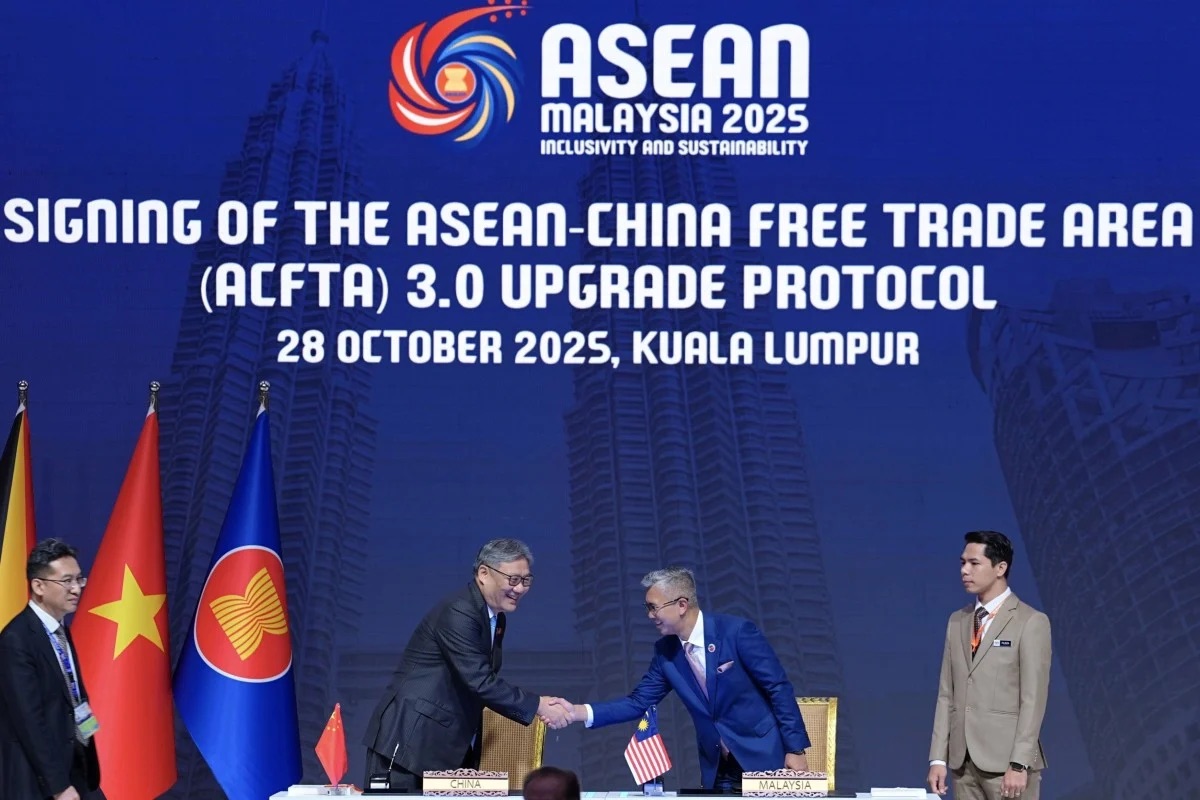
Faced with the structural reality of China, Southeast Asia is trying to turn it into an advantage without losing control of its choices
China-Asean relations are usually described in two ways. One emphasises danger: the South China Sea, US-China rivalry, military pressure and risk of Southeast Asia being pulled into China’s orbit. The other emphasises opportunity: trade, infrastructure, investment, supply chains and shared growth.
Both are true. Neither is enough.
I recently joined a study tour by the University of Hong Kong’s Centre on Contemporary China and the World to Chengdu, Kuala Lumpur and Jakarta. During the trip, I was struck by how much the relationship between China and the Association of Southeast Asian Nations lies beyond the usual language of geopolitics. It is being built through food systems, satellites, aircraft, universities, finance, culture, infrastructure, data centres, business networks and regional institutions.
The first lesson came from Chengdu. A visit to a dairy company might seem an unlikely starting point for thinking about China-Asean relations. Yet it spoke directly to a basic Chinese development priority: food security. More than supply, food security for China means quality, safety, standards and consumer trust. The “24-hour milk” we were served was a statement about reliability in a society that still remembers food-safety scandals.
That concern about basic security sat beside China’s technological frontier. Visits to companies involved in the commercial satellite and electric vertical take-off and landing aircraft businesses showed a country trying to shape industries, not just join them. An exchange with a leading university added an intellectual dimension: China studies, Southeast Asian studies, Eurasian studies, technology, security, finance, climate and governance increasingly overlap.
Southeast Asia encounters all of these Chinas: of trade and capital, technology and infrastructure, tourism and students, culture and historical memory, and strategic pressure. None of this began with the Belt and Road Initiative or US-China rivalry. It rests on older circuits of trade, migration, education, family networks and cultural familiarity that make China both more intimate and politically sensitive in Southeast Asia than most external powers.
Malaysia offered a different angle. If Chengdu showcased the sources of Chinese capability, Kuala Lumpur highlighted the problem of living with that capability without being defined by it. Malaysia is better understood not as a middle power but as an indispensable country in the middle: strategically located, economically relevant, politically plural and central to Asean’s geography.
The usual word for its behaviour is hedging. But hedging is too thin. Malaysia is trying to keep domestic politics, economic development and regional diplomacy aligned enough to preserve room for manoeuvre.
China is economically indispensable, but not exclusive. The United States remains strategically important, but not sufficient. Asean is necessary, but not always decisive.
The harder question is whether Malaysia can convert strategic positioning into national capability: political coherence, deeper industrial capacity, and educational and technological institutions strong enough to make openness productive rather than reactive. The South China Sea casts a shadow, but the region cannot be organised around deterrence alone. Southeast Asia also needs dialogue, confidence-building and trust, backed by institutions strong enough to handle pressure.
Indonesia took the discussion to a larger scale. Its relationship with China cannot be reduced to alignment, dependency or resistance. China is a source of trade, investment, infrastructure, technology and markets. It also complicates Indonesia’s strategic environment. Indonesia’s challenge is to use China, the US, Asean, business networks and domestic reforms to serve national development.
A Jakarta lunch with a leading Indonesia think tank showed how policy communities are connecting domestic reform, regional leadership and geopolitical pressure. This is where political economy becomes central. Indonesia is trying to mobilise capital, rationalise state assets, build infrastructure, strengthen industrial capacity and manage a vast archipelagic state. Agency alone will not build ports, discipline state-owned enterprises, upgrade skills or raise productivity.
Infrastructure illustrates the point. Western discussions mainly frame China-backed projects through debt, dependence and Chinese influence. On the ground, the picture is often more practical: infrastructure is judged by whether it improves mobility, supports development and serves national priorities. The same logic applies to data centres and digital infrastructure. The issue is whether such investment can build domestic capability rather than deepen dependence.
The Asean layer gives these national strategies a regional setting. Asean cannot eliminate geopolitical rivalry, force China and the US into trust or solve every South China Sea dispute. It can convene, connect, set norms and keep channels open.
But usefulness should not be confused with effectiveness. The 2021 upgrade of China- Asean relations to a comprehensive strategic partnership widens the agenda, but only capacity will make those wider channels meaningful.
Hong Kong should pay close attention. Asean has become a commonly repeated solution to the city’s need to diversify and remain global. But Hong Kong’s relevance will not come from another geopolitical slogan but from practical usefulness: finance, legal services, universities, technology, professional networks, culture and regional knowledge.
The common theme our group encountered was agency under constraint. China’s rise has become part of the operating environment of Southeast Asian development. The question is no longer whether Southeast Asia can exercise agency in response. It plainly can.
The harder question is whether countries such as Malaysia and Indonesia can convert agency into stronger institutions, higher productivity and more resilient development. Geopolitical room for manoeuvre is valuable. It is not the same thing as national capability.
The real story is not China dominating Southeast Asia, or Asean balancing China. It is China becoming a structural reality in the region’s development, and Southeast Asia trying to turn that reality into advantage without losing control of its choices.
Source: SCMP
Share:


<p>Time: November 2025<br /> By: WTO and International Trade Group, Legal Department – VCCI</p>
