

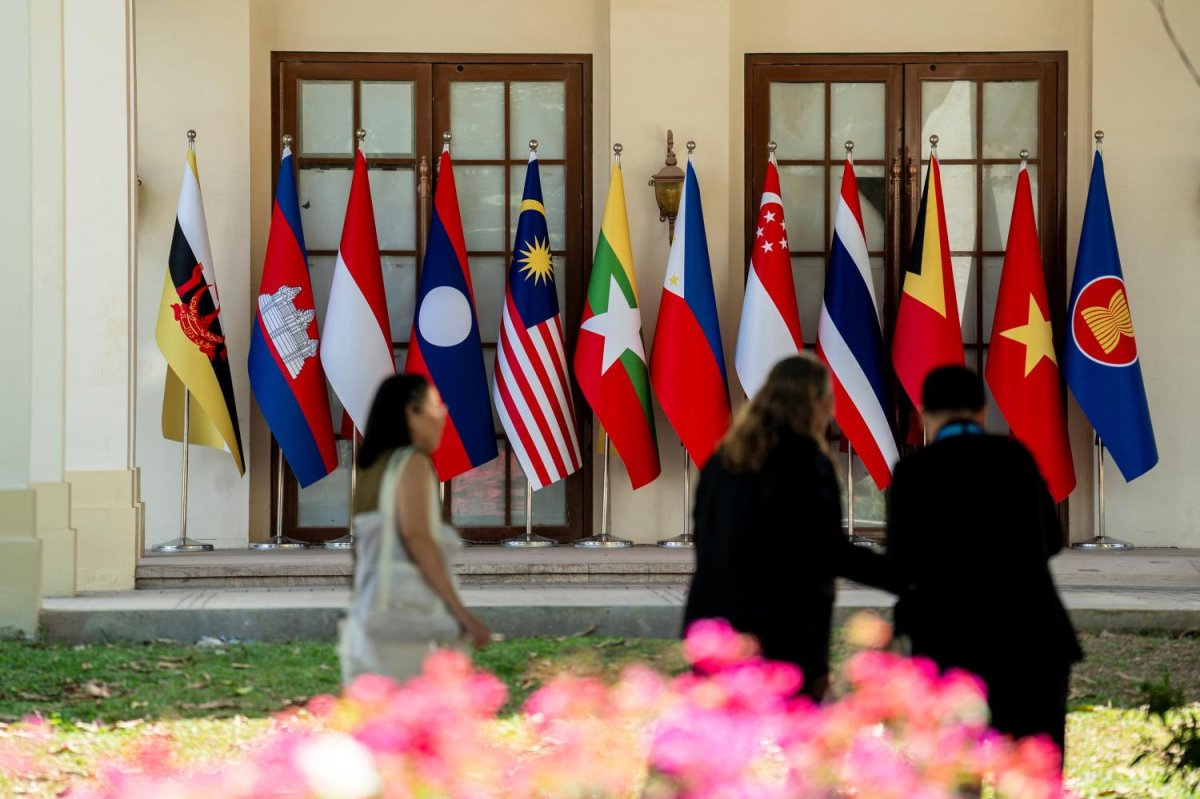
It sounds somewhat paradoxical to think that Asean is more internally problematic than ever, and yet the 11-member Southeast Asian bloc also needs to rely on itself like never before. But such is the tough reality in Thailand's regional neighbourhood. Under pressure from both the United States and China, Asean will also have to rely on external partners, particularly Japan, to navigate and overcome the adverse challenges on the horizon.
Asean today is similar to its past. The region is divided and weakened by superpower competition and conflict. In the past, the Soviet Union and the United States, during the Cold War, divided Southeast Asia between Asean and Indochina. Today, it is the United States and China in a new kind of Cold War that is pressuring Asean member states to choose sides. When the great powers are not at relative peace and in relative balance, they tend to pick the region apart for their own self-interests.
As a result, Asean somehow must maintain its central organising role -- known as "Asean centrality" -- in promoting and securing regional peace and security by continuing to act as a "buffer, bridge and broker" among the great powers in the region. For the past three decades, Asean benefited from a relatively favourable external environment. Globalisation expanded trade and investment. Major-power competition was manageable. Supply chains became increasingly integrated. Economic growth was robust. Today, that environment is changing.
The international system is becoming more fragmented. Strategic competition among major powers is intensifying. Trade and technology are increasingly impacted by geopolitics. Economic security and national security are becoming closely intertwined. Consequently, Asean faces pressures from multiple directions.
On one side are the effects of strategic rivalry among major powers. On the other side are disruptions to trade, supply chains, and investment flows. For example, China's overcapacity has led to the dumping of cheap goods in Asean, while the Trump tariffs and US protectionism threaten Asean's traditional export-led growth model. Asean has never been so vulnerable to geoeconomic shifts and external shocks, particularly in energy, supply chains, and critical resources.
In this environment, Asean's best bet is Asean itself. To be sure, three thorny issues have hindered Asean. Myanmar's February 2021 coup, civil war and junta-backed government after a bogus election, along with the persistent Thai-Cambodian border tensions and the South China Sea conflict between China and the Philippines, have tested Asean's solidarity and resolve. Despite these constraining issues, no other organisation can convene Indo-Pacific countries the way Asean has done through its annual meetings, such as the East Asia Summit and the Asia-Pacific Economic Cooperation (or Apec). Asean is still trusted by external partners that lack a common intermediary.
At the same time, Japan's role, engagement, and value to Asean have never been more essential. For decades, Japan has been viewed throughout Southeast Asia as a trusted, reliable, and constructive partner. Japan has supported Asean's development, connectivity, institution-building, and regional integration. Equally important, Japan has consistently respected and upheld Asean centrality and has never pressured Asean countries to choose sides.
Moving forward, three priority areas stand out that Asean can work with Japan for mutual benefit. Energy security is at the forefront. The ongoing Middle East conflicts have reminded us that energy vulnerabilities remain among the most serious risks facing Asean and Japan. Any disruption affecting major shipping routes or global energy supplies can have immediate consequences for Asean economies. Energy security, therefore, must be treated as an essential component of national security and economic security.
It is encouraging that Asean leaders at the recent Cebu Summit have tasked the Economic Research Institute for Asean and East Asia (ERIA) with developing recommendations on regional crude-oil stockpiling and strategic petroleum reserves. This is a timely and crucial initiative that testifies to the Asean-Japan partnership and ERIA's policy and research expertise and experience. The objective is to reduce vulnerability and enhance resilience. An Asean-Japan combined approach to stockpiling can provide insurance against future disruptions while strengthening confidence among Asean member states.
Another area is economic security. Economic survivability and durability increasingly depend on supply-chain resilience. The pandemic, geopolitical tensions, and industrial overcapacity have demonstrated the risks of excessive concentration in production networks. This is particularly relevant in sectors involving critical minerals and strategic industries. Asean holds immense potential to become an important hub for downstream processing, refining, and manufacturing activities. By encouraging investment in these sectors, Asean can strengthen its own industrial capabilities while diversifying regional supply chains. Japan can play a vital role in this effort through investment, technology, skills development, and long-term partnerships.
Doing so requires institutional resilience, an area where Japan can work with Asean through ERIA, which has become much more than a research institute and a think-tank on policy concerns. ERIA actually serves as a bridge and an enabler between policy ideas and their formulation and implementation, transforming ideas into actionable policy recommendations. It is akin to a facilitator and a locomotive for Japan's engagement with Asean. Whether the issue is energy security, critical minerals, supply chain resilience, decarbonisation, digital transformation, or human capital development, Japan, through ERIA, is well-positioned to contribute and make headway. The stronger Asean becomes, the more important ERIA's role and Japan's contribution will be. Put another way, the stronger a role ERIA can play, the stronger Asean could become.
The Asean–Japan relationship is already one of the most -- if not the most -- successful partnerships in Asia. But we are entering a new, uncertain, and adverse era. At issue is not just economic growth and regional integration but resilience and our collective ability to confront and overcome myriad geoeconomic risks and threats amid geopolitical tensions and conflict. Multifaceted resilience in energy, supply chains, institutional capacity, and regional cooperation is an element of the new geostrategic game facing Asean and Japan.
While Asean needs Asean more than ever, Asean also needs a strong and enduring partnership with Japan. On the other hand, Asean can be a benefit to Japan like no other country or regional organisation can match. As the going gets tougher in the international system, Asean must not buckle under the pressure of the US and China and should get going with Japan and other like-minded external partners.
Source: BangkokPost
Share:



<p>Time: November 2025<br /> By: WTO and International Trade Group, Legal Department – VCCI</p>
