

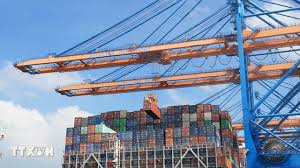
Data from the World Bank (WB) shows that since 2022, the economies of Indonesia, Vietnam, and the Philippines have all maintained an annual growth rate of at least 4%.
For decades before the pandemic, exports of goods to major markets such as the United States and the European Union (EU) were a key driver of growth for Southeast Asia.
However, business leaders are shifting their focus to seeking more opportunities within the region and in the domestic market.
Shifting the economic focus
From the 1980s to the early 2000s, exports to Western markets boosted economies such as Singapore, Malaysia, and Thailand.
Most recently, Vietnam has also recorded impressive economic growth thanks to effectively leveraging the restructuring process of global supply chains.
According to the "ASEAN Intelligence 2026" survey report, conducted by The Business Times in collaboration with market research firm Kantar, 63% of the 538 business leaders interviewed expressed confidence that the strongest economic opportunities in the next three years will lie within the ASEAN region.
In addition, 62% of survey participants rated the domestic market as offering the most attractive prospects. China ranked third with 48%.
Assessing the bloc's stature, two economic experts, Taimur Baig and Chua Han Teng, at DBS Bank, noted that ASEAN is currently the world's fifth-largest economic bloc and is on track to rise to fourth place by 2030.
Data from the World Bank (WB) shows that since 2022, the economies of Indonesia, Vietnam, and the Philippines have all maintained an annual growth rate of at least 4%.
The survey report indicates that businesses in Southeast Asia are expected to allocate up to 81% of their capital spending to intra-Asia over the next three years, with 90% of leaders focusing on the ASEAN bloc, 77% prioritizing the domestic market, and 64% allocating to China.
Conversely, businesses are showing more caution towards the US and EU markets, with investment consideration rates at only 31% and 24%, respectively.
In the investment portfolio, automation and artificial intelligence (AI) became the top priority with 48% of choices, followed by market expansion (44%), information technology and cybersecurity (42%).
Two experts from DBS Bank emphasized that ASEAN is becoming a crucial link in the AI hardware ecosystem. According to them, the region will continue to benefit from the global wave of AI investment thanks to strong foreign direct investment (FDI) into data centers, a deep network of suppliers, and increasingly sophisticated chip manufacturing capabilities.
The wave of supply chain restructuring
Not only manufacturing businesses, but also many entities in the consumer goods, retail, healthcare , and financial services sectors are increasing their presence in the region.
Approximately 80% of business representatives indicated they are highly likely or likely to shift more manufacturing or supplier activities to ASEAN between now and 2028.
This intention to relocate is strongest in Vietnam (95%), Indonesia (92%), and the Philippines (83%). When choosing a location, businesses pay particular attention to infrastructure, business convenience, market access, and supply chain resilience.
While costs, tariffs, investment incentives, and human resources remain important factors, they take a backseat to the requirement for a market capable of supporting efficient, reliable, and scalable operations.
Brian Lee, an economist at Maybank Securities, noted that the shift in production models from "just-in-time" to "risk mitigation" has made supply chain resilience a key factor.
According to him, companies are actively diversifying their production bases to various regions, including Vietnam and Malaysia.
A prime example of this trend is the upscale bakery and coffee shop chain Paris Baguette, owned by the diversified conglomerate SPC Group (South Korea).
Hana Lee, CEO of the upscale bakery and coffee chain Paris Baguette in the AMEA region, affirmed that ASEAN is central to the company's strategy.
This company is leveraging its manufacturing facility in Johor (Malaysia) to serve both the Malaysian and Singaporean markets, while also using it as a platform for expansion throughout the region.
Another example is the Berli Jucker Group (Thailand), a manufacturing and retail corporation that operates the Big C chain.
The group spent $720 million to acquire the MM Mega Market Vietnam supermarket chain from its parent company, TCC. Representatives of the manufacturing and retail group Berli Jucker stated that this transaction reflects a long-term vision of building an integrated regional platform connecting manufacturing, supply chains, and retail across Southeast Asia.
The gap between opportunity and belief
Despite its attractive prospects, ASEAN still faces a barrier of trust. A survey by The Business Times reveals that a situation of "high opportunities but low confidence" exists in ASEAN and some member economies.
Over 40% of respondents in the Philippines and Singapore indicated low levels of confidence in the region, despite seeing significant opportunities. Business leaders from Vietnam, Indonesia, and Malaysia reported similar gaps.
Intense competition, rising costs, uneven development rates, and structural fragmentation within the bloc are the main causes of this mindset.
In the domestic market, the Philippines experiences the largest gap between opportunity and confidence due to rigid local regulations. Meanwhile, businesses in Indonesia are concerned about exchange rate volatility and rising inflation.
Frederic DyBuncio, Chairman and CEO of the diversified conglomerate SM Investments Corporation (Philippines), noted that despite cost pressures, the Philippines still benefits from a strong domestic consumer base.
According to him, household spending accounts for about three-quarters of the economy, supported by remittances and a young workforce. Therefore, the group continues its plan to expand its retail network and banking operations to seize market opportunities.
Data from the ASEAN Secretariat shows that intra-ASEAN investment increased from US$22 billion in 2023 to US$31 billion in 2024. Intra-ASEAN investment now accounts for 13.9% of total FDI into ASEAN.
Chen Huifen, editor of The Business Times, asserted that the goal of these in-depth studies is to go beyond superficial perceptions of regional growth.
She emphasized that investing in privileged information systems gives readers access to facts from the grassroots that outside observers might miss, thereby supporting leaders in transforming change into opportunities for growth.
Although conflicts in the Middle East continue to cast certain shadows over global business prospects, the overall sentiment among business leaders in ASEAN remains positive.
According to Brian Lee of Maybank Securities, the network of intra-ASEAN free trade agreements and bilateral agreements between ASEAN and China is contributing to reducing investment barriers and improving market access.
Source: Vietnam.vn
Share:


<p>Time: November 2025<br /> By: WTO and International Trade Group, Legal Department – VCCI</p>
