

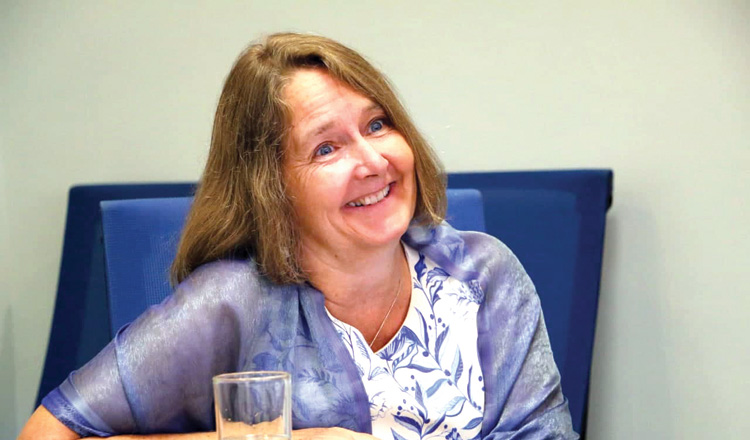
As the post-Brexit UK charts an independent course in international trade relations, Great Britain and Cambodia have maintained strong ties. Khmer Times’ reporter Jason Boken speaks to Tina Redshaw, the British ambassador to the Kingdom, on climate change, education, trade and future developments between the two nations.
KT: The United Kingdom decided not to replicate the EU’s partial withdrawal of trade preferences under the Everything But Arms (EBA) largely tariff-free programme. What was the reasoning behind that?
TR: The UK shares the EU’s concerns about human rights violations in Cambodia and continues to raise these with the Cambodian government at every opportunity. However, the UK believes that suspending a country’s trade preferences should only be used as a measure of last resort once all other channels have been exhausted.
Therefore, the UK will seek to intensify our dialogue with the Cambodian government on these issues and continue to assess other channels we can use to encourage changes.
By taking this approach we are committed to helping to improve the lives of the people of Cambodia, while avoiding exacerbating the severe development impacts of COVID-19 and damage to vulnerable garment workers. We will continue to monitor the situation in Cambodia and consider whether it is appropriate to suspend preferences following further in line with arrangements in our Generalised Scheme of Preferences (GSP) programme.
KT: How long will the GSP arrangement for Cambodia last? Will that decision come under review?
TR: We will seek to increase engagement with the Cambodian government on human rights’ concerns and we will continue to speak to human rights organisations and NGOs operating in Cambodia. We will also continue to consider reporting by the UN’s human rights bodies and independent organisations such as Amnesty International and Human Rights Watch.
We retain the power to withdraw preferences at a later stage following further assessment.
KT: What is your hope for the future of UK development aid in Cambodia and the region?
TR: My hope for UK development aid is to have a positive impact on livelihoods so that we can see equitable human and economic development.
The UK is committed to Cambodia and the wider ASEAN region as a long term partner. We are strongly supporting the recovery from COVID-19 [by] expanding access to education and working on climate change.
KT: The UK currently has Cambodian students studying in Britain as part of the Chevening scholarship. Why is this scholarship programme so important for future Cambodia-UK ties?
TR: Cambodian-UK relations are based on a rich fabric of cooperation and people to people links. British nationals living in Cambodia and vice versa bring our nations together and enhance our culture and development. The UK has world-class education institutions and since 1993, 184 current and future leaders in Cambodia have benefited from this through the Chevening programme. Our aim is to strengthen these people-to -people links and to continue to provide more opportunities for Cambodians to study in and experience the UK.
KT: The UK aims to be 50 percent self-sufficient on renewable energy by 2030. Cambodia seems to be heading in the opposite direction to this. Why is it so important for the Kingdom to focus on renewable energy?
TR: Climate change is a global challenge and we are all vulnerable to the changes. Cambodia is a relatively low emitter of greenhouse gases but is highly vulnerable to climate change, which is why it is important for Cambodia to take every action to decrease the impacts of climate change by decarbonising its economy and investing in mitigation and adaptation measures.
Cambodia has committed to 25 percent installed renewable energy which is a base to seek further ambition. Cambodia rightfully wants cheaper, reliable and widespread energy sources to meet its development demands. A focus on renewable energy helps to decrease the amount of greenhouse gases emitted by Cambodia, diversifies the electricity supply which makes the grid stronger and makes Cambodia an attractive country for international investment.
Countries across Asia, including Bangladesh and Vietnam, have shown that renewable energy is the long-term economic solution to those needs by either stopping or reducing their reliance on fossil fuels. Renewable energy should be seen as an opportunity to modernise and attract new investment into Cambodia. Large sectors, such as the garment industry, have corporate objectives to be carbon-neutral and are prioritising destinations with renewable energy power supply.
KT: With the UK being hard hit by the global health crisis, will existing bilateral cooperation or assistance projects between Britain and Cambodia be able to be maintained?
TR: The UK’s commitment to development in Cambodia is long standing and we must work together to have a full recovery from the health and economic impacts of the COVID-19 pandemic.
KT: Cambodia recently signed a free trade agreement (FTA) with China, is close to securing one with South Korea and is in talks with the Euroasian Economic Union. Are the UK and Cambodia any closer to securing an FTA?
TR: We have not begun any negotiations on an FTA between our nations yet. The GSP framework in place gives countries duty-free/quota-free access to UK markets. Our hope is to expand the UK-Cambodia trading partnership within this framework.
Source: Khmer Times
Share:

<p>Time: November 2025<br /> By: WTO and International Trade Group, Legal Department – VCCI</p>
