

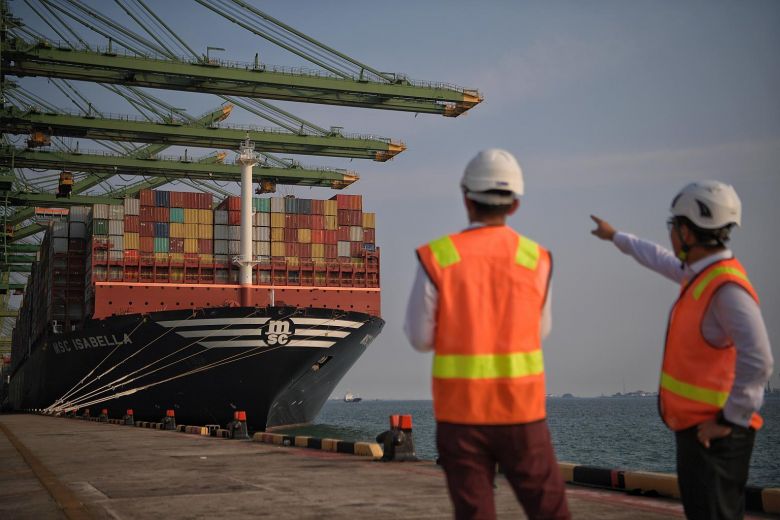
Say you are a company producing mutton curry in Singapore.
With the newly-signed Regional Comprehensive Economic Partnership (RCEP) trade pact, you can buy ingredients such as mutton and curry paste from 14 other countries and still have the final can or packet dish count as being made in Singapore.
This will be more cost-effective for two reasons.
One, the ingredients bought from the other RCEP countries are considered as originating in Singapore when determining their origins to enjoy preferential tariffs.
Two, perishable goods can be cleared by Customs as swiftly as within six hours of arrival .
Singaporeans will also be able to enjoy cheaper mutton curry when the cost savings are passed on to them.
This cascade of benefits is an example of how the RCEP - the world's largest trade pact inked on Nov 15 - will impact businesses and consumers here.
Involving the 10 Asean members, plus China, Japan, South Korea, Australia and New Zealand, the RCEP covers nearly one-third of the world's population and contributes to around 30 per cent of the world's gross domestic product (GDP).
One of its key achievements is that it eliminates tariffs for about 92 per cent of goods traded among the members.
A single rule
But the biggest benefit for Singapore is the presence of a single rule for each product that applies across all 15 parties to the RCEP, said Ms Sulaimah Mahmood, the chief RCEP negotiator at the Ministry of Trade and Industry.
Previously, different countries had different rules, she added. "If you exported to South Korea, there was one rule; if you exported to Japan, there was another."
Each of Asean's trade agreements has different rules of origin.
For example, if a company in Vietnam makes a bicycle, it may be eligible under a trade deal with Japan, but may need different components or manufacturing process to be eligible under a deal with South Korea.
"We thought: What would be the best way to consolidate the rules so that it's easier for our companies?"
Besides a single rule, there is also the cumulation of rules of origin (ROO), which sets out how much regional content a product must have before it can enjoy lower tariffs.
Before the RCEP was concluded, many businesses in Singapore could tap only on the existing Asean-plus-one free trade agreements (FTAs) - or the trade agreements between the 10-member regional bloc and individual dialogue partners such as Japan, South Korea and China.
Now, the RCEP has thrown the door wide open. Businesses can source for inputs from any of the 14 other RCEP members, said Ms Sulaimah.
Food, automotive sectors to benefit most
While the RCEP allows for broader sourcing by companies, preferential tariffs are likely no better than those already on offer under other FTAs, like the Asean-plus-one FTAs, said PwC's Asian Worldtrade Management Services managing partner, Mr Frank Debets.
Source: The Straits Times
Share:

<p>Time: November 2025<br /> By: WTO and International Trade Group, Legal Department – VCCI</p>
