

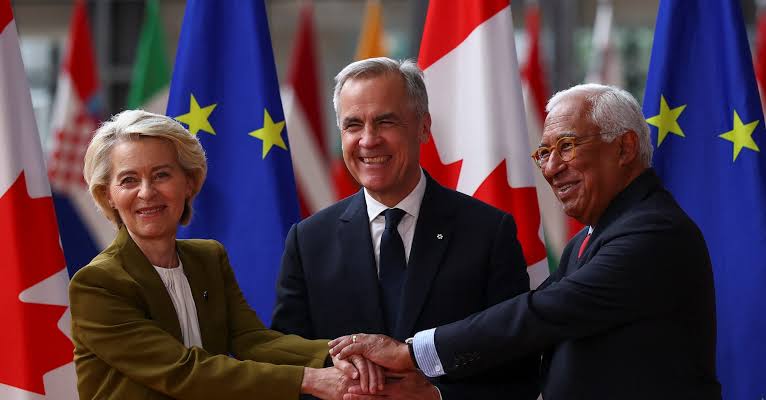
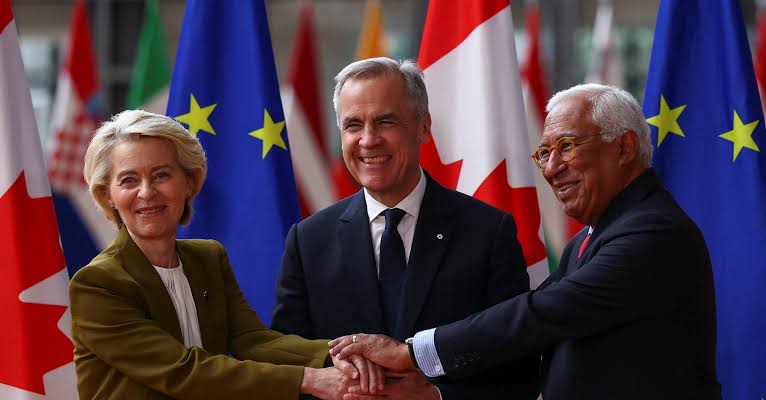
With Thai talks ongoing, Brussels may value pragmatism over rights reform amid global strife
European businesses are calling for a region-to-region trade agreement with ASEAN following a breakthrough in the EU's deal with the Philippines last week, as Brussels seeks to diversify its trade and political ties.
The European Union is also expected to conclude a trade agreement with Thailand by the end of this year, with the 10th round of talks ongoing until Tuesday. To date, the EU has trade deals in the region with Singapore, Indonesia and Viet Nam, and is in negotiations with Malaysia.
But businesses want the EU to go deeper and wider by seeking a deal with ASEAN as a bloc, in the face of competition from the two biggest economies -- China and the U.S.
"Southeast Asia regards European companies as credible investors, but those companies are competing against the full political and financial weight of the American and Chinese governments," said Chris Humphrey, executive director of the EU-ASEAN Business Council.
He told Nikkei Asia that bilateral agreements should not be the end point and that European businesses have consistently called for a region-to-region trade agreement, particularly in energy, health, digital and financial services.
Only 18% of 150 European business leaders surveyed by the business council in early September said the EU was sufficiently engaged with ASEAN. Humphrey said high-level meetings remained scarce beyond visits by Trade Commissioner Maros Sefocovic and the EU's top diplomat, Kaja Kallas.
Concerns about human rights, and environmental and food safety standards have hampered talks between the blocs. For example, one sticking point for years in the EU's negotiations with Indonesia was over deforestation before they finally signed a wide-ranging comprehensive economic partnership agreement last year.
Likewise, trade negotiations between the EU and Bangkok stalled in 2014, a year after they began, because the Thai military seized power in a coup. Talks were formally relaunched in 2023 and while analysts say they do not see any stumbling blocks for an agreement soon, Thailand's labor standards in tuna and seafood fishing have raised concerns in the European sector.
On a region-to-region level, negotiations were first launched in 2007 and subsequently paused by mutual agreement in 2009, over EU concerns about a military coup and subsequent crackdown on protesters in Myanmar.
"ASEAN has been a priority for much longer than the current geopolitical debate suggests," said Camille Nessel, lecturer at Universite Libre de Bruxelles and KU Leuven.
Joanne Lin, senior fellow at Singapore's ISEAS-Yusof Ishak Institute, agreed that a mismatch in expectations has held back engagement, with the EU hoping to nudge reforms in labor, environment, sustainability, human rights and regulation through trade.
"But ASEAN would want the EU to become a more practical partner," she said, citing areas for cooperation like in green transition, energy connectivity, digital trade, resilient supply chains and sustainable infrastructure.
Times have changed though -- geopolitical competition and tension have surged in the past few years, and the EU has felt squeezed by China and the U.S. at a time when major European economies are struggling to grow. In its own backyard, it is also fighting against Russian hybrid attacks while wrestling with weak defense budgets and political instability.
In this context, Sefocovic may take a more pragmatic approach and seek cooperation with allies, even those farther away, analysts said.
On the part of ASEAN countries, competition with neighbors may also have accelerated the conclusion of trade deals as parties reach for compromise.
"Once Viet Nam had an agreement with the EU, this mattered for Indonesia and the Philippines," Nessel said. "They compete in many of the same sectors, and preferential access changes that competitive balance."
The EU-Philippines deal would remove tariffs on 94% of goods traded, including agrifood, machinery and appliances. For the first time, the Philippine government procurement market will also be open to foreign players.
"The agreement delivers real opportunities for businesses of every size," said Sefocovic. "It also delivers a stronger, more diversified supply chain at a moment when resilience has become a strategic priority."
The EU was the Philippines' fourth-largest trading partner last year, representing 8.3% of the country's total trade in goods, with bilateral trade in goods valued at 17.6 billion euros ($19.9 billion), according to official figures.
These singular trade deals could propel both blocs finally toward an agreement.
"This network of bilateral FTAs with individual ASEAN members can act as building blocks toward an eventual region-to-region FTA, which remains our shared long-term objective," an EU spokesperson said.
Source: Nikkei
Share:
<p>Time: November 2025<br /> By: WTO and International Trade Group, Legal Department – VCCI</p>
