

Businesses must take advantage of regional linkages to grow and survive in a more competitive landscape
The Association of Southeast Asian Nations (Asean) must make better use of its combined market, deepen economic integration and ensure that smaller businesses share in regional growth if it is to remain competitive amid geopolitical tensions and supply chain disruption, business leaders told the 2026 World Knowledge Forum (WKF).
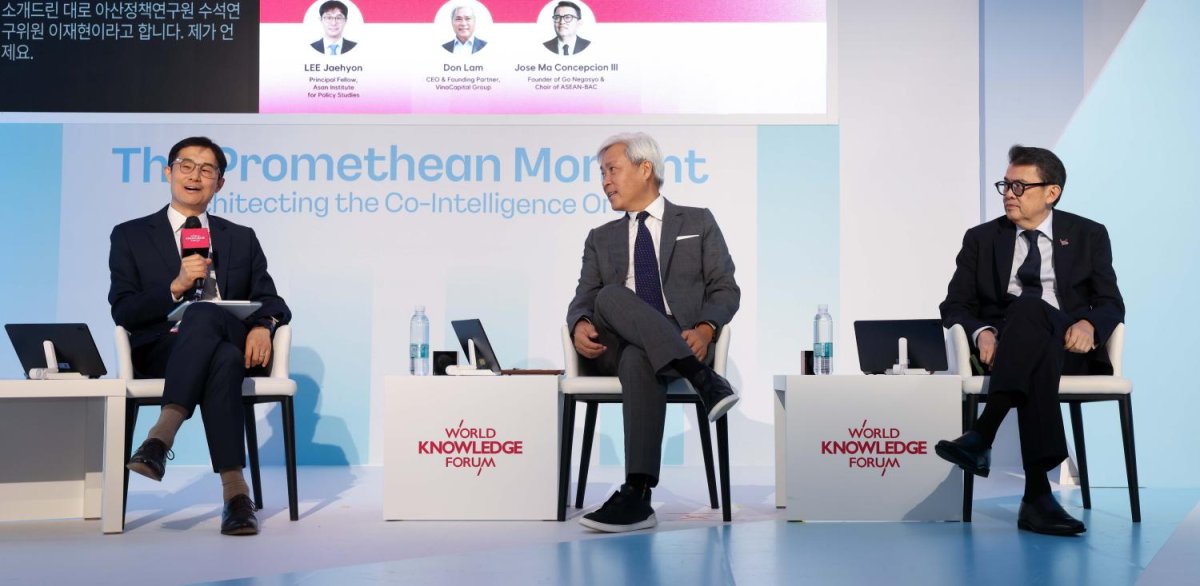
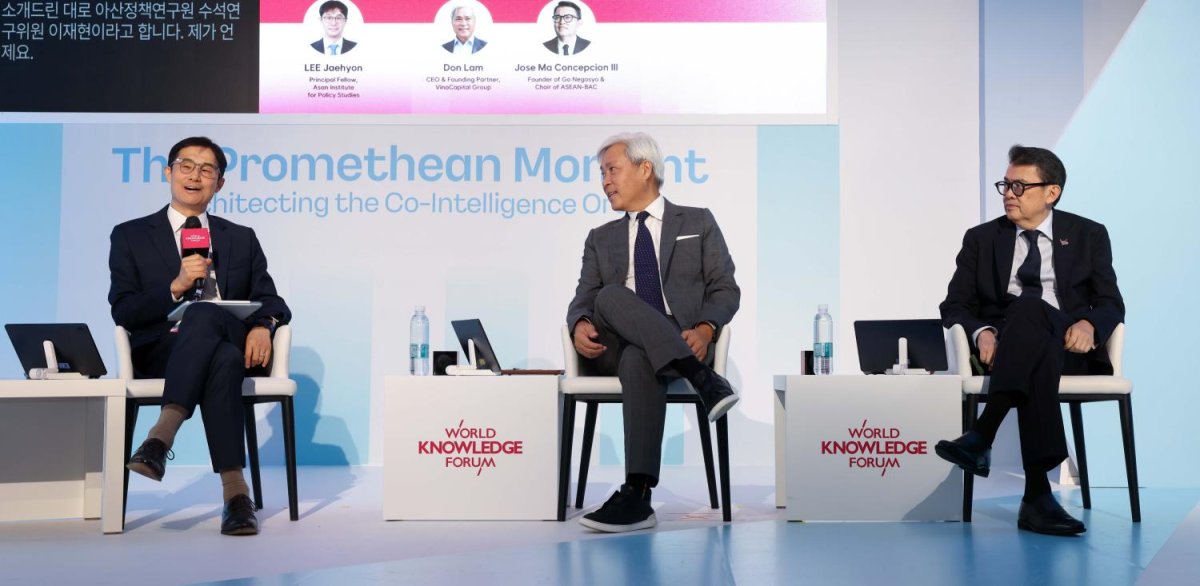
Speaking during a discussion titled "Empowering Asean's Future: Entrepreneurship, Investment and Resilient Growth" in Seoul, South Korea, on Wednesday, they said the regional grouping offered businesses the scale needed to compete globally while providing opportunities for more inclusive development.
The session featured Jose Ma Concepcion III, founder of the Philippine Centre for Entrepreneurship and chairman of the Asean Business Advisory Council Philippines, and Don Lam, chief executive officer and founding partner of VinaCapital Group.
Both received the 11th Asean Entrepreneurs Award for their contributions to entrepreneurship, investment and economic development in Southeast Asia.
Mr Concepcion was recognised for promoting entrepreneurship and empowering micro, small and medium-sized enterprises (MSMEs), while Mr Lam was honoured for his leadership in investment and contribution to Viet Nam's economic development. VinaCapital has nearly US$4 billion in assets under management.
Last year's recipients were Thailand's Marisa Chearavanont, founder of the Chef Cares Foundation and special adviser to Charoen Pokphand Group, and Nazir Razak, chairman of Malaysia's Ikhlas Capital.
Ms Marisa was recognised for her contributions to social entrepreneurship and philanthropy. Her initiatives include the Chef Cares Dream Academy, which provides culinary training and support to disadvantaged young people, and Thai Taste, a free digital archive promoting Thai culinary heritage.
Kim Jae-shin, secretary-general of the Asean-Korea Centre, said this year's winners reflected the dynamism and resilience of Asean's business community.
"Their achievements bring pride to their respective countries and inspire the entire Asean region," he said. "True entrepreneurship is not only about profit but also about purpose."
Discussion moderator Lee Jaehyeon, principal fellow at the Asan Institute for Policy Studies, said Asean remained one of the world's most dynamic economic regions despite challenges including geopolitical tensions, supply chain realignment and climate change.
The bloc is South Korea's second-largest trading partner and second-largest destination for foreign direct investment. Annual people-to-people exchanges between South Korea and Southeast Asia exceed 10 million.
Strength through scale
Mr Concepcion said Asean's strength lay in combining the markets and capabilities of its member states to achieve the scale needed to compete internationally.
Greater regional cooperation could give businesses access to more consumers, stronger supply chains and wider commercial opportunities. However, Asean must look beyond facilitating large companies and ensure that MSMEs also benefit, he said.
"We can have the Asean meetings and talk about big business, but in the end, how much impact does Asean have on those micro, small and medium enterprises?" he said.
Economic growth could not remain concentrated among large companies and wealthier sections of society. It would be sustainable only if people and businesses at every level could participate, he said.
Mr Concepcion said smaller entrepreneurs generally needed three things to grow: mentorship, money and markets.
Large companies could contribute their knowledge and experience, while governments and financial institutions could improve access to funding. Deeper regional integration could then give smaller businesses wider markets for their products.
The approach has been adopted by the Philippine Center for Entrepreneurship, which has close to 500 mentors supporting entrepreneurs. Mr Concepcion said the model could offer lessons for efforts to empower MSMEs across Asean, although programmes must reflect conditions in each country.
He said cooperation between large and small businesses was also being applied to agriculture through the Asean Food Security Alliance, which brings established agricultural companies together to share expertise with smaller farmers.
The initiative covers about 25 to 30 agricultural categories, including rice, sugar, tobacco and durian.
Mr Concepcion described it as a "big brother, small brother" model in which agribusinesses mentor farmers and help them improve production.
Connecting farmers and companies in similar sectors across Asean would allow them to achieve scale, exchange knowledge and reduce production costs, he said.
Agriculture often struggles to attract young graduates, many of whom are more interested in artificial intelligence and digital technology. Developing a new generation of farmers was nevertheless essential to strengthening regional food security, he said.
A regional connector
Mr Lam said investors should view Asean as a collection of diverse markets within an increasingly integrated economic community.
Member states shared many characteristics, but investors still needed to understand differences in market conditions and political stability. Despite that diversity, Asean's strong economic growth and rapidly expanding middle-income population made it increasingly difficult for international businesses to ignore, he said.
South Korean companies recognised the region's potential early, supported by a free trade agreement concluded between South Korea and Asean about 20 years ago.
Mr Lam cited Viet Nam as an example of the investment and manufacturing links that had developed. South Korea is Viet Nam's largest foreign investor, with companies including Samsung and LG operating there.
He said Viet Nam's ability to maintain relations with both China and the United States had helped it develop as a connector economy where companies could manufacture goods while trading with both markets.
Asean could play a similar role collectively, serving as a bridge between the world's two largest competing markets and creating opportunities across the region, he said.
However, maintaining competitiveness would also require responsible investment.
Strong ESG (Environmental, Social and Governance) performance had commercial as well as social value, he said, particularly because buyers in Europe and the United States often considered environmental and social standards when selecting suppliers during periods of disruption.
Companies meeting those expectations were better positioned to retain customers and withstand crises, he said. The same principle could help make Asean businesses and supply chains more resilient.
Deeper Asean-Korea ties
Technology, manufacturing and agriculture were identified as promising areas for closer cooperation between Asean and South Korea.
Mr Lam said Viet Nam's plan to train 50,000 artificial intelligence (AI) engineers over the next 18 months could create opportunities for collaboration between research and development centres in Seoul and technology specialists in Southeast Asia, particularly as South Korean companies faced manpower shortages.
Manufacturing links were already well established, but greater integration between the South Korean and Asean economies could unlock further opportunities, he said.
Mr Concepcion said Asean had built substantial production capacity, but its internal market remained relatively weak. Member states needed to improve their ability to market and sell products to one another.
Regular face-to-face engagement among business leaders was also important for identifying shared challenges and building durable partnerships, he said.
Asked what advice they would give young entrepreneurs, Mr Lam urged them to "think big" and develop products for regional and global markets.
"You can't survive with a single-country market," he said.
Mr Concepcion agreed that scale was essential, particularly for smaller businesses lacking capital and expertise. Partnerships with large companies could provide the resources and knowledge they needed to compete.
Mr Lee said deeper Asean-South Korea cooperation could support regional resilience.
Source: Bangkok Post
Share:
<p>Time: November 2025<br /> By: WTO and International Trade Group, Legal Department – VCCI</p>
