

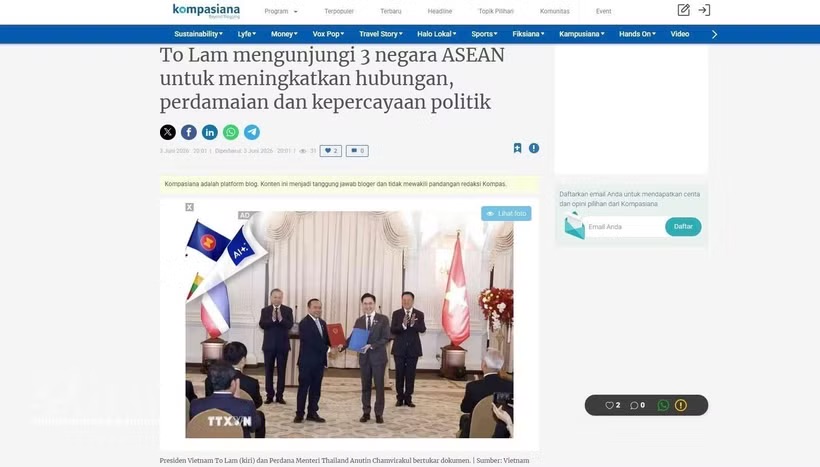
The article noted that the top Vietnamese leader’s engagements in the three countries underscored the growing role of high-level diplomacy in shaping strategic directions for bilateral relations, and laid foundations for long-term cooperation between Viet Nam and its regional partners.
Indonesian newspaper Kompasiana has described General Secretary of the Communist Party of Viet Nam Central Committee and State President To Lam’s recent visits to Thailand, Singapore and the Philippines as a significant diplomatic move that contributes to promoting peace, strengthening political trust and expanding economic cooperation in ASEAN.
The tour reflected not only Viet Nam’s foreign policy orientation in a new stage of development but also the country’s increasingly proactive, practical and results-oriented approach to diplomacy, according to a commentary published by the site on June 3.
The article noted that the top Vietnamese leader’s engagements in the three countries underscored the growing role of high-level diplomacy in shaping strategic directions for bilateral relations, and laid foundations for long-term cooperation between Viet Nam and its regional partners.
Kompasiana highlighted the warm and high-level receptions accorded to General Secretary and President Lam in all three countries as evidence of Viet Nam’s rising standing within ASEAN. His meetings and talks with the leaders of Thailand, Singapore and the Philippines opened up new avenues for cooperation at a time when all four nations are entering new development phases and adapting to an increasingly complex regional and international environment.
According to the article, one of the most notable outcomes was Viet Nam’s continued efforts to elevate and deepen relations with key ASEAN partners. Viet Nam and Thailand advanced their Comprehensive Strategic Partnership through long-term cooperation orientations, while ties with Singapore were strengthened through the establishment of a strategic dialogue mechanism between the two ruling parties. Meanwhile, relations between Viet Nam and the Philippines were upgraded to an Enhanced Strategic Partnership.
The article also highlighted agreements to establish new cooperation mechanisms aimed at reinforcing political trust and creating frameworks for more substantive collaboration in the future. These include the Action Programme for implementing the Viet Nam–Thailand Comprehensive Strategic Partnership for the 2026–2031 period and the Strategic Dialogue mechanism between the Communist Party of Viet Nam and Singapore’s People’s Action Party.
In addition, the newspaper praised business connectivity and innovation-related activities conducted during the visits, viewing them as important steps toward expanding economic cooperation and fostering new growth opportunities.
One aspect of the trip that received particular attention was the top Vietnamese leader’s keynote address at the 23rd Shangri-La Dialogue in Singapore, one of the Asia-Pacific region’s premier security and defence forums, which brought together around 500 delegates from more than 40 countries.
According to Kompasiana, a central message of the speech was the call for greater dialogue, confidence-building and respect for international law as means of preventing conflicts. The Vietnamese leader stressed the need to develop more effective consultation, mediation and crisis-management mechanisms, and expand confidence-building initiatives among defence, security and maritime law enforcement agencies, as well as academic and business communities.
The article said Viet Nam’s views at the dialogue clearly reflected its approach to contemporary security challenges, emphasising preventive diplomacy, regional cooperation and the role of international law in maintaining peace and stability.
Particular attention was also given to Viet Nam’s emphasis on ASEAN centrality. The Indonesian newspaper described the message as especially relevant at a time of intensifying strategic competition in the region, arguing that ASEAN’s central role can only be sustained through unity, strategic autonomy and the capacity to shape a common regional agenda.
The article concluded that these visits helped communicate Viet Nam’s development vision, strategic priorities and foreign policy orientations more clearly to regional partners, while conveying the message that Viet Nam remains committed to working with countries both within and beyond the region to strengthen trust, promote dialogue, enhance cooperation and contribute to a peaceful, stable and sustainable Asia-Pacific region./.
Source: Vietnam+
Share:

<p>Time: November 2025<br /> By: WTO and International Trade Group, Legal Department – VCCI</p>
