

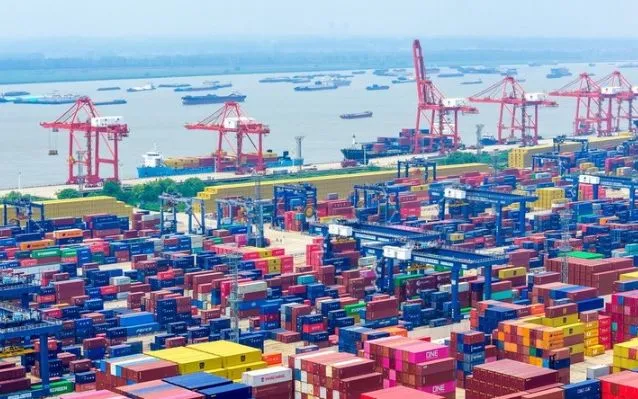
China-ASEAN trade is expected to exceed US$1 trillion in 2025, entering a new growth phase thanks to RCEP, AI, and upgraded supply chains.
According to data recently released by China's General Administration of Customs, the total value of China's imports and exports with the Association of Southeast Asian Nations (ASEAN) is projected to exceed US$1 trillion in 2025.
Chinese experts, in interviews with China News Service, all stated that China-ASEAN economic and trade cooperation has strong endogenous momentum and is creating a new growth cycle.
According to Hu Zhiyong, a researcher at the Institute of International Studies, Shanghai Academy of Social Sciences , despite interference from major countries outside the region, many of China's exports to ASEAN are irreplaceable, bilateral trade will continue to grow, and the trade imbalance will tend to improve thanks to joint efforts from both sides.
Meanwhile, Lei Xiaohua, Vice President of the Institute of Southeast Asian Studies at Guangxi Academy of Social Sciences, believes that China's industrial upgrading and investment will help boost domestic production capacity, optimize the structure and quality of ASEAN exports to China, and promote more balanced bilateral trade.
Xu Ningning, Chair of the Industrial Cooperation Committee under the Regional Comprehensive Economic Partnership (RCEP), stated that China and ASEAN share a geographical location with interconnected mountains and rivers, and their economies are highly complementary, providing a foundation for enhanced cooperation. The China-ASEAN Free Trade Area 3.0 will propel both sides to a new level in terms of supply chain connectivity and the alignment of standards and regulations. Particularly noteworthy is the fact that small and medium-sized enterprises (SMEs) account for the majority (90%) of bilateral trade and economic cooperation. The upgraded Protocol to the China-ASEAN Free Trade Area 3.0 includes a chapter dedicated to micro, small, and medium-sized enterprises (MSMEs), allowing them to maximize their enormous potential under the preferential policies of version 3.0, thus strengthening the foundation for cooperation.
Expert Lei Xiaohua believes that after surpassing the $1 trillion mark, bilateral trade between China and ASEAN will experience a new growth cycle, driven by the shift of the global economic center eastward. Southeast Asia is on an upward economic trajectory, and its growth, infrastructure development, and expanding consumer markets create strong import demand, naturally supplementing China's production capacity.
Mr. Ho Chi Dung pointed out that artificial intelligence (AI) is becoming a major driving force for deeper China-ASEAN cooperation. It not only promotes the connectivity of digital infrastructure and upgrades the digitalization of logistics and cross-border payments, but also deepens integration in areas such as smart manufacturing and modern agriculture by building differentiated development models for industrial chains. Cooperation between the two sides in AI governance, interoperability of industry standards, and even the development of global rules will create new impetus for regional integration.
Sharing the same view as expert Ho Chi Dung, researcher Lei Xiaohua predicts that the "three new pillars" of future trade between China and ASEAN could include AI applications, robotics, and breakthrough drugs, which will create a significant increase in trade.
Chairwoman of the RCEP Industrial Cooperation Committee, Xu Ningning, also pointed out that the extensive implementation of the RCEP Agreement has brought significant benefits to regional cooperation, and the China-ASEAN Free Trade Area 3.0 will create a synergistic effect and be upgraded alongside RCEP.
Regarding future prospects, experts believe that 2026 will mark the 5th anniversary of the establishment of the comprehensive strategic partnership between China and ASEAN, signifying a new phase in upgrading and improving bilateral relations. The vitality of economic and trade cooperation will be further emphasized, contributing to regional and global growth.
Source: VTV
Share:


<p>Time: November 2025<br /> By: WTO and International Trade Group, Legal Department – VCCI</p>
