

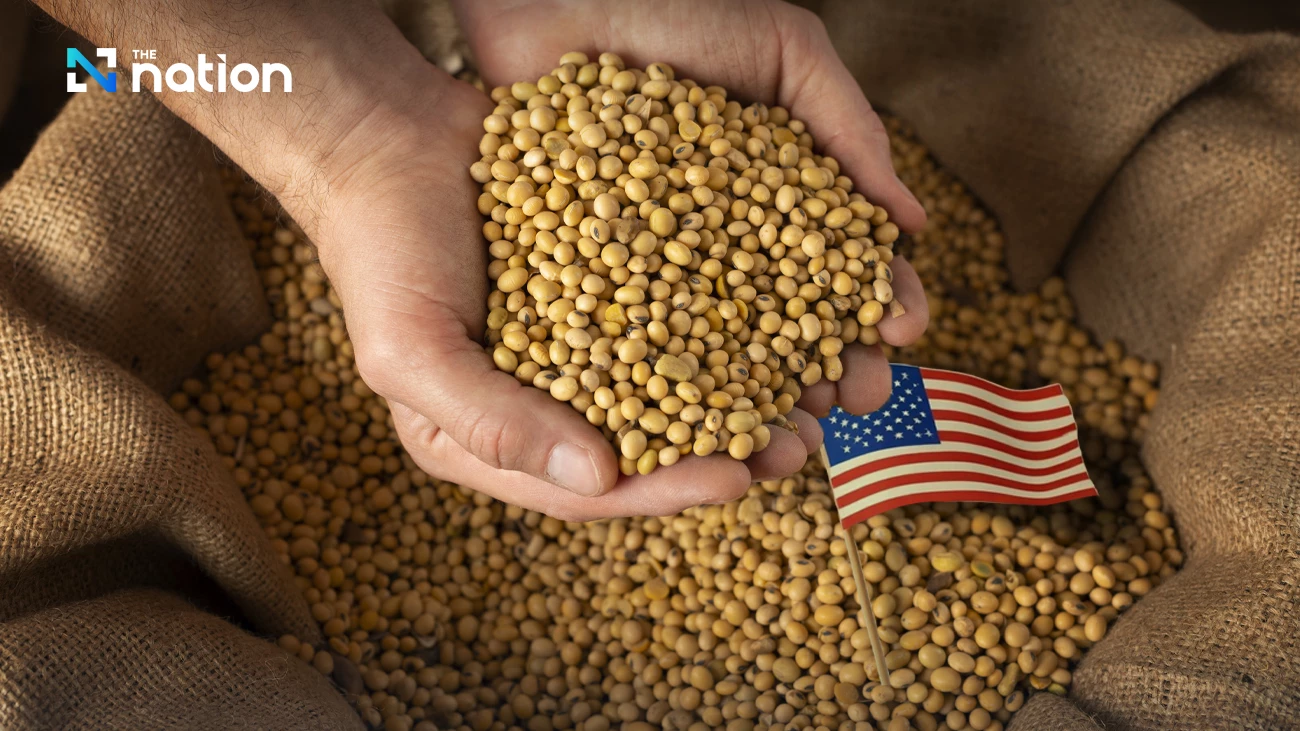
As Trump's reciprocal tariffs shut American farmers out of the Chinese market, Thailand emerges as a key target for US soybean exports.
Thailand has become a primary target for United States soybean exporters as American farmers struggle to find alternative markets following the collapse of trade with China.
According to a report by Pranee Muenphangwaree for Krungthep Turakij, the global soybean market is undergoing a seismic shift.
Reciprocal tariffs imposed by the Trump administration have led China—the world’s largest consumer—to slash imports of US crops in favour of Brazilian supplies.
This has left US producers with a massive surplus, turning their attention toward secondary markets like Thailand to absorb the overflow.
Domestic Production in Decline
The timing of the US export push coincides with a projected downturn in Thailand’s own agricultural output.
For the 2026/27 season, domestic soybean cultivation is expected to shrink to roughly 57,000 rai, a decline of 2.43%.
Total yield is forecast to fall to just 15,627 tonnes, as Thai farmers abandon the labour-intensive crop in favour of more mechanised alternatives.
With domestic demand for 2026 estimated at 4.22 million tonnes—primarily for oil extraction and animal feed—Thailand now relies on imports for a staggering 99.63% of its supply.
The Quota Balancing Act
In response to these global pressures, the Oilseed Crops and Vegetable Oil Committee, chaired by Deputy Prime Minister and Minister of Agriculture Captain Thamanat Prompow, has finalised a three-year management plan (2026–2028).
The committee has approved a WTO in-quota limit of 230,559 tonnes at a 10% tariff rate.
However, any imports exceeding this volume will face a punitive 133% tax, a measure intended to protect the fragile domestic industry and prevent a total market collapse.
Quotas will be allocated on a "first come, first served" basis.
Source: Nation Thailand
Share:


<p>Time: November 2025<br /> By: WTO and International Trade Group, Legal Department – VCCI</p>
