

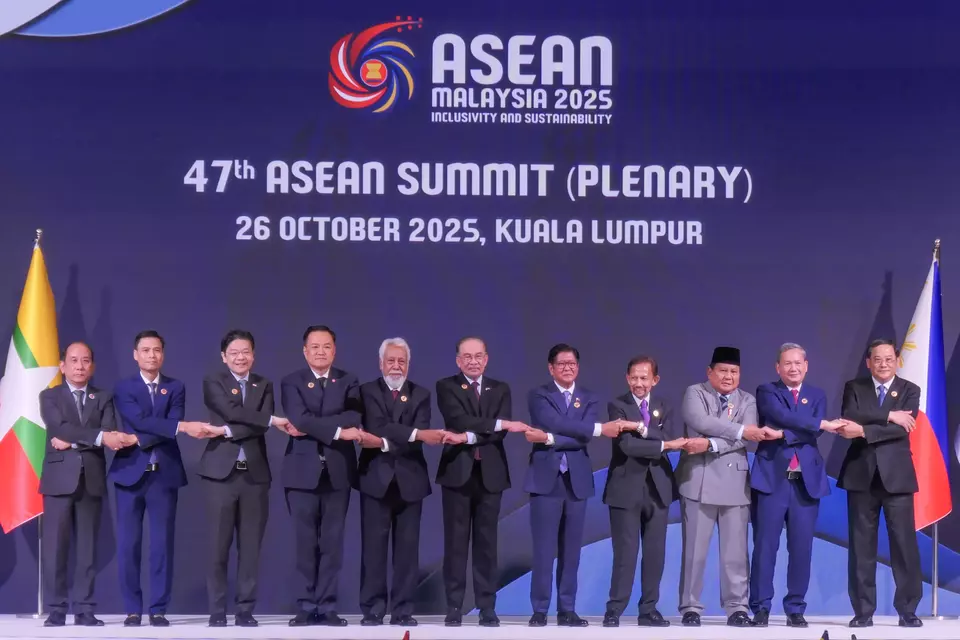
Over the last half-century, the global economy has expanded 30-fold, from around $3 trillion in 1970 to more than $110 trillion in 2024. This remarkable surge is often attributed to openness: more open trade, cross-border investment, and the mobility of talent. But openness was never the whole story. What mattered most were the domestic institutions and industrial capabilities that allowed countries to harness global markets for development.
As the next wave of growth coalesces around digitalization and artificial intelligence, these fundamentals will become even more critical. Competitiveness will depend not just on access to global markets, but on a country’s ability to develop technological capacity, build reliable energy systems, and cultivate talents.
In the United States, this economic shift has prompted a political response that mistakes symptoms for causes. Instead of facilitating firms and workers to move up the value chains, President Donald Trump revived a narrow protectionism that blames foreign countries – a misdiagnosis that has produced demonstrably counterproductive policies. Trade barriers and tariff brinkmanship have driven recession risks to 93 percent, with manufacturing losing 78,000 jobs, unemployment rising to 4.3 percent in August, and inflation hitting 3 percent. Legal and political turbulence is mounting as small and medium-sized enterprises (SMEs) challenge Trump-era tariffs before the Supreme Court. These are manufactured policy failure. Blame-based protectionism harms the global economy – including ASEAN – but the United States bears the steepest costs.
ASEAN is one of the United States’ key economic partners, ranking as its fourth-largest trading partner. The two-way trade between the US and ASEAN reached $475 billion in 2024, and $271 billion in the first half of 2025. US foreign direct investment (FDI) into ASEAN totaled $74.4 billion in 2023, making the United States ASEAN’s biggest extraregional investor. These ties are deep. Yet trade barriers and tariff brinkmanship have heightened uncertainty, raised recession risks, and eroded productive capacity. For ASEAN, these effects are immediate: improvised US protectionism sends shocks through global value chains.
Meanwhile, China remains ASEAN’s largest trading partner, and the scale of integration is still expanding. In the first half of 2025, total exports and imports between ASEAN and China reached $429.8 billion – an 18.7 percent increase from the previous year – with manufactured goods accounting for about 90 percent of the total. From 2019 to 2024, ASEAN’s imports from China rose by 63.1 percent, with three-quarters comprising capital and intermediate goods feeding into ASEAN’s production networks. This deepening interdependence creates opportunities for efficiency gains, but it also heightens ASEAN’s exposure to China’s economic weight.
Yet this surge also intensifies competitive pressure on local industries. China’s export share to ASEAN climbed to 16.4 percent in 2024 – higher than its export share to the US or the EU – and China now supplies 31.3 percent of total ASEAN imports. The influx of lower-cost Chinese finished goods is already reshaping domestic markets. In Indonesia and Thailand, factory closures and layoffs are increasingly attributed to import competition. The result is a widening tension between regional integration and industrial resilience – one that ASEAN can no longer ignore.
After decades of stability and open markets, ASEAN now sits on the fault line of a reshaped global economy, where great-power rivalry increasingly defines the rules. Historically, ASEAN has refused to treat the United States and China as mutually exclusive partners. But with Washington’s hard line on Beijing set to continue – regardless of whether a Republican or Democrat occupies the White House – and China equally unyielding, competition is hardening in an era shaped by robotics, digital technologies, and artificial intelligence. Economic strategy can no longer be separated from geopolitics.
How, then, should ASEAN position itself?
First, ASEAN’s strongest buffer against volatility is a transparent and rules-based trading system. Advancing trade facilitation, customs modernization, and regulatory coherence will lower transaction costs for firms. Full implementation of the Regional Comprehensive Economic Partnership (RCEP) – especially through reforms of non-tariff measures and digital trade rules – can strengthen ASEAN’s role as a stable production hub amid global uncertainty. Strengthening regional supply chains, promoting local currency settlement, and expanding regional payment systems will help cushion the region from external shocks.
Second, concerns over “import flooding” from China are legitimate, but sweeping protectionism would be damaging. More effective responses – consistent with WTO rules – include targeted safeguards, anti-dumping duties, and industrial-adjustment support, paired with investment in skills, innovation, and infrastructure. This approach can turn external pressure into productive restructuring.
Third, ASEAN governments must respond by strengthening export-readiness programs, trade-linked credit lines, and digital platforms that help SMEs connect to buyers across both US and Chinese markets. The goal should not be protectionism, but empowerment – facilitating firms to upgrade skills, adopt technology, and move up the value chain to be globally competitive.
Last, ASEAN must prepare for the next phase of industrial transformation, driven by robotics, digital technologies, and artificial intelligence. These technologies are transforming production and labor markets worldwide. ASEAN’s growth will depend on attracting digital investment, building cross-border data interoperability, and developing capacity for AI governance. The ASEAN Digital Community 2045 initiative can serve as a framework for shared standards that foster innovation while narrowing digital divides.
Tariff shocks from Washington and export surges from Beijing are no longer temporary disruptions but fixtures of a new global equilibrium, making the path even more treacherous, with both cyclical and structural challenges. Yet they should not dictate Southeast Asia’s future. The region’s resilience will rest on clear and credible trade rules, empowered SMEs, strategic industrial policies, stronger technological capabilities, and diplomatic agility.
ASEAN must be more proactive as a rule-setter, not a rule-taker. By strengthening the multilateral trading system, shaping standards, deepening South–South cooperation, and advancing initiatives such as the green transition and AI governance, it can rebuild trust and reinforce its centrality. Its credibility rests not only on market size, but on its ability to lead a rules-based global order that upholds international law, peace, and regional stability.
Trump’s protectionism may again unsettle the global economy, but it underscores a stark reality: the world is no longer organized around a single center of power – and it never will be again.
Source: Jakarta Globe
Share:


<p>Time: November 2025<br /> By: WTO and International Trade Group, Legal Department – VCCI</p>
