

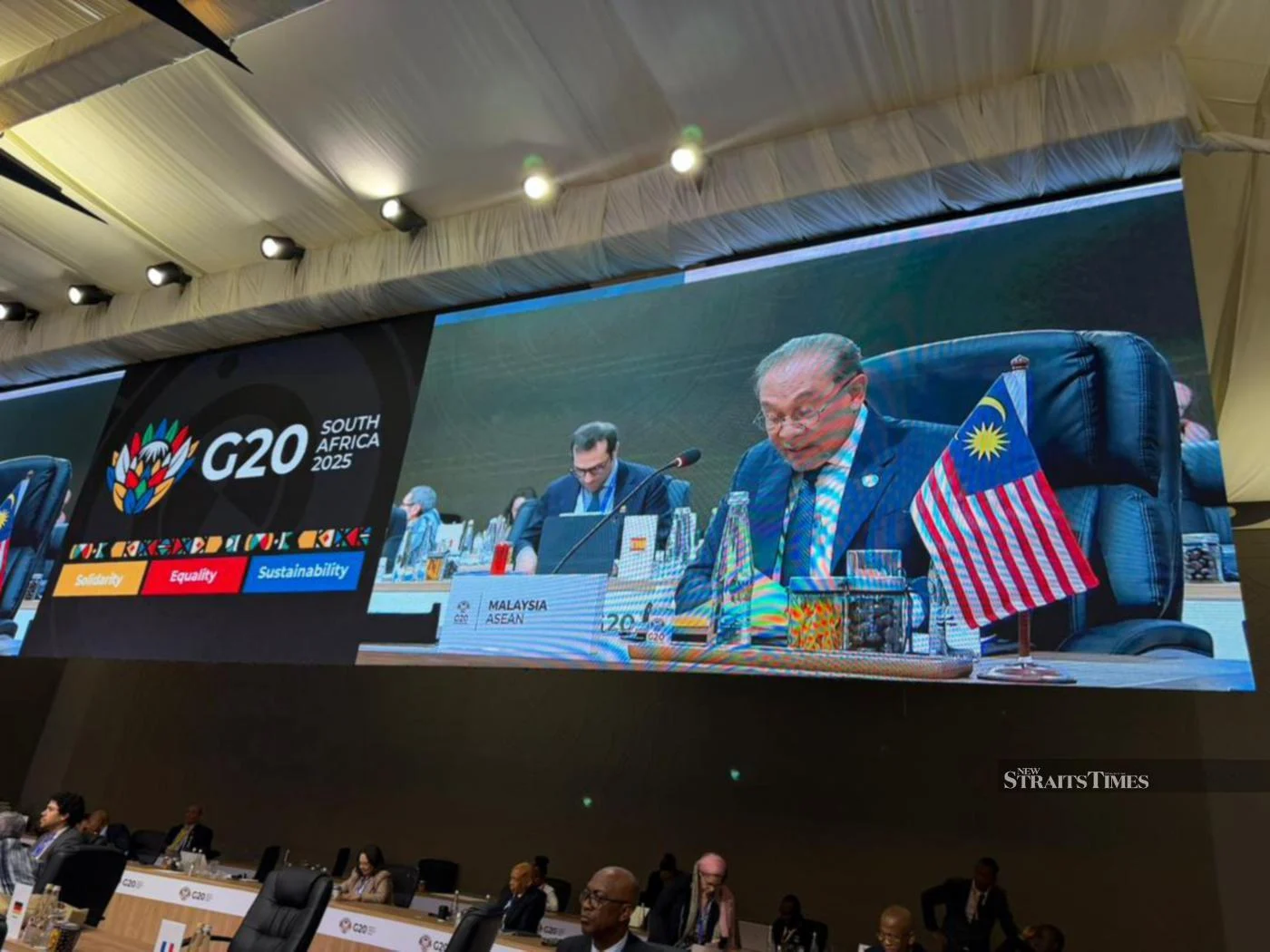
The prime minister today said the lesson learnt from facing these challenges indicated that emerging economies could not afford to isolate themselves.
"We have found that when policies are aligned and rules are predictable, shocks pass through with less damage.
"The lesson is clear ... resilience comes from common preparedness, not isolation."
He added that this lesson mattered because the next disruption in emerging economies would likely be harder to contain.
He said artificial intelligence (AI) was expected to reorganise labour markets at a pace local institutions would struggle to match.
To overcome this, he said it was vital for governments to start investing in workers, especially the young.
He said this when delivering Malaysia's statement during Session 1 of the Group of 20 (G20) Summit here with the theme "Inclusive and Sustainable Economic Growth, Leaving No One Behind."
His participation in the summit was in Malaysia's capacity as Asean chair and on the invitation of South African President Matamela Cyril Ramaphosa.
Anwar said this year's G20 summit was being held at a critical juncture of deep economic and geopolitical unease and one cannot help but feel that it was the eve of even greater volatility.
"Globalisation created unprecedented prosperity, but its gains were uneven and the world was slow to adjust.
"After the 2008 financial crisis and again during the Covid-19 pandemic, many were left vulnerable rather than supported.
"The political effects of those shocks persist to this day," he said.
Anwar said the world had seen the consequences of globalisation when societies were unprepared for it.
He said with AI, the destabilisation could be worse if countries entered this transition unprepared.
"This will be one of the defining challenges of our times," he said, adding it was essential for countries to prepare their people, especially the youth, for the speed of technological change.
He said investments were needed in training programmes while safety nets must be put in place.
"Small- and medium-sized firms, which will carry much of the employment burden, would also need support," he said, adding emerging economies also needed to double down on international trade.
He said Malaysia had worked towards this by moving quickly on the Asean Digital Economy Framework Agreement, which would set common standards for data, payments and digital trade.
Touching on global resilience, he said many developing economies now spent more on servicing debt instead of education or investment.
He said countries needed the capacity to invest ahead of disruption and this could only be achieved if multilateral development banks worked with those who needed help to build resilience.
"Malaysia is, therefore, ready to work with all partners to meet this common challenge and to help sustain an open, predictable global economy that gives our people a fair chance to thrive," he said.
He earlier also thanked Ramaphosa for his leadership, and for inviting Malaysia to the summit.
Source: New Straits Times
Share:

<p>Time: November 2025<br /> By: WTO and International Trade Group, Legal Department – VCCI</p>
