

A new assessment released by the Asian Development Bank (ADB) yesterday says the United States’ 19 percent tariffs on Cambodian exports is unlikely to affect the Kingdom’s economy in the immediate term, though the situation could shift sharply if the rate increases or if regional competitors secure more favourable trade conditions.
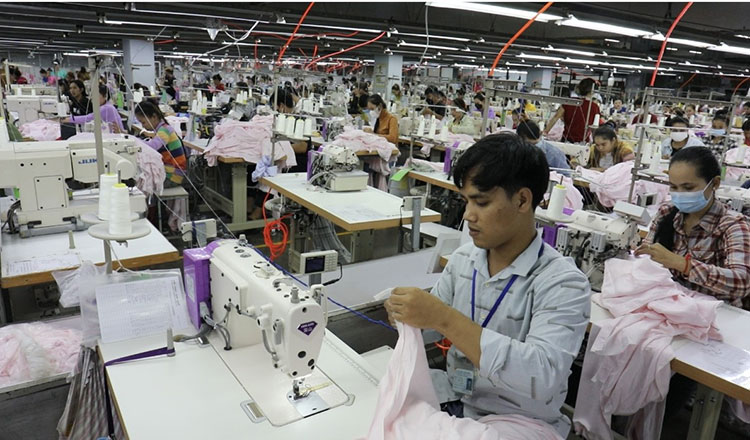
The tariffs, imposed in August 2025, applies to a wide range of Cambodian goods entering the US market. The US remains Cambodia’s largest single export destination, accounting for roughly one-third of exports and around a quarter of gross domestic product. Much of this trade is concentrated in garments, footwear, travel goods and electronics assembly – industries that employ large numbers of workers and remain central to Cambodia’s economic structure.
The ADB report notes that although any tariff has the potential to raise production costs and weaken competitiveness, Cambodia currently maintains a relative advantage when compared with its major export competitors. Countries such as Vietnam, Bangladesh, India and China face an average tariff of around 24 percent, higher than the 19 percent imposed on Cambodian products.
This relative difference has tempered the impact of the tariff, the report explains, with the reduction in US demand being broadly offset by Cambodia’s favourable position among low-cost exporters. As a result, the near-term effect on GDP is considered negligible. Cambodia, in effect, remains competitive in the US market despite the tariff headwind.
“Government and industry experts have been monitoring the situation closely for months. Their intuition was that the high tariff proposed earlier in the year would have been a heavy economic burden, but that the current 19 percent tariff rate is not,” said Milan Thomas, ADB Country Economist for Cambodia and lead author of the brief assessment.
“Economic modelling confirms that the current tariff is indeed manageable, while demonstrating that a higher tariff would have dire consequences for Cambodian families through unemployment and poverty,” he added.
However, the ADB stresses that this balance should not be taken for granted. The global trade environment has become less predictable, with tariff schedules shifting rapidly in response to political considerations in major economies. Should US trade policy move toward the previously signalled 36 percent tariff level – which has not been imposed but remains under consideration – the economic effects would become considerably more serious.
Under a 36 percent tariff scenario, Cambodia’s GDP could decline by nearly one percent due to a loss of competitiveness in labour-intensive manufacturing. The garment, footwear and travel goods sector would be among the hardest hit. The report estimates that sector output could fall by more than two percent, with smaller but still meaningful declines in electronics and supporting industries.
The social implications of such a shift would be substantial. The ADB’s modelling suggests that around 130,000 workers could lose their jobs, and a further 54,000 could be forced to move into lower-paid sectors such as agriculture or informal services. Many of the workers at risk are women employed in factories who support extended family networks, meaning the effects would spread across communities rather than being contained to individuals.
The report notes that the poverty rate could rise by 1.3 to 1.6 percentage points if the higher tariff were imposed. While the percentage may appear small, it represents tens of thousands of households shifting from stability to vulnerability. The impact would be most pronounced among families living just above the poverty line, where even a temporary loss of wages can quickly push households into hardship.
The ADB also highlights fiscal risks. Lower consumer spending and weaker company earnings would likely reduce government revenue. The report estimates that a 36 percent tariff scenario could lower state revenue by around $600 million, widening the budget deficit. Although the shock would not reach the scale experienced during the COVID-19 pandemic, it would coincide with ongoing pressures, including the reintegration of nearly 900,000 migrant workers who have returned from Thailand in recent years.
The report concludes by emphasising the importance of continued economic diversification. While garments and footwear will remain central to Cambodia’s economy for the foreseeable future, developing stronger domestic production capacity, increasing value-added processing, and expanding into services and light manufacturing would reduce vulnerability to external trade shocks.
For now, Cambodia remains competitively placed in the US market. But the stability of that position depends on decisions being made in a political environment far beyond Phnom Penh’s control.
Cambodia has avoided the most damaging tariff outcome in the US market but now enters a more competitive and uncertain trade environment, according to Arnaud Darc, Chairman and CEO of Thalias and Co-Chair of the Government-Private Sector Forum (Working Group D).
He told Khmer Times recently that the White House’s Executive Order 14257, issued on July 31, 2025, replaced the previously proposed 49 percent tariff on Cambodian exports with a 19 percent rate, effective from August 7.
“This decision prevents severe disruption to Cambodia’s export sector,” Darc said. “The next 100 days will determine whether Cambodia stabilises its US trade position,” he said. “The situation is manageable, but only with fast, coordinated action.”
Source: Khmer Times
Share:


<p>Time: November 2025<br /> By: WTO and International Trade Group, Legal Department – VCCI</p>
