

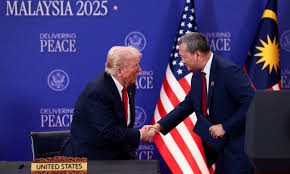
Cambodia and the United States have pledged to deepen their economic partnership under a landmark U.S.-Cambodia Reciprocal Trade Agreement signed Oct. 26 by Prime Minister Hun Manet and President Donald Trump on the sidelines of the ASEAN Summit.
The accord establishes a comprehensive framework for bilateral trade and investment, eliminating nontariff barriers, strengthening intellectual property enforcement, and committing Cambodia to customs modernization, labor protections, and digital economy standards. Cambodia will open its markets to U.S. goods and investment, while gaining expanded access for its exports. Most tariffs have been reduced or eliminated, though some Cambodian goods remain subject to a reciprocal U.S. tariff of up to 19 percent.
“The pact serves as a blueprint for how emerging economies can engage constructively with major powers,” said Bora Chhay, managing director of BowerGroupAsia Cambodia, a Washington-based strategic advisory consultancy firm.
He added “The Cambodia – U.S. Trade Pact gives Washington broader access to Cambodia’s critical minerals and energy sectors, resources important for clean energy, semiconductor manufacturing, and advanced defense technologies, including bauxite, copper, iron-ore and gold exploration. It’s sends a clear signal to investors that Cambodia is serious about reform, transparency and long-term growth.”
Under the deal, Cambodia will eliminate tariffs on 100 percent of U.S. industrial, food and agricultural products. In return, the United States will maintain zero tariffs on many Cambodian goods, while certain exports, particularly in labor-intensive sectors, remain subject to tariffs of up to 19 percent. The agreement includes a safeguard clause allowing Washington to terminate the deal if Cambodia enters into another trade pact deemed to undermine U.S. interests.
Cambodia also committed to removing import licensing and technical barriers, streamlining regulatory approvals, and recognizing U.S. safety and health standards for vehicles, medical devices and agricultural goods. The accord prohibits Cambodia from imposing digital services taxes on U.S. firms and supports a permanent moratorium on customs duties for electronic transmissions at the World Trade Organization. It also strengthens copyright and trademark enforcement and pledges action against online piracy and counterfeiting.
Labor and environmental provisions require Cambodia to prohibit imports produced by forced labor and enhance environmental protections. U.S. investors will receive national treatment in Cambodia’s critical minerals, energy, telecommunications and infrastructure sectors, though land ownership remains subject to domestic law.
Cambodia will fully digitalize its customs procedures within five years and cooperate with U.S. authorities on export controls, sanctions and anti-smuggling measures. The agreement includes a duty evasion cooperation clause aimed at preventing third-country transshipment, a concern for the Trump administration amid tensions with China.
State-owned enterprises in Cambodia must operate on commercial principles and avoid discriminatory practices. The agreement also includes a review mechanism to expand market access in sectors still facing tariff ceilings.
As part of the deal, Cambodia committed to purchasing 10 Boeing 737 MAX aircraft, with anoption for 10 more.
“It’s a win-win partnership, Cambodia deepens its cooperation and credibility with the United States, while Washington strengthens its engagement through mutual respect and shared interests.” Bora said.
Source: Kampuchea Thmey Daily
Share:

<p>Time: November 2025<br /> By: WTO and International Trade Group, Legal Department – VCCI</p>
