

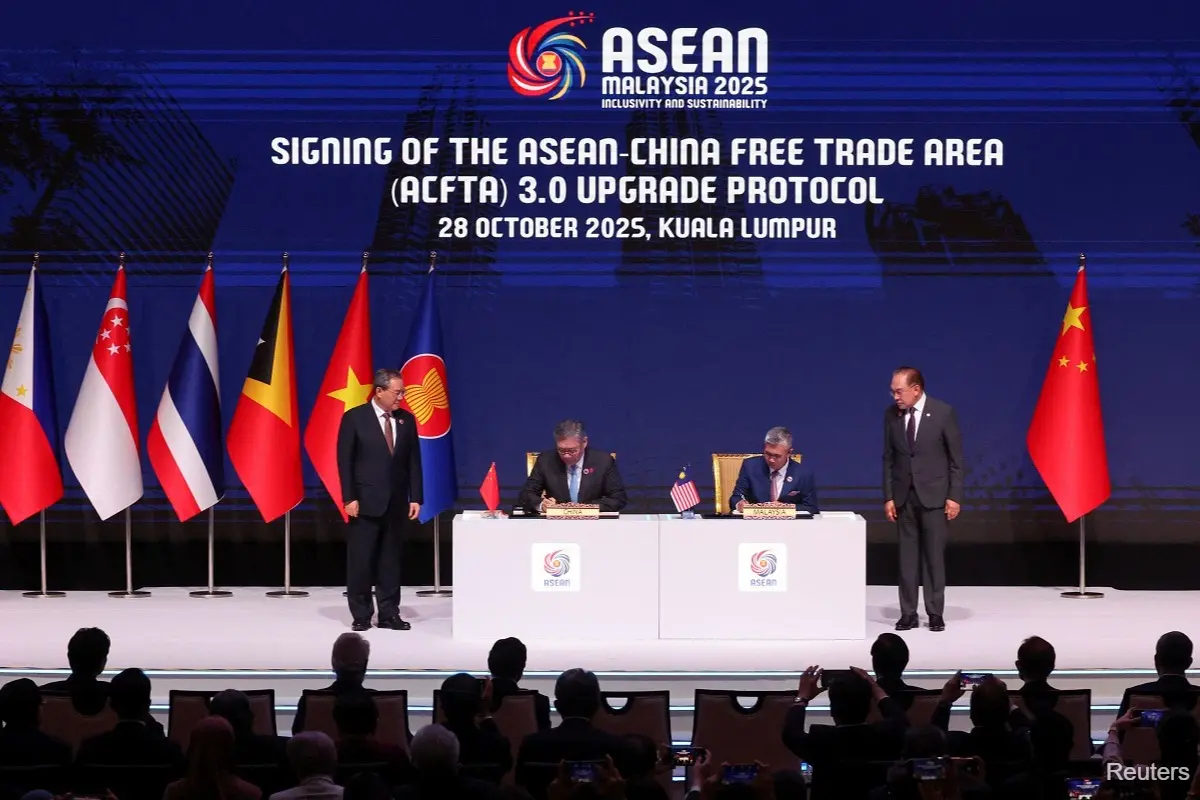
The Asean-China Free Trade Agreement 3.0 (ACFTA 3.0), signed in Kuala Lumpur this week, is far more than just a new trade deal. It signals a fundamental realignment of Asia's regional economic architecture.
In an era defined by global supply chain fragmentation, escalating US tariffs, and mounting geopolitical tension, this upgraded agreement offers Southeast Asian economies a strategic path. It allows them to diversify beyond volatile Western markets and position themselves at the heart of the world's fastest growing economic corridors.
The digital and green pivot
ACFTA 3.0's key differentiator is its deliberate focus on two emerging sectors: digital technology and green energy.
China has established formidable global leadership in these areas, and the timing of the agreement is no coincidence. It aligns perfectly with China's current five-year plan, which emphasises technological self-reliance and ambitious climate commitments. This comes as the US has stepped back from the Paris Agreement and Europe struggles to form a coherent digital economy strategy.
Technology and finance: The agreement commits to transparency in AI and fintech regulations. This is vital for Malaysia's aspirations as a regional technology hub. Simplified regulatory frameworks can accelerate Malaysian participation in China's digital infrastructure projects, from smart cities to digital payment systems along the Belt and Road Initiative.
Market diversification: Finding new customers
The strategic logic of ACFTA 3.0 is evident in the current trade imbalance. In 2024, China recorded a US$190.71 billion (RM799.5 billion) trade surplus with Asean, more than triple the figure from a decade ago. A relationship with such a stark imbalance is unsustainable.
Recognising this, Beijing has included provisions to actively facilitate Asean exports to China, including enhanced market access commitments and use of platforms like the China International Import Expo.
For Malaysia, the challenge is to strategically leverage its comparative advantages:
High-value exports: Malaysia's halal food and beverage industry is perfectly positioned to serve China's 1.4 billion consumers, especially as disposable incomes rise and demand for premium imported products grows.
Service exports: Asean’s strengths in tourism, medical tourism, and education services directly target China's expanding middle class, sectors where Chinese domestic supply cannot easily substitute imports.
Crucially, Malaysian firms facing US tariffs can now redirect their finished products to Chinese consumers, reducing dangerous dependence on volatile Western markets. The risk of trade being "weaponised" (like recent US actions against firms trading with Russia) makes this diversification essential.
Supply chain repositioning: Moving up the value chain
For Malaysian firms in the semiconductor supply chain, ACFTA 3.0 creates a unique opportunity for hedging.
Malaysian companies already supply critical chip components to EV manufacturers in America and Europe. The enhanced provisions of ACFTA 3.0 allow them to pivot towards China's massive EV market without abandoning Western partnerships. Streamlined customs and supply chain connectivity commitments facilitate this crucial repositioning.
This model applies more broadly:
Lower-cost manufacturing shifts: As China transitions to a high income economy, labour intensive manufacturing will shift to lower-cost Asean neighbours like Vietnam and Indonesia.
Malaysia's new role: Malaysia, with its established position in sophisticated higher value electronics assembly and testing, can capture the more complex segments of production networks leaving China.
ACFTA 3.0 facilitates this regional specialisation, allowing Malaysian firms to move up the value chain by supplying higher margin components to China's advanced manufacturing sectors.
Navigating the risks
Realism, however, requires acknowledging the agreement's risks and limitations.
The major threat is Chinese overcapacity, where goods are often sold below production costs, threatening to overwhelm Asean manufacturers, particularly small and medium sized enterprises (SMEs). Whilst the upgraded FTA includes commitments against anti-competitive practices, enforcement mechanisms remain unclear.
Asean member states must:
Address overcapacity: Use the enhanced dialogue platforms under ACFTA 3.0 to candidly address overcapacity concerns. This is not about protectionism, but about the long term sustainability of the trade relationship.
Scrutinise data sovereignty: Carefully scrutinise the data sharing and regulatory harmonisation provisions. As digital and customs integration deepens, questions of data sovereignty, privacy protections, and potential exposure to extraterritorial jurisdiction become paramount. Economic cooperation cannot override fundamental legal safeguards.
Moving forward: The real work begins
ACFTA 3.0 is a significant opportunity for Malaysia and Asean to reshape their economic destinies amid global turbulence. It acts as partial insurance against the volatility of geopolitical trade and diversifies both market access and supply chain positioning.
However, it is no panacea. Asean's economic future still depends on maintaining multiple partnerships: with China, but also with India, Japan, South Korea, and where possible, America and Europe.
Effective implementation must be strategic:
Support for businesses: Malaysian enterprises, especially SMEs, require targeted support, from trade financing to market intelligence, to navigate China's complex regulatory environment and identify viable business opportunities.
Institutional investment: The benefits of transparency and simplified procedures only materialise if there is investment in trade facilitation infrastructure, training programmes and institutional capacity.
The prime minister urged swift ratification, but the real work begins now, in boardrooms and government offices, to ensure this agreement delivers tangible benefits to businesses and workers, not merely headlines for political leaders.
Source: The Edge Malaysia
Share:

<p>Time: November 2025<br /> By: WTO and International Trade Group, Legal Department – VCCI</p>
