

The move marks a significant recalibration of Cambodia’s trade policy, balancing immediate consumer gains with the longer-term strategic objective of positioning the Kingdom as a modern, rules-based trading partner in the global economy.
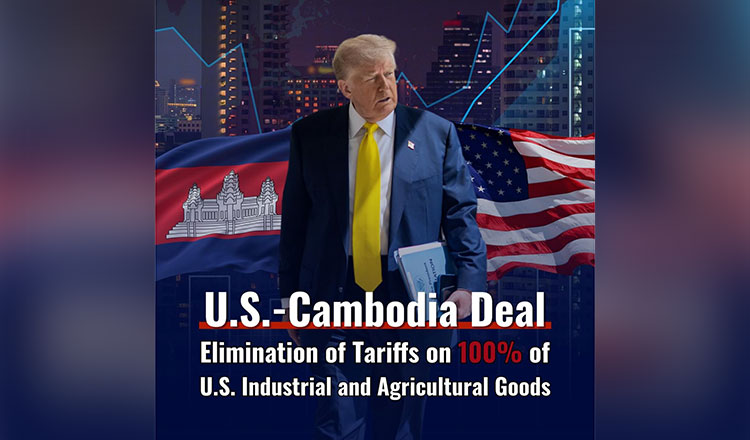
Cambodia has agreed to remove tariffs on 100 percent of US products exported to the Kingdom under a new trade agreement signed between Prime Minister Hun Manet and US President Donald J Trump, marking a significant step in strengthening bilateral economic ties and expanding market access for American businesses.
According to the Office of the United States Trade Representative (USTR), Executive Office of the President, on Sunday, the ‘US–Cambodia Agreement on Reciprocal Trade’ is a legally binding accord designed to provide unprecedented levels of access for US exporters while supporting America’s national and economic security objectives.
Under the agreement, Cambodia has fully eliminated import tariffs on all US goods, creating commercially meaningful market access opportunities across the full range of American exports.
In return, the United States will maintain a 19 percent reciprocal tariff rate on Cambodian imports, except for certain products listed in Annex III to Executive Order 14346, which will receive a zero percent tariff.
The agreement also includes extensive commitments by Cambodia to address long-standing non-tariff barriers. Phnom Penh has pledged to simplify import licensing and regulatory requirements, accept US vehicle safety and emissions standards, and recognise US Food and Drug Administration (FDA) certifications for medical devices and pharmaceuticals.
For agriculture, Cambodia has agreed to prevent and remove obstacles to US food and farm exports by recognising US sanitary and phytosanitary standards and accepting relevant certificates issued by US authorities.
In digital trade and services, the Kingdom has committed to maintaining a moratorium on customs duties for electronic transmissions, ensuring data transfer across trusted borders, and refraining from introducing digital services taxes or other discriminatory measures.
Cambodia has also undertaken to strengthen intellectual property protection, including implementing key international treaties and combating counterfeit markets.
Furthermore, the Kingdom has pledged to enhance labour rights—specifically banning the import of goods made with forced labour and safeguarding workers’ rights to association and collective bargaining.
On the environmental front, the agreement commits Cambodia to uphold high levels of environmental protection and ensure effective enforcement of its environmental laws.
Both nations have agreed to work together on increasing supply chain resilience and addressing unfair trade practices by third countries. Cambodia will also take steps to ensure that state-owned enterprises operate under fair market conditions and that domestic subsidies do not distort competition.
The USTR noted that the deal will soon undergo domestic procedures before it officially enters into force. The United States currently runs its eighteenth-largest goods trade deficit with Cambodia, amounting to $12.3 billion in 2024.
President Trump hailed the agreement as “a forward-looking and tough trade deal that will benefit American workers, exporters, farmers, small businesses, and digital innovators”. He described it as a major victory in his administration’s drive to achieve reciprocal trade relationships and eliminate unfair trade practices.
Since April 2, 2025—when President Trump declared a national emergency over the US trade deficit—the administration has pursued a series of policies aimed at levelling the playing field for American producers. The new deal with Cambodia, officials say, demonstrates that “America can defend its domestic production while obtaining expansive market access with its trading partners.”
Analysts say the removal of tariffs could reshape local industries, consumer markets, and long-term bilateral relations. “The policy, announced on October 26, 2025, is seen as a strategic step to strengthen ties with the United States while enhancing domestic competitiveness.”
Thong Mengdavid, lecturer at the Institute for International Studies and Public Policy at the Royal University of Phnom Penh, told Khmer Times that the new arrangement offers both opportunities and challenges for Cambodia’s economy.
“Under this agreement, cheaper US inputs and finished goods could benefit Cambodia through lower production costs, technology transfer, and greater investment incentives,” he said. “However, this will also heighten competition for import-competing industries, particularly those linked to Japan, South Korea, and China.”
Mengdavid noted that the removal of tariffs will make US vehicles, spare parts, and capital equipment more affordable. “This could boost productivity for firms reliant on machinery and offer consumers lower prices—but it may disadvantage emerging domestic assembly operations and regional suppliers,” he added. Similarly, the lower tariffs are expected to reduce the cost of imported pharmaceuticals, reagents, and medical equipment, improving access to critical health products.
Despite these advantages, Mengdavid emphasised that Cambodia’s exports to the US, mainly garments, footwear, and electronic components, remain central to its trade surplus. “Eliminating tariffs on US goods does not automatically secure better access for Cambodian exports,” he said.
“The key factors are US market access conditions and the reciprocal tariff rates granted to Cambodian products. The agreement’s primary value may be political and strategic, strengthening bilateral ties and attracting investment, rather than immediately boosting export volumes.”
Arnaud Darc, Chairman and CEO of Thalias and Co-Chair of the Government-Private Sector Forum (Working Group D), said the decision reflects Cambodia’s commitment to transformation rather than protectionism.
“This isn’t protectionism in reverse; it’s Cambodia betting on its own transformation,” Darc told Khmer Times. He highlighted sectors such as agriculture, automobiles, and pharmaceuticals, where increased competition from US imports is expected to have immediate impacts. “Expect a surge of US dairy, feed, and processed food into the market. That will pressure local producers, particularly those facing high logistics and energy costs,” he said.
Darc also noted that tariff-free US electric vehicles and hybrids could shift consumer preferences, provided Cambodia invests in EV infrastructure and revises tax structures accordingly. In pharmaceuticals, he added, “Improved access to FDA-quality products is a public health win—but it also forces us to upgrade regulatory oversight, from import licensing to post-market surveillance.”
On the trade strategy front, Darc stressed that the agreement stabilises Cambodia’s access to US markets and investor confidence. “In 2024, the US imported over $9.1 billion in goods from Cambodia, primarily garments, footwear, and bicycles. The new 19 percent tariff rate puts us on par with regional peers like Vietnam and Indonesia,” he said.
Yet, he warned that long-term benefits will depend on Cambodia’s ability to diversify into agro-processing, renewables, and digital services while strengthening infrastructure, education, and trade facilitation.
Implementation challenges remain, particularly around labour, environmental, and digital trade standards. “This isn’t just a trade deal, it’s a governance pact,” Darc said. Compliance with ILO labour standards, WTO rules, and US digital norms requires robust administrative systems. From tracking forced labour in supply chains to upgrading environmental monitoring and enforcing intellectual property rights, the path ahead is complex.
Businesses, he noted, are already reviewing US-sourced products for compliance, and widespread adoption of these standards will be critical over the next two years. “The real risk isn’t ambition—it’s failing to execute in time,” Darc said, pointing to 2026–2027 as the crucial period for effective implementation.
The move marks a significant recalibration of Cambodia’s trade policy, balancing immediate consumer gains with the longer-term strategic objective of positioning the Kingdom as a modern, rules-based trading partner in the global economy.
Source: Khmer Times
Share:

<p>Time: November 2025<br /> By: WTO and International Trade Group, Legal Department – VCCI</p>
