

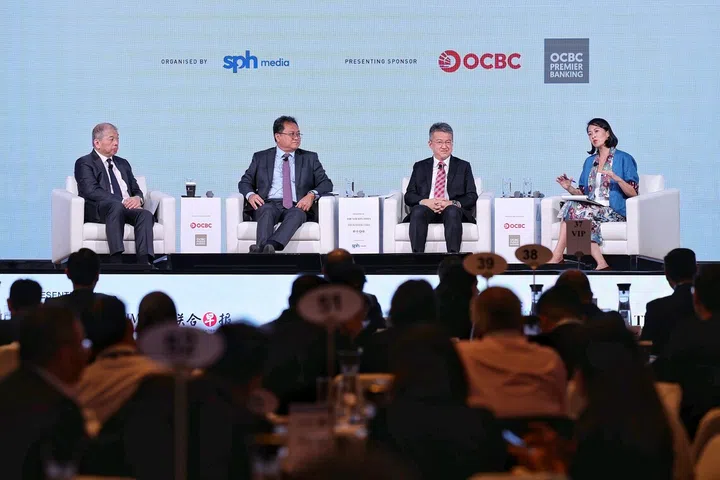
Asean must start taking itself more seriously and move beyond being a production hub for others if it is to thrive in a world marked by rising protectionism and shifting global power, said observers at the Asia Future Summit on Oct 9.
At a panel discussion on the region’s economic future, they cautioned that South-east Asia’s longstanding export-led model, which powered its growth for decades, is losing momentum.
This comes amid US tariffs, technological disruption and the rise of artificial intelligence – forces that are reshaping global trade flows.
One of the three panellists was Malaysia’s Deputy Minister of Investment, Trade and Industry Liew Chin Tong.
He said the region must start imagining a future – say, in 20 years’ time – where it is not merely a manufacturing hub for the world but also a significant consumer of goods and services.
“I want Asean to take Asean very seriously. I want Asean to believe in Asean more, and to believe in our own companies a lot more, to believe in our people a lot more,” said Mr Liew.
He was responding to a question from The Straits Times foreign editor Li Xueying, who moderated the discussion on the present reality of Asean and what the grouping could become.
The Asia Future Summit was a thought leadership conference jointly presented by SPH Media flagship titles The Straits Times, Lianhe Zaobao and The Business Times, with OCBC Bank as the presenting sponsor. The two-day event was held at The Ritz-Carlton, Millenia Singapore.
The other two panellists were Mr Teo Siong Seng, Pacific International Lines executive chairman and Singapore Business Federation chairman, and Dr Yose Rizal Damuri, executive director of Indonesia’s Centre for Strategic and International Studies.
Mr Liew said the economic model of export-led industrialisation to the US, which has served the region well for half a century, “is coming to an end”.
Asean’s prosperity, he explained, was driven by competition to attract investors by cutting wages and environmental standards.
He said this approach had turned into a “race to the bottom”, built on the assumption that the United States would keep absorbing the region’s exports.
But now, Washington has raised barriers through trade tariffs and other measures, Mr Liew noted, and is effectively telling others not to export there without paying a price.
He called on Asean governments to focus on nurturing regional multinational companies and to work towards a common industrial policy that would allow the grouping to compete on its own terms.
“Maybe in 10, 15 years, we have a mini Huawei or mini Samsung or a mini TSMC,” he said, referring to successful tech companies that have sprung up in other parts of Asia.
“And it is possible that if we put our heads together, we put a policy together, and we take a different policy path.”
Echoing the call for Asean to chart its own path, Mr Teo said the region’s vast potential remains constrained by fragmentation and uneven development. The region’s 700 million-strong market, he noted, is still “very fragmented”.
“You look at the 58 years from the initial five countries, we don’t move as one... We all have a different dream,” said Mr Teo, referring to the grouping founded in 1967 by Indonesia, Malaysia, the Philippines, Singapore and Thailand.
He recalled how, more than two decades ago, there were discussions about specialisation among member economies, such as how potentially, Malaysia could specialise in agriculture, while Thailand could specialise in car parts – but such plans have “gone out the window”.
Source: The Straits Times
Share:

<p>Time: November 2025<br /> By: WTO and International Trade Group, Legal Department – VCCI</p>
