

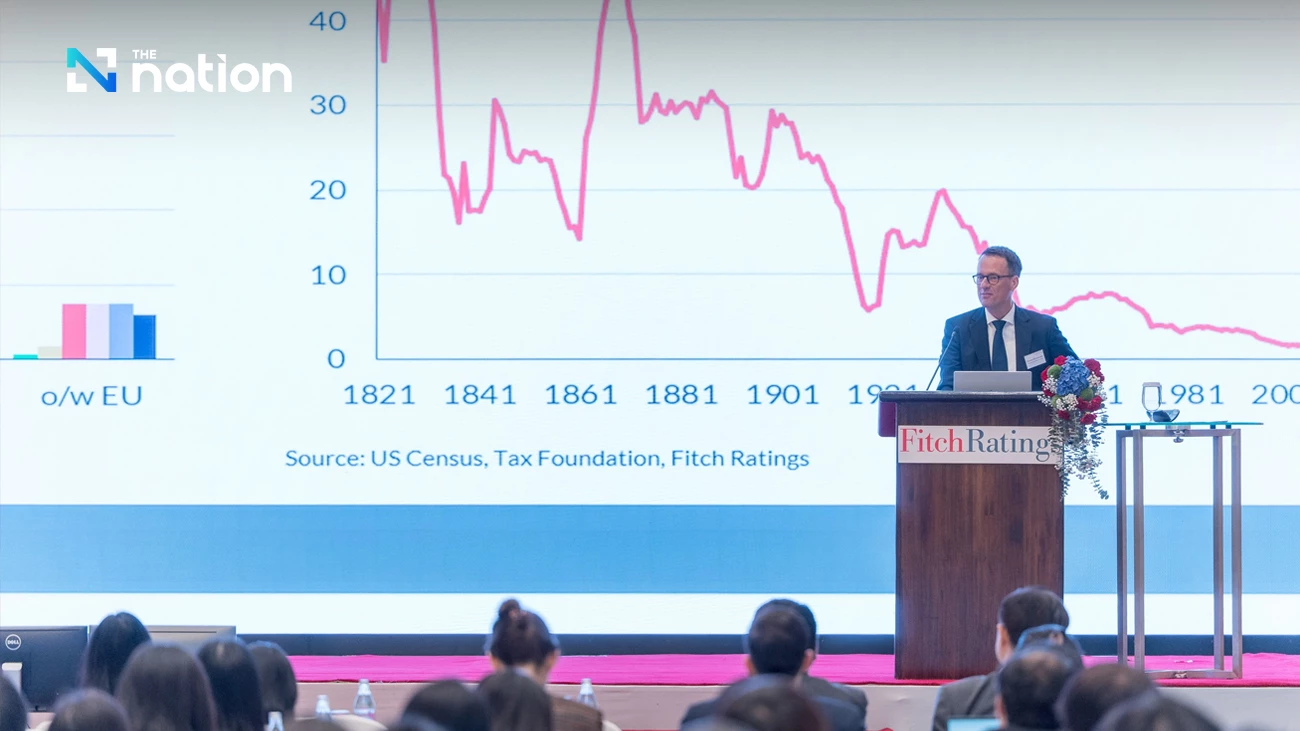
Thailand is grappling with intensified economic challenges stemming from slower global growth, diminished fiscal capacity and ongoing political uncertainty, Fitch Ratings warned at its annual conference on Thailand held in Bangkok on Wednesday.
The event, which brought together senior economists and credit analysts, painted a sobering picture of the kingdom's economic trajectory as public debt continues to climb and external headwinds mount.
Reform or Risk Decline
Opening the conference, Dr Kobsak Pootrakool, director and senior executive vice president at Bangkok Bank, emphasised that Thailand stands at a critical juncture.
He noted that whilst foreign direct investment is flowing into the ASEAN region, Thailand must act swiftly to capitalise on this opportunity.
"Thailand is at a distinctive crossroads that needs reform and takes action now or never," Dr Kobsak said, adding that the country should leverage its existing infrastructure whilst accelerating development in education and SMEs.
He stressed the importance of human capital investment to integrate Thailand into global supply chains and transition into the new global economy era.
Debt Trajectory Raises Concerns
Thomas Rookmaaker, senior director for Asia-Pacific sovereigns at Fitch Ratings Hong Kong, outlined the global risks facing Asian economies.
He noted that Fitch expects world growth to decelerate to 2.4 per cent in 2025, down from 2.9 per cent last year, amid evidence of a US economic slowdown.
Thailand has been particularly hard hit. The Covid-19 pandemic drove the country's general government debt ratio from approximately 35 per cent to 60 per cent currently, with projections showing it will stabilise around 65 per cent over the next few years – though considerable uncertainty surrounds this forecast.
Negative Outlook Reflects Fiscal Risks
Fitch recently revised its outlook on Thailand's 'BBB+' rating to negative from stable, reflecting rising risks to public finances from prolonged policy uncertainty combined with slowing global demand, delayed tourism recovery and household deleveraging.
The deterioration centres on uncertainty surrounding the medium-term debt-to-GDP ratio trajectory. Key concerns include headwinds from the external environment, a lagging tourism recovery and household deleveraging, which collectively imply lower growth prospects.
Political uncertainty has further complicated fiscal policy planning, leaving questions about whether deficits will narrow or continue to widen.
However, Rookmaaker noted that a return to a stable outlook remains possible if confidence improves in the general government debt trajectory over the medium term.
Source: Nation Thailand
Share:


<p>Time: November 2025<br /> By: WTO and International Trade Group, Legal Department – VCCI</p>
