

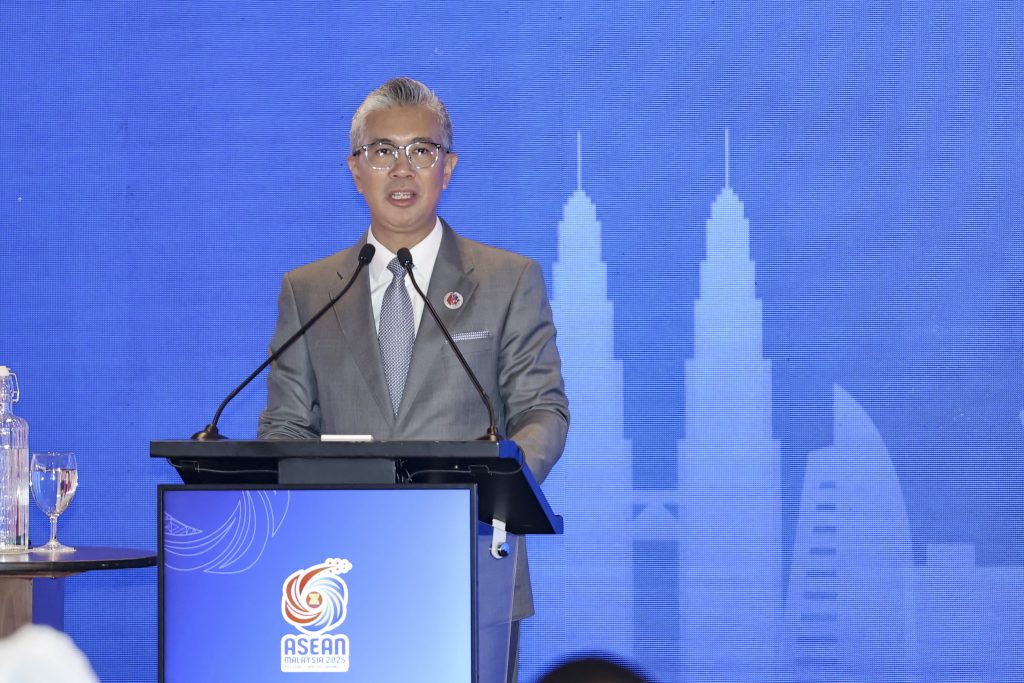
The Investment, Trade and Industry Minister Tengku Datuk Seri Zafrul Tengku Abdul Aziz confirmed progress on finalising the US-Malaysia trade agreement ahead of President Donald Trump’s visit in late October, but stopped short of announcing new measures, saying the deal is now in the “scrubbing” stage.
According to Tengku Zafrul, his talks with US Trade Representative Ambassador Jamieson Greer had been constructive, with both sides pushing to conclude the agreement in writing before Trump’s arrival.
“We have concluded, it’s just the agreement (left to finalise). It’s the regular scrubbing of what we already announced,” he told reporters at the 57th ASEAN Economic Ministers’ (AEM) Meeting recently.
He explained that Prime Minister (PM) Datuk Seri Anwar Ibrahim had also been briefed by Greer and that both governments had instructed their teams to finish the process, with the next step involving line-by-line work to translate earlier high-level announcements into the final agreement.
Tengku Zafrul further stressed that certainty was vital for businesses, noting that the US remains Malaysia’s largest export market and the top investor in both Malaysia and across ASEAN. The talks, he said, provided an opportunity to raise concerns and reaffirm the importance of the bilateral relationship.
One area of focus was the semiconductor industry, which he acknowledged would be a concern under the US’ ongoing Section 232 review.
The Trump administration has previously opened Section 232 investigations, under the authority of the Trade Expansion Act of 1962, into more than 10 sectors, including semiconductors and pharmaceuticals to determine the effect of imports on national security.
“We will have to wait. But at the same time, we need to work on ensuring that we continue to engage and explain how Malaysian companies and American companies, who are based here and exporting to the US, actually complement the US ecosystem,” he said.
On transhipment, Tengku Zafrul said there were no issues raised by the US and that both sides were satisfied with Malaysia’s handling. He also clarified that tariff adjustments in Malaysia were not on the table, noting that it was up to the US administration to decide on its own measures. Speaking separately, Greer sought to reassure that Washington’s immediate focus was on completing negotiations. However, he acknowledged that tariff options could not be dismissed.
“That being said, if we are not able to reach agreements, then the tariff solution is the solution,” he said, stressing the sensitivity of semiconductors.
On semiconductors, Greer described the supply chain as complex and critical to national security to the US and the ASEAN nations.
“We want to be very careful and very thorough in how we address the international trade situation. We have to have the supply chains back in the US, but of course South-East Asia remains an important source for the semiconductor supply chain,” he said.
EU Eyes Closer Trade Ties with Malaysia, ASEAN
Beyond Washington, ASEAN also drew attention from Brussels, with the European Union (EU) signalling deeper intent to anchor ties in South-East Asia.
European Commissioner for Trade and Economic Security Maroš Šefčovič said negotiations with Malaysia, Thailand and the Philippines were advancing well, stressing that concluding these agreements would be the best way to mark the anniversary of ASEAN-EU dialogue.
“We see ASEAN as a very dynamic, vibrant region, with a huge market of 660 million,” he said, emphasising that ASEAN should be regarded as a strategic partner, highlighting its position as one of the world’s most dynamic regions rather than merely an economic bloc.
After meeting with regional business councils, he reaffirmed that both political leaders and companies were pushing for deeper collaboration to unlock new investment and job opportunities.
Šefčovič described free trade agreements as “strategic assets” that generate growth, jobs and investment, citing the newly concluded EU–Indonesia deal as proof.
The agreement, finalised after two years of talks, eliminated more than 98% of tariffs and is expected to increase EU exports to Indonesia by 30% within five years, while saving European exporters more than €600 million (RM2.97 billion) annually in import duties.
He noted that the deal had been welcomed not only at the political level but also by the business community, with Indonesia projecting even greater export gains from the agreement.
Automotive Breakthrough, Steel Concerns
On relations with Washington, Šefčovič confirmed a major breakthrough in the automotive sector.
“What we expect right now is the tariff already charged would be returned to the carmakers as of Aug 1, which is something like €500-€600 million per month,” he said.
The US decision to lift the 15% all-inclusive tariff on cars and parts retroactively from Aug 1 will provide immediate relief to European automakers and boost exports.
Šefčovič acknowledged that the measure still requires parliamentary backing in Europe but said majority support from member states makes approval likely.
He also pressed for a joint EU-US approach to address global steel overcapacity, warning that unchecked imports could undermine domestic industries on both sides.
“We are not each other’s challenge. We are not exporting that much steel to each other, but we are faced with a global overcapacity of steel products which are flooding our markets,” he added.
Linking the issue to Europe’s rising military spending, Šefčovič said steel was essential for both security and industry and called for coordinated action to protect the sector.
Nonetheless, the flurry of engagements highlighted how ASEAN is increasingly seen as a strategic fulcrum by both Washington and Brussels.
For Malaysia, the meetings reinforced its dual role as the US’ top ASEAN trade partner and as a key link in the EU’s effort to expand economic integration with South-East Asia.
ASEAN’s Economic Backdrop
The remarks by Tengku Zafrul, Greer and Šefčovič were delivered against the backdrop of the 57th AEM Meeting in Kuala Lumpur (KL) from Sept 22-28, held under Malaysia’s chairmanship.
The annual gathering brought together ministers from all 10 member states, along with dialogue partners, to assess the bloc’s economic performance and set priorities for the year ahead.
This year’s meeting carried the theme of Inclusivity and Sustainability, reflecting ASEAN’s ambition to balance growth with resilience amid an uncertain global environment.
Ministers reviewed progress on regional trade commitments and considered new steps to strengthen supply chains, digital trade and investment flows at a time when protectionist pressures are reshaping global commerce.
As part of that review, ASEAN reported that its economy expanded by 4.8% in 2024, supported by resilient domestic demand and broad-based growth in trade and services.
Intra-ASEAN trade accounted for 21.6% of total commerce, while services trade grew by 12.2% year-on-year (YoY), figures that officials said underscored ASEAN’s ability to maintain momentum even in a challenging external environment.
Ministers also reaffirmed their commitment to an open, rules-based multilateral trading system and pledged to accelerate the upgrade of the ASEAN Trade in Goods Agreement (ATIGA). They endorsed Malaysia’s Priority Economic Deliverables (PEDs), which include initiatives to enhance ASEAN-Gulf Cooperation Council (GCC) economic cooperation, streamline customs procedures and expand trade facilitation measures across the region.
Source: The Malaysian Reserve
Share:

<p>Time: November 2025<br /> By: WTO and International Trade Group, Legal Department – VCCI</p>
