

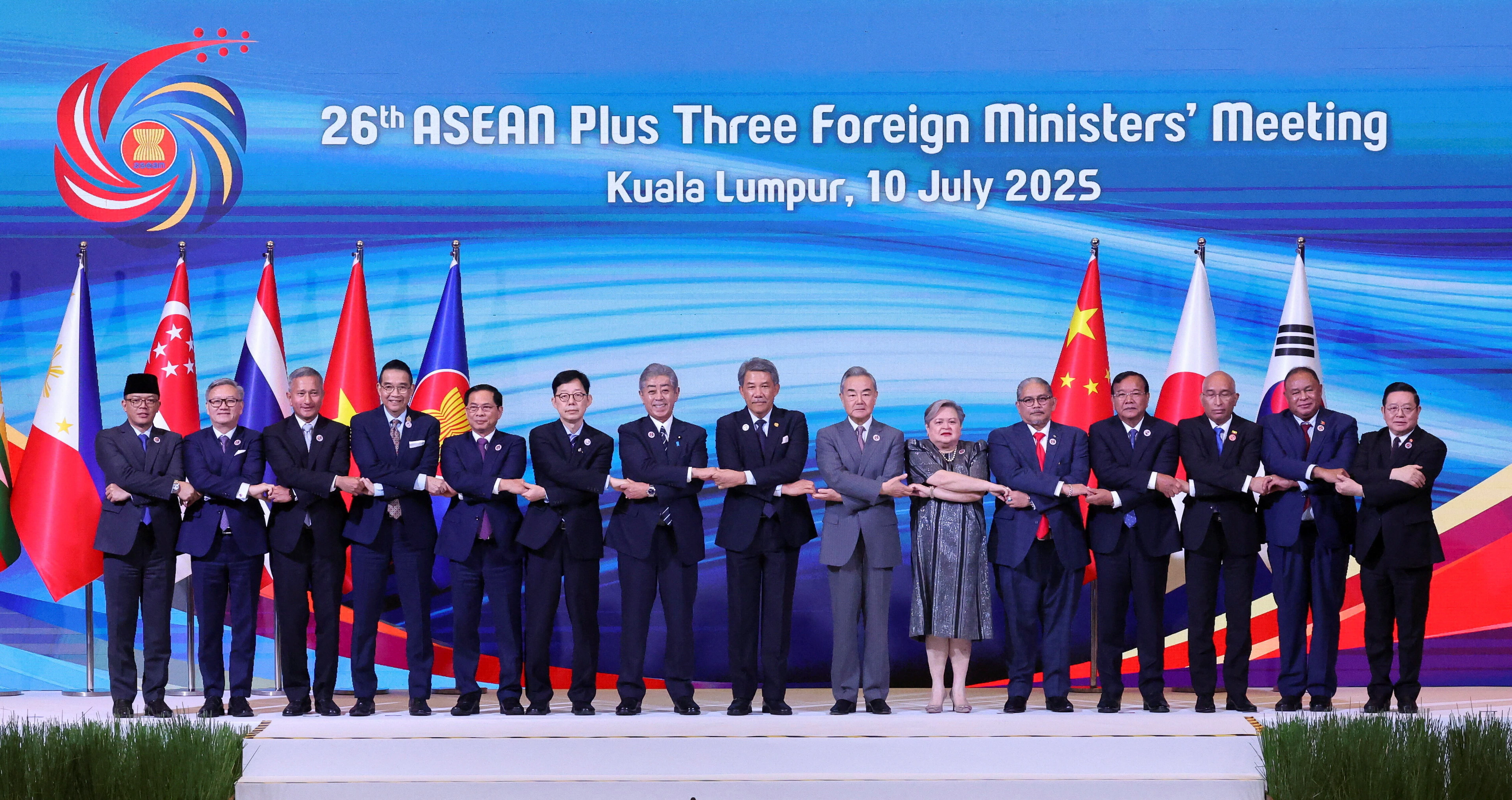
The tariff shockwaves of 2025 have presented ASEAN with its most significant test of unity since the 1997 financial crisis – and also its greatest opportunity for transformation.
The sudden escalation in trade restrictions has underscored the fragility of regional solidarity, as member states responded with divergent strategies to safeguard their national economies.
Yet within this disruption lies a moment of possibility: the chance for ASEAN to accelerate economic integration and strengthen its strategic autonomy. Under Malaysia’s current chairmanship, ASEAN is navigating this pivotal moment with both urgency and vision. From advancing regional payment connectivity to championing digital economy frameworks, Malaysia is positioning the bloc not only to respond to immediate challenges, but also to set a course for long-term resilience in an increasingly multipolar world.
The US tariffs announced on 2 April were effective precisely because they exploited ASEAN’s structural weaknesses. Unlike the European Union’s supranational authority, ASEAN operates on consensus and non-interference, principles that slow decision-making and prioritize national over regional interests. The 90-day tariff pause announced on 9 April triggered a scramble, with 75 countries reportedly seeking bilateral deals with Washington.
Vietnam’s decision to strike its own agreement highlighted the fragility of trust within ASEAN, making collective action impossible. The lesson is clear. Without institutional mechanisms to reinforce cooperation, unity will remain fragile in moments of external pressure.
Building what works: payment connectivity
Malaysia has advanced one of the most practical de-dollarization initiatives in decades with Regional Payment Connectivity (RPC). While BRICS continues to debate symbolic currencies, ASEAN has already operationalized cross-border payments in local currencies through standardized QR codes across eight member states.
The Malaysia-Cambodia QR payment linkage, launched in April, exemplifies this pragmatic approach. Travelers from Malaysia can now pay instantly in Cambodia using the MAE app, with automatic conversion – bypassing the dollar entirely. Similar systems now connect Thailand’s PromptPay, Singapore’s PayNow, Indonesia’s QRIS and Vietnam’s VietQR, creating an interoperable ecosystem that excludes US financial infrastructure. This isn’t theoretical de-dollarization; it is already affecting millions of transactions across the region.
A reality check for BRICS
While ASEAN has prioritized functionality, BRICS’ de-dollarization efforts remain largely aspirational. Despite headlines about replacing the dollar, its progress has been limited to “practical experimentation” rather than systemic change. The symbolic BRICS notes distributed earlier this year were explicitly framed as political signals, not legal tender.
Even where progress exists – such as the 95% of Russia-Iran trade now conducted in rubles and rials – it reflects crisis-driven necessity rather than a sustainable architecture. The renminbi accounts for just 2-3% of global foreign exchange reserves despite China’s economic weight, while the US dollar still commands 57-58% as of late 2024.
Source: WeForum
Share:



<p>Time: November 2025<br /> By: WTO and International Trade Group, Legal Department – VCCI</p>
