

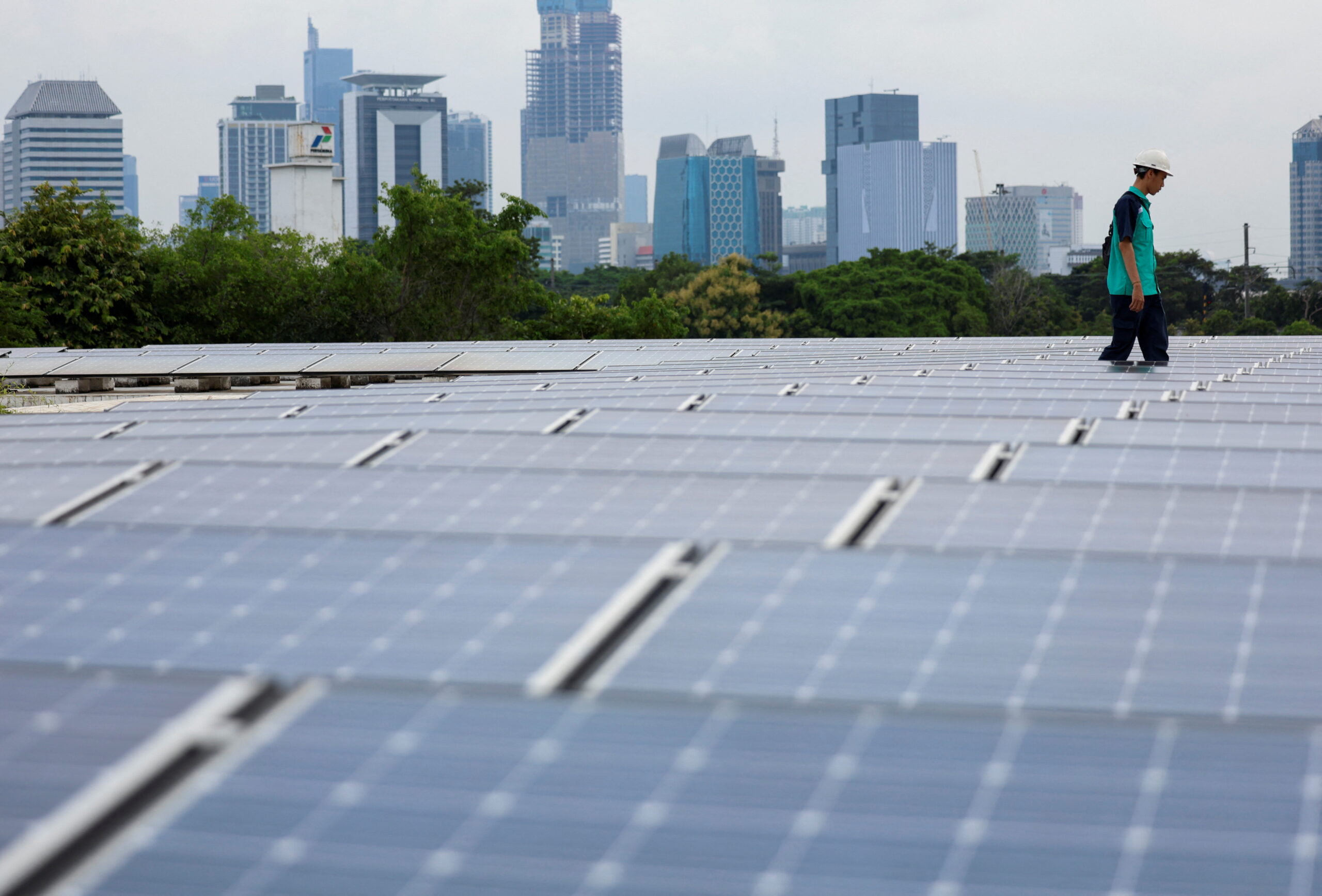
ASEAN’s clean energy sector is expanding quickly with China as the dominant investor, but fragmented policies, weak labour safeguards, and fragile supply chains risk locking the region into a low-value role in the green economy.
A China–ASEAN clean energy–industrial mechanism could align investment, skills, and governance, embedding environmental and social safeguards while ensuring the region captures more durable and strategic benefits from the transition.
ASEAN’s clean energy boom is taking shape. But without coordination, the region risks being locked into low-value roles in the green economy. China has emerged as ASEAN’s largest clean energy financier and now dominates regional electric vehicle and battery markets. Yet beneath the investment momentum, policies, standards, skills development and knowledge transfer remain fragmented. A China–ASEAN clean energy–industrial mechanismcould fill this gap.
Across the region, operations such as nickel processing in Indonesia and mining in the Philippines have drawn criticism for unsafe labour conditions, community displacement and habitat loss. US tariffs of up to 3500 per cent on ASEAN solar exports imposed in April 2025 exposed how fragile regional supply chains are. Without a framework to align industrial policy, workforce upgrading and environmental safeguards, Southeast Asia risks remaining a low-cost assembly hub, dependent on external capital but unable to shape the rules of the energy transition.
For Beijing, deeper clean energy engagement with ASEAN aligns with strategic priorities such as diversifying export markets, embedding outbound manufacturing in emerging industrial hubs and locking in supply chains for critical minerals and green technologies. For ASEAN, China offers capital, technology, and scale.
ASEAN already has platforms such as the ASEAN-China Clean Energy Cooperation Centre and the ASEAN+3 Clean Energy Roundtable Dialogue, but they lack the mandate and focus to align investment, industrial upgrading and governance on a regional scale. What is missing is a dedicated mechanism to link clean energy cooperation with industrial policy — one that embeds environmental, social, and governance (ESG) safeguards from the outset.
A China–ASEAN clean energy–industrial mechanism could anchor cooperation in labour and skills development. The mechanism could convene thematic working groups, support regional training hubs and co-design curricula with industry and academia to match labour upgrading with institutional commitment to build a capable workforce with structured training programs.
The mechanism could bridge the disconnect between capital and capacity. While investment is pouring into electric vehicles and renewable projects, enabling environments remain uneven. Drawing on models such as Singapore’s FAST-P and Indonesia’s Danantara, the mechanism could link Chinese policy banks, ASEAN state-owned enterprises and global financiers to develop ESG-anchored green industrial zones that pair infrastructure with manufacturing. A curated pipeline of bankable regional projects would turn capital inflows into strategic industrial capacity.
The mechanism can also create the institutional alignment required to move from one-off projects to enduring partnerships. Clean energy capacity alone does not guarantee resilience — trust and transparency require policy coordination and governance capability. The mechanism could host Track 1.5 dialogues, enabling joint procurement reforms, decarbonisation case studies and ESG compliance workshops.
Verifiable sustainability safeguards must be continuous and enforceable, not just contractual at project outset. Improving ASEAN’s environmental record will require Chinese corporates to adopt higher operational standards, ASEAN ministries to embed clear ESG regulations and local authorities to enforce them consistently — with the mechanism serving as the channel to align and monitor these efforts.
Initial participation could focus on ASEAN members with significant clean energy and industrial cooperation with China, such as Indonesia, Vietnam and Malaysia, before expanding as political and market conditions allow. A smaller coalition of willing states sidesteps ASEAN consensus paralysis and gives proof of concept.
But it would need a clear ministerial mandate spanning industry, labour and environment portfolios. The mechanism could be co-chaired by a standing Chinese lead ministry and a rotating ASEAN co-chair aligned with the ASEAN Chair, ensuring continuity on China’s side and regional ownership on ASEAN’s.
Private businesses’ roles would go beyond consultation. As conveners, firms could commit capital and expertise to joint research and development, ESG compliance and local partnerships on supply chains, helping translate government frameworks into tangible industry practice and durable benefits.
For ASEAN, such a mechanism would operationalise centrality by aligning national strategies with regional goals and enabling coherent engagement with external partners. For China, it would provide a structured channel to address ESG concerns, reduce friction and ensure investments generate long-term goodwill and influence.
While the mechanism centres on China given its economic gravity, it would not operate in isolation. Japan and South Korea remain important partners whose engagement could be channelled through the existing roundtable dialogues. This would allow the mechanism to remain focused on aligning cooperation with China, while still complementing and reinforcing wider regional partnerships.
Left uncoordinated, Southeast Asia’s clean energy transition will continue in fragmented steps, leaving much of the value captured elsewhere. ASEAN must balance multiple partners, but China’s weight makes a dedicated mechanism necessary. The growing costs of fragmented bilateralism — from tariff shocks to nickel disputes — only strengthen the case for a structured channel, making pragmatic cooperation less a choice than a necessity.
Such a mechanism would not erase the political frictions that have long hampered bilateral cooperation. But by starting with a smaller group of willing states and keeping its design lean and industry-facing, it offers a more credible path than past talk shops. Its durability will rest not on declarations, but on its ability to deliver tangible projects that serve both ASEAN and China’s climate and development needs in a turbulent global economy.
Source: East Asia Forum
Share:

<p>Time: November 2025<br /> By: WTO and International Trade Group, Legal Department – VCCI</p>
