

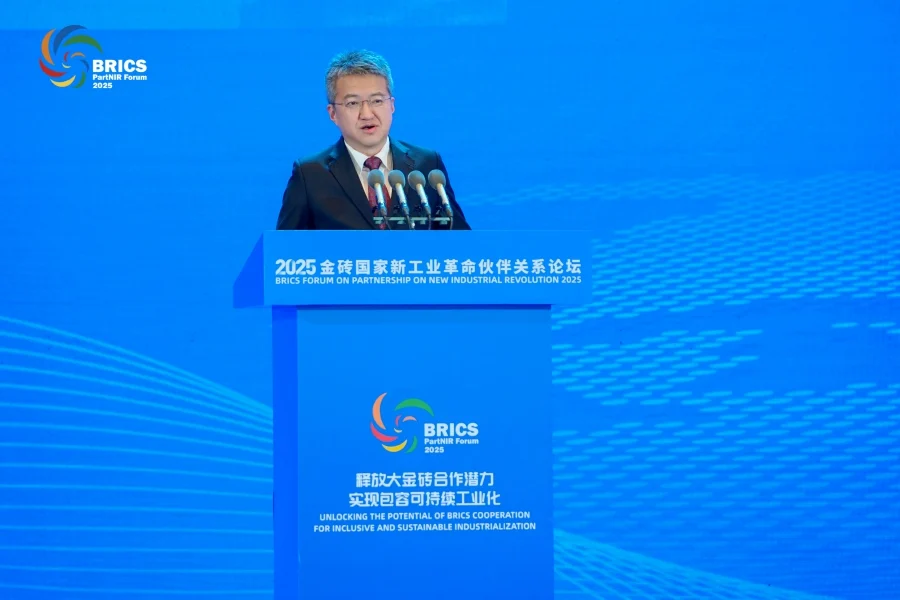
Malaysia is seeking to transform its role in the global economy by moving beyond contract manufacturing for multinationals under the "Made in Malaysia" model, said Deputy Investment, Trade and Industry Minister Liew Chin Tong.
He said the government aims to build homegrown multinational champions through innovation and technology under a new "Made by Malaysia" approach.
Liew said this transformation is central to Malaysia's New Industrial Masterplan (NIMP) 2030, which charts a path to elevate the country's industrial base and global competitiveness.
He added that the country's ambitions align with broader regional priorities.
"Malaysia hopes to move from the 'Made in Malaysia' model, which is essentially serving as contract manufacturers for multinationals, to the "Made by Malaysia" approach that would create Malaysian multinationals with technological innovation.
"These missions and aspirations are not just for Malaysia. We believe all developing nations aspire to achieve the same. The Asean Community Vision 2045 espouses very similar ideas," he said at the BRICS Forum on Partnership on the New Industrial Revolution (PartNIR) in Xiamen, China.
Liew cautioned that developing nations face a more complex industrial landscape, as traditional export-led strategies are being undermined by automation, artificial intelligence and reshoring trends in the United States.
To adapt, he said the Global South must focus on building domestic demand through job creation, expanding the middle class and fostering "middle technologies", affordable innovations that address everyday needs such as healthcare, housing, energy and connectivity.
"We should all take a leaf from the China experience. When China joined the World Trade Organisation in 2001, there were only around 100 million Chinese who were considered middle class. Today, by any standard, 400-500 million Chinese live middle-class lives.
"Asean currently has a population of slightly less than 700 million. If by 2045, a third to half of them become middle class, it is not just good for the region; it is better for the world. Asean would not just be a production site, but it will be a sizable consumer market for the world's producers," he said.
Liew added that Malaysia supports President Xi Jinping's efforts to curb involution, noting that price wars in China - and their potential spillover internationally - risk undermining growth prospects for both China and the wider developing world.
"This is probably the time to internationalise China's "dual circulation" strategy – the balancing of the dependence on export with a much stronger domestic demand.
"To deal with the end of the export-led industrialisation strategy, it is not only China that needs more domestic demand; Asean and other developing countries also need to work together to create domestic demand to sustain industrial capacity, technologies and jobs," he said.
The forum was co-hosted by China's Industry and Information Technology Ministry, the Fujian provincial government, the BRICS PartNIR Innovation Centre and the Xiamen municipal government.
Source: New Straits Times
Share:


<p>Time: November 2025<br /> By: WTO and International Trade Group, Legal Department – VCCI</p>
