

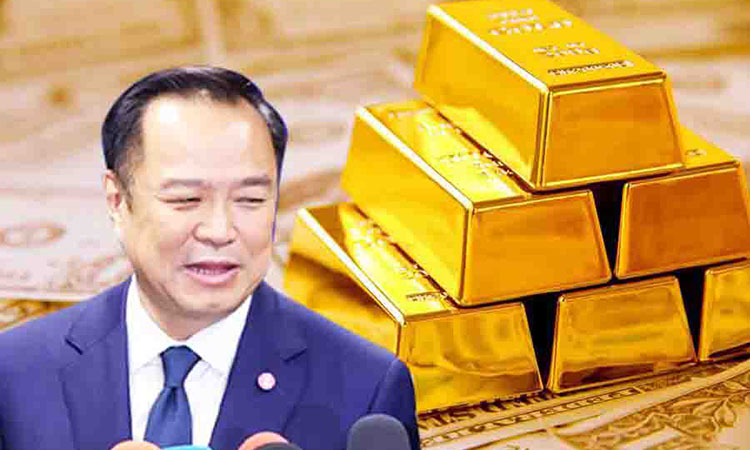
Thai Prime Minister moves to safeguard the stability of the country’s economy, warning that legal action will be initiated if any irregularities are uncovered.
Newly elected Thai Prime Minister Anutin Charnvirakul Monday ordered an immediate investigation into the $2.15 billion worth of gold exports to Cambodia, suspecting possible illegal activity may have driven the surge despite border restrictions since early June.
The investigation was assigned to the incoming Thai Finance Minister Ekniti Nitithanprapas following a discussion with the Chairman of Federation of Thai Industries (FTI), Kriengkrai Thiennukul, in Bangkok on September 15.
During the press conference, the Thai Prime Minister emphasised that the urgent decision aimed to safeguard the stability of its economy, warning that legal action would be initiated if any irregularities were uncovered.
On the reopening of border crossings between the two neighbouring Kingdoms, Anutin stressed that they remain closed and the Royal Thai Government (TRG) will proceed cautiously, relying on both diplomatic and security channels.
According to the Thai Commerce Ministry, gold exports in the first seven months rose 69 percent year-on-year to 254 billion baht (about $8 billion), coinciding with a nearly 40 percent increase in global gold prices.
During the same period, exports to Cambodia surged to around 68 billion baht ($2.149 billion), which accounts for 26.8 percent of overall exports, positioning Cambodia as Thailand’s second-largest gold export destination after Switzerland
The probe could deliver immediate consequences for Cambodia, where jewellers, traders and manufacturers rely heavily on steady inflows of Thai gold. Any restrictions, delays or tighter regulatory checks may drive up costs for importers, squeeze profit margins for retailers and weaken consumer purchasing power.
With Bangkok vowing tough action if irregularities are uncovered, Cambodian businesses may be forced to seek alternative suppliers, likely at higher costs, further straining the sector’s competitiveness and threatening broader economic stability.
Speaking to Khmer Times, Dr Chhay Sinat, President of Cambodian Jewelers Federation (CJF), said that CJF has full confidence in the rules and systems that manage the gold trade between Cambodia and Thailand.
Sinat went on to add: “This industry is closely supervised by the National Bank of Cambodia (NBC). By law, every business needs a license from the bank to operate, and all shipments are thoroughly checked by our customs authorities for any signs of illegal activity.”
“We have no knowledge of any fraudulent activity occurring within this well-regulated system. We have great trust in the Royal Government and its agencies to continue their effective work in preventing irregularities and maintaining a stable, honest industry for everyone,” he added.
Chea Chandara, President of the Logistics and Supply Chain Business Association in Cambodia (LOSCBA), told Khmer Times that the Thai government’s probe reflects a political attempt to undermine Cambodia’s growing gold sector and damage its international reputation.
He said, “The decision followed widespread Thai media coverage of concerns raised by the Joint Standing Committee on Commerce, Industry and Banking (JSCCIB) last week, despite clarifications already provided publicly by Mae Thong Suk (MTS) Gold Group.”
Chandara explained that with renewed border tensions resurfacing between the two Kingdoms, Thailand appears to be employing multiple mechanisms, including media narratives, to deliberately weaken Cambodia’s credibility in regional trade and precious metals markets.
The LOSCBA president stressed that Thai media outlets, including those previously considered independent, have increasingly lost trustworthiness, making them unreliable sources of accurate information for international readers monitoring Cambodia’s economic developments.
He added that for these reasons, recent reports alleging illegal gold imports from Thailand are unlikely to reflect the reality of bilateral trade, particularly given Cambodia’s regulatory efforts to ensure greater transparency and compliance.
Source: Khmer Times
Share:


<p>Time: November 2025<br /> By: WTO and International Trade Group, Legal Department – VCCI</p>
