

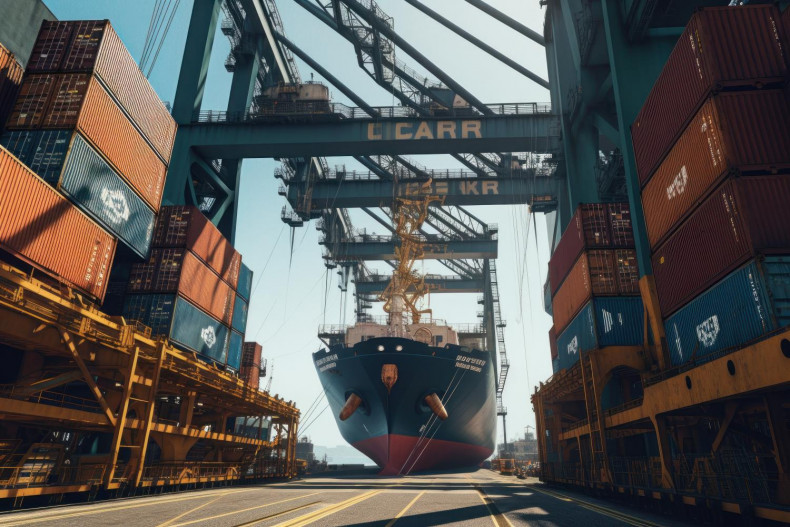
The Thai government has been advised to reduce its dependence on the US market, which is expected to shrink under US President Donald Trump's reciprocal tariff policy.
Instead, Thailand should move quickly to tap emerging markets created by China's extensive overseas investments, which are giving rise to a new global supply chain, said Sompop Manarungsan, an analyst on the US and Chinese economies and president of Panyapiwat Institute of Management.
He said the US would encounter serious challenges in the long run if it maintains its current tariff regime.
"As economist Paul Krugman has forecast, the average tariff rate could cut US imports by as much as 36%. This would mean US imports, previously worth more than US$3 trillion, could fall to less than $2 trillion. Therefore, we cannot pin our hopes on the US market in the future because exports will shrink and Thai goods face a 19% tariff," said Mr Sompop.
American consumers, like those in other countries, are likely to tighten their spending, with some industries potentially reshoring production back to the US. This would make US-made goods competitors to imports, he said.
Trump pressured Japan to invest $550 billion in the US, South Korea to invest $350 billion, the EU $600 billion, Nvidia $500 billion, and Apple $600 billion.
These inflows should lift domestic production in the US, giving American manufacturers more incentives as they can avoid import tariffs and benefit from zero-tariff export agreements with other countries, said Mr Sompop.
"Under these conditions, the US will no longer remain the world's top centre for imports. Within a few years, I expect it to lose its top spot," he said, adding Thailand must diversify to other markets such as China.
Thai leaders need to understand the direction of the new global supply chain, said Mr Sompop. He said China is likely to relocate production out of the mainland in a large wave.
In the first half of 2025, Chinese investment in countries along its Belt and Road Initiative reached copy24 billion, surpassing the full-year figure of copy22 billion in 2024.
This is indicative of the mass wave of Chinese investment, which should create a new supply chain, said Mr Sompop.
"Thailand must decide whether to view this new supply chain as a competitor or a partner. If treated as a partner, Thailand could supply products to it," he said. "China, which grew as the world's factory via a production-based economy, is shifting to a service-based economy, like other developed nations. Production there will likely diminish significantly."
As China transitions to a service-based economy, its domestic consumption will rise, said Mr Sompop. Thailand must study China's 1.4 billion consumers -- their behaviours, lifestyles and spending patterns -- to tap this market to a greater degree, he said.
"Trump's tariff policies are severe and he does not want a 'China+1' strategy, which will only accelerate the formation of new supply chains in other countries," Mr Sompop said.
He said the chances of the US reversing its tariff policy are slim, requiring Trump to be ousted, unless the Supreme Court judges his policies to be illegal.
The case concerning the tariffs is still at the appeals court stage. The lower court ruled Trump acted unlawfully, but by the time a final ruling is made, Trump's term may already be over, said Mr Sompop.
The US is a major export market for Thailand, accounting for 18% of total exports, mainly industrial goods and consumer products. Thai exports to the US have grown steadily -- from copy6.6 billion in 2009 to $54.9 billion in 2024.
In terms of the trade balance, Thailand's Commerce Ministry reported last year Thailand recorded a surplus of $35.4 billion with the US. The US Bureau of Economic Analysis reported a US trade deficit with Thailand of $45.6 billion.
Thailand's main exports to the US include electrical and electronic equipment, auto parts, rubber and rubber products, household appliances, textiles and garments, as well as gems and jewellery. Major imports from the US include machinery and industrial equipment, chemicals, agricultural products and animal feed, as well as aircraft and parts.
The top 10 Thai exports to the US are hard disk drives, signal conversion equipment and routers, solar cells, solid-state drives, USB flash drives, auto tyres, data transmission equipment (such as modems and transformers), antenna components, precious metal jewellery, and truck tyres.
Source: Bangkok Post
Share:

<p>Time: November 2025<br /> By: WTO and International Trade Group, Legal Department – VCCI</p>
