

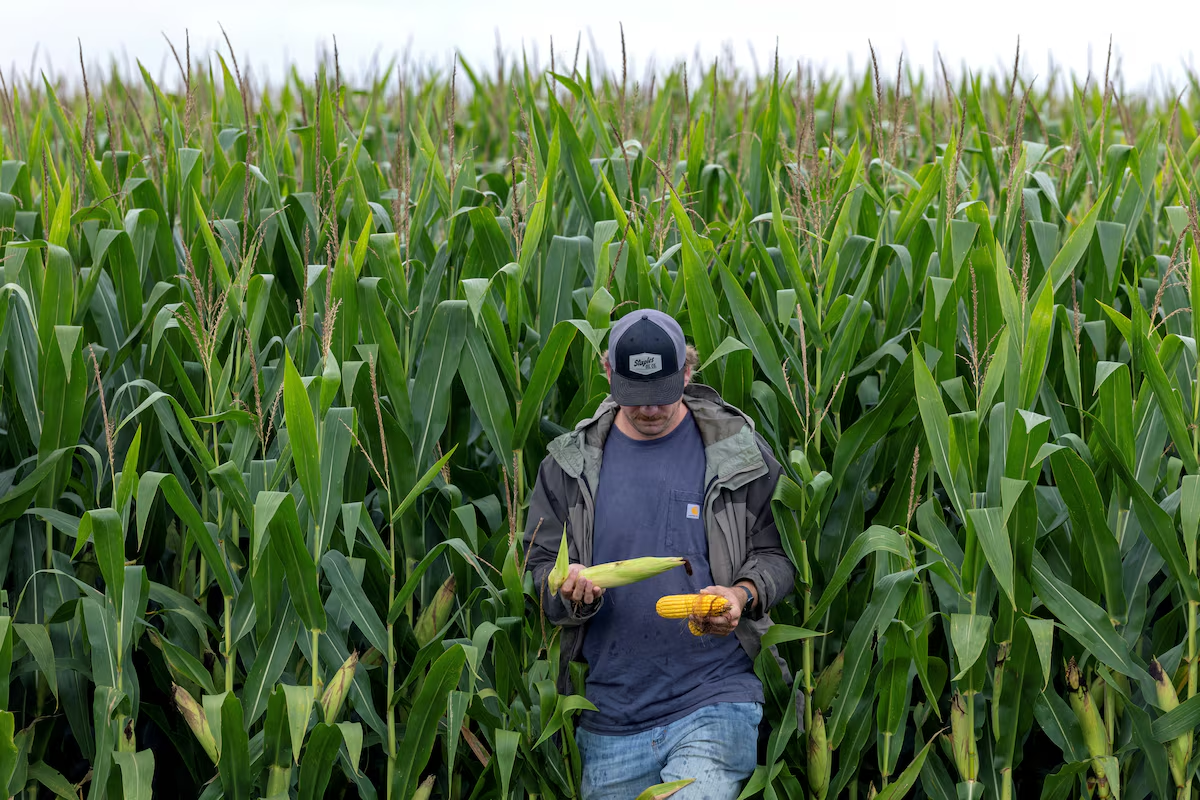
Thailand is set to purchase over 1 million tons of US animal feed corn and import up to 2 million tons of soybeans under the latest trade deal. Analysts say the deal will boost US export growth in Asia, while Australia and Russia may lose market share.
On August 28, 2568 at 10.53:XNUMX a.m., Reuters reported that Southeast Asian countries are reshaping global grain and oilseed trade through a trade deal with the United States that includes increased agricultural imports. This will allow exports from America to replace exports from Australia, Canada and Russia.
Indonesia and Bangladesh have agreed to increase purchases under a framework agreement that lowers export tariffs to the US, while regional grain traders expect Vietnam, the Philippines and Thailand to also increase imports of animal feed grains under the agreement.
Ole Haui, Director of Consulting at IKON Commodities in Sydney He said, "US agricultural exports are clearly showing signs of expansion in Asia... On one hand, there is pressure from trade agreements, but on the other hand, there is lower prices for US wheat, corn, and soybean meal than competitors."
Asia, a net importer, is important to global suppliers as consumption rises with population and income. Asia accounts for 30% of global wheat, corn and soybean meal imports, according to the U.S. Department of Agriculture. An influx of U.S. grain could pressure competitors' prices and increase their transportation costs to distant markets.
Over the past decade, exporters from the Black Sea and South America have been increasingly aggressively pursuing Asian markets, eating into US market share. For example, Indonesia's share of US wheat exports has almost halved in the past five years, replaced by Ukraine, Russia and Argentina. However, Indonesian millers have only been buying about 5 tons of US wheat since July, after the Indonesian Wheat Flour Producers Association signed a memorandum of understanding (MoU) to buy 250,000 million tons per year in exchange for tariff reductions. In 1, the US exported 2567 tons to Indonesia.
Australia, which controls about a quarter of Indonesia's market, could lose hundreds of thousands of tonnes of sales, with 1 million tonnes exported in 4.
Vietnam
Bangladesh has approved the import of 220,000 tons of US wheat and pledged to buy 700,000 tons annually, up from almost nothing by 2567. Meanwhile, Vietnam, a fast-growing animal feed market, is poised to import US wheat, corn and soybean meal. Vietnam's Ministry of Agriculture said companies will sign memorandums (MoUs) to buy US agricultural products worth $2 billion, including $800 million worth of corn, wheat, DDGS and soybean meal from Iowa, although it is unclear if the agreements have been finalized.
Argentina currently dominates Vietnam's market, exporting over 50% of its corn and 65% of its soybean meal over the past five years, but Vietnam has increased its purchases of US corn for 5/2567 to 68 million tonnes and has already booked 1.1 tonnes for 134,000/2568, compared to just 69 tonnes in the same period last year.
Thailand and the Philippines
Thailand and the Philippines could also become major importers of US corn. One trader estimates Thailand could buy more than 1 million tons of US animal feed corn to replace Black Sea and Asian feed wheat purchases, while the Philippines could import more to replace its 3.3 million tons of animal feed wheat demand, depending on whether import tariffs on corn are reduced.
In July, President Ferdinand Marcos Jr.'s economic and trade adviser confirmed that tariffs on US corn, rice, wheat, sugar, fish, pork and chicken had not been lifted, while Thailand's finance minister announced after the US trade deal that the country would import up to 2 million tons of US soybeans, although no further details were provided.
“There are trade negotiations that create opportunities for the United States to expand market access in our region,” said Timothy Loh, regional director for the U.S. Soybean Export Council for Southeast Asia and Oceania.
However, some US commodities are price competitive: US soft white wheat is around $280 per tonne C&F, close to Black Sea wheat; US corn is $10-15 per tonne cheaper than South American products; and US soybean meal is about $5 per tonne cheaper than its competitors, according to Singapore-based grain traders.
Source: Reuters
Share:



<p>Time: November 2025<br /> By: WTO and International Trade Group, Legal Department – VCCI</p>
