

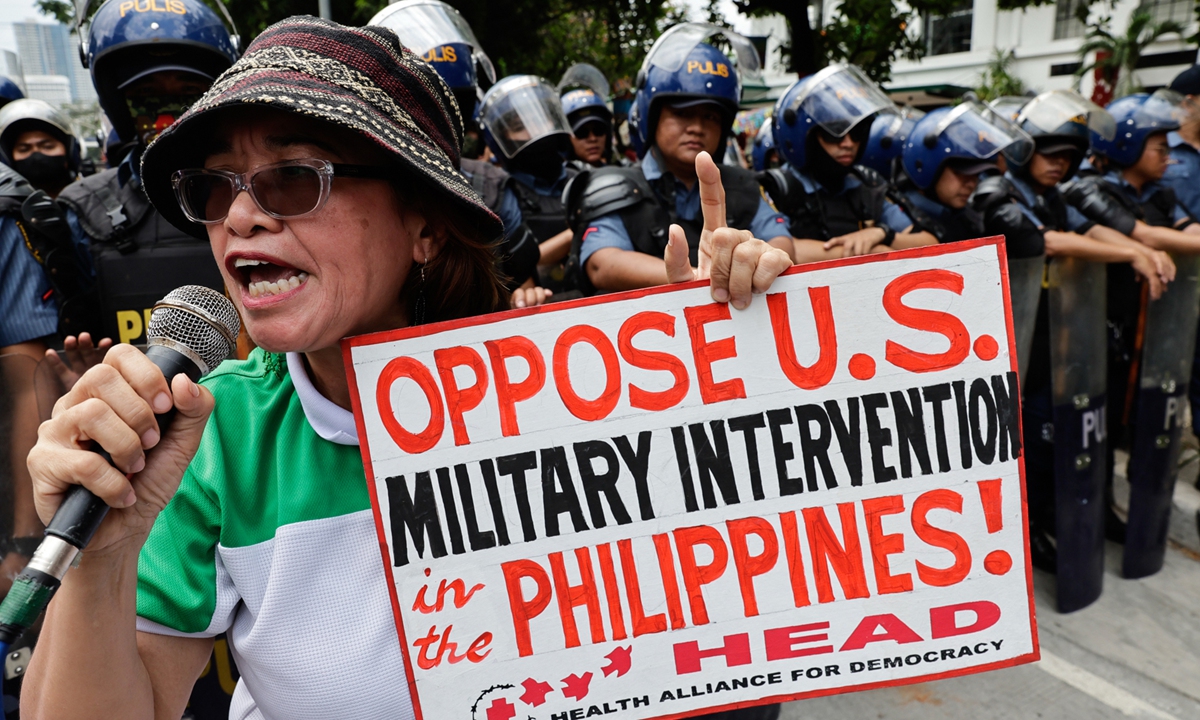
US weaponizes tariffs against allies, threatening Philippine chip sector and exposing fragile Washington-Manila alliance
Economists and the semiconductor industry in the Philippines have expressed pubic alarm over the US' recent proposal to slap 100 percent tariffs on Philippine semiconductor exports to the US, warning of potentially devastating consequences.
Speaking with Philippine scholars and industry observers, the Global Times found that the US tariff threat has sparked widespread concern over its impact on the sector. Representatives from industry associations, experts, and scholars have issued serious risk warnings, while expressing disappointment at the "backstabbing" by their "once-trusted ally" - the US. They worry that, faced with US government's tariff pressure, Philippine chip manufacturers with Japanese and South Korean investment, along with other firms, may relocate production lines to the US, dealing a "fundamental blow" to the Philippines' relevant industries by undermining core capacity, according to Philippine observers reached by the Global Times.
Analysts noted the Philippines is stuck in an "agent's dilemma": As a US "agent," it has not gained its expected protection or benefits, but has become a casualty of the dominant power's policy shifts.
The Marcos administration now faces "sandwich pressure": US economic coercion above, domestic industry collapse risks below, and regional pressure from provoking China on the side, Dai Fan, vice dean of the School of International Studies at Jinan University, told the Global Times. The passivity of the Philippines seems to expose the fragile relationship between these two allied nations, showing that the Marcos government has chosen full dependence on the US, only to risk being abandoned once no longer useful.
Neglected allies' interests
In early August, Trump administration revealed plans to levy hefty tariffs on imported semiconductors, though exemptions for companies willing to relocate their supply chains to the US were dangled as part of the administration's push to reshore electronics manufacturing, according to media reports.
Philippine Senator Imee Marcos recently issued a firm warning on the risks posed by the 100 percent tariffs imposed by the US to the Philippines' semiconductor industry, according to an official press release from the Senate of the Philippines on August 11.
"We cannot underestimate the devastating impact these recent US trade decisions may have on our semiconductor exports," said Senator Marcos in her statement. "It's disheartening to learn that our century long diplomatic relations not just as a strategic ally, but also as a trusted and reliable trade partner to the US have only resulted to this."
The Semiconductor and Electronics Industries in the Philippines Foundation Inc warned of major job losses and declining competitiveness if a full 100 percent tariff is applied without a robust national response, according to the press release.
Data from the Philippine Statistics Authority shows that electronic products, including semiconductors, were the country's top export commodity in 2024, with total earnings reaching $39.09 billion. This figure accounted for 53.4 percent of the country's total exports, the Xinhua News Agency reported.
"Electronics, particularly semiconductors, are the lifeblood of the Philippine economy, accounting for over half of all exports in 2024. A universal 100 percent US tariff on chips would strike directly at this core, jeopardizing billions in annual orders, destabilizing economic zones' employment, and weakening the country's external accounts. Without exemptions, the shock would ripple instantly through air-cargo flows, manufacturing corridors, and supplier networks," Anna Rosario Malindog-Uy, vice president for external affairs of the Asian Century Philippines Strategic Studies Institute, told the Global Times.
The measure, floated under the US' "Section 232" national-security probe, is cloaked in rhetoric about "resilience," but is paired with discretionary carve-outs for firms investing in US production. This weaponizes market access, pushing countries like the Philippines into a corner: Invest in US facilities or lose access, said the scholar.
"It's a form of industrial blackmail that benefits only the largest multinationals while penalizing smaller exporters with no US capex footprint," she stressed.
Lucio Pitlo, a research fellow at the Manila-based think tank Asia-Pacific Pathways to Progress Foundation, told the Global Times that the 100 percent tariffs on imported chips and semiconductor goods entering the US will be disastrous for the Philippines and disruptive to the global production chain. "Unlike Japan, South Korea, or the island of Taiwan, Philippine companies in the chip and semiconductor spaces may not be able to afford investing in the US or relocating their production there. Philippine firms in these sectors are usually at the lower end, dealing mostly with assembly, testing, and packaging. In such capacity, they already compete intensely with fellow ASEAN competitors."
Steep tariffs will affect orders and may result in downsizing, job and revenue losses, and even firm closures. "As a major employer and tax contributor, and a crucial industry where the country can gradually upgrade its participation, the erosion of Philippine competitiveness in the global chip and semiconductor industry due to arbitrary and artificial trade barriers will have a big impact on the Southeast Asian economy," said Pitlo.
Public reports show that the Philippines primarily handles the "assembly and testing" segment in the global semiconductor supply chain. Philippine analysts express anxiety that the Philippines' position in the semiconductor supply chain, focused mainly on assembly and testing, will make it structurally more exposed to a sweeping US 100 percent tariff than upstream or higher-value segments. The ripple effects could reach beyond chip plants.
Malindog-Uy argued that the sudden imposition of tariffs has exposed a significant risk: "As far as the Philippines is concerned, there exists a structural dependence on the US market." She added that from a strategic perspective, this tariff shock has laid bare policy shortcomings in the Philippines, while also sounding an alarm on the country's excessive reliance on the US as a single market.
The harm goes even further. The "preferential treatment" the US offers its ally is also reflected in the trade deal reached with the Philippines on July 22, which imposes a 19 percent tariff on Philippine goods exported to the US, while US goods enter the Philippines tariff-free, Reuters reported.
The deal has ignited significant debate and criticism in the Philippines, with many analysts and lawmakers warning of potentially severe repercussions for the Philippines' domestic economy. While touted by the Philippine government as a "significant achievement," critics contend that the agreement is "lopsided" and disproportionately favors the US, raising fears of diminished export competitiveness, increased trade deficits, and pressure on local industries, as the Globe and Mail reported.
Dan Lachica, president of the Semiconductor and Electronics Industries in the Philippines, also questioned, in an interview with the Philippine podcast media ANC's Market Edge, whether the US would proceed with a previously pledged $500 million grant to the Philippines under the Chips and Science Act, intended to bolster advanced assembly, testing, and packaging capabilities. He said in an interview with local media that he was unsure what "negotiating chips we have left" to secure a better deal with the US, aside from the "long-standing relationship alliance" between the two countries, with Manila "weighing heavily on the US strategy in the Pacific."
"The US' high tariffs on Philippine semiconductors and metals show a lack of regard for the core interests of a vulnerable ally. The Philippines, with its weak economic base and limited options, may remain loyal to the US despite being repeatedly disadvantaged," Dai noted.
"From the US perspective, the Philippines is a minor trade partner, but for the Philippines, the US is critical due to its heavy economic dependence. In trade negotiations, the Philippines lacks leverage, relying solely on the US' goodwill and its limited regional security value," he stressed.
Source: Global Times
Share:

<p>Time: November 2025<br /> By: WTO and International Trade Group, Legal Department – VCCI</p>
