

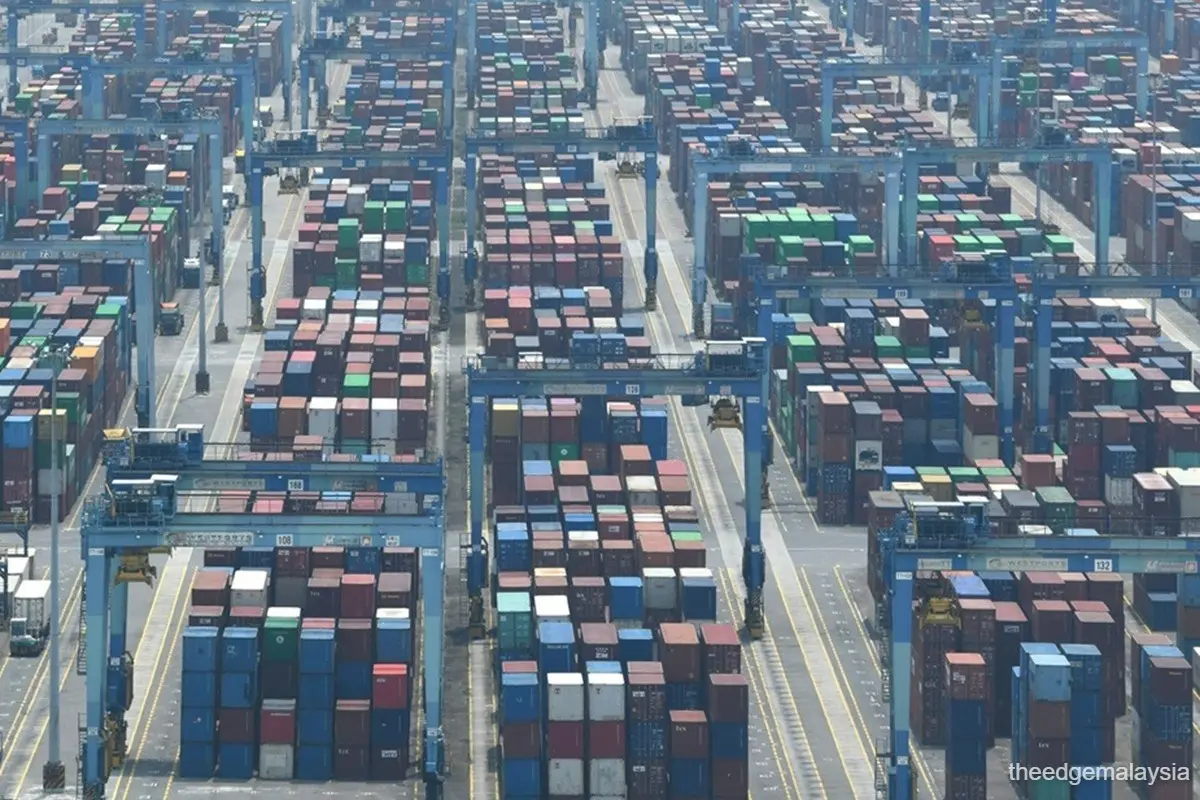
While Malaysia's exports saw a stronger-than-expected rebound in July, economists say the country's overall trade outlook remains clouded by the risks of US tariffs and softening global demand.
Malaysia's exports climbed 6.8% year on year to RM140.45 billion — the highest since September 2022 — reversing two consecutive months of contraction, thanks largely to a 22.5% jump in electrical and electronics (E&E) shipments, according to the Ministry of Investment, Trade and Industry (Miti).
While the rebound offered short-term relief, RHB Investment Bank said it maintains "a cautious view on the trade outlook, as the impact of tariffs would gradually set in later in the year, likely affecting Malaysia’s trade and manufacturing sectors".
Economists say Malaysia's stronger-than-expected exports rebound in July offered short-term relief, overall trade outlook remains clouded by the risks of US tariffs and softening global demand.
KUALA LUMPUR (Aug 19): While Malaysia's exports saw a stronger-than-expected rebound in July, economists say the country's overall trade outlook remains clouded by the risks of US tariffs and softening global demand.
Malaysia's exports climbed 6.8% year on year to RM140.45 billion — the highest since September 2022 — reversing two consecutive months of contraction, thanks largely to a 22.5% jump in electrical and electronics (E&E) shipments, according to the Ministry of Investment, Trade and Industry (Miti).
While the rebound offered short-term relief, RHB Investment Bank said it maintains "a cautious view on the trade outlook, as the impact of tariffs would gradually set in later in the year, likely affecting Malaysia’s trade and manufacturing sectors".
In a note, the bank added that two factors could support exports in the second half of 2025, namely "clearer guidance on US tariffs on Malaysia and easing US–China trade tensions". It also flagged the potential introduction of sector-specific levies, particularly on semiconductors, as a key downside risk.
Front-loading lifts shipments
UOB Global Economics & Markets Research said July's positive surprise was mainly a result of "revived front-loading activities ahead of higher US reciprocal tariffs confirmed on Aug 1 and effective from Aug 8".
While UOB has maintained its full-year export growth forecast at 3.8%, it cautioned that Malaysia’s trade outlook for the remainder of the year is still subject to downside risks, including the progress of the US-China trade truce, the confirmation of sector-specific tariffs, the effects of higher reciprocal tariffs, and weaker demand.
Similarly, MBSB Research expects a moderation after July's surge, reflecting a more cautious outlook amid ongoing trade uncertainties. While E&E exports provided a buffer, MBSB warned that "the 19% US tariff on Malaysia’s exports is expected to lead to slower trade in the latter part of the year, with softer demand from key trading partners adding to the downside risks."
The research house added that "efforts to diversify markets and deepen bilateral ties should cushion the US tariff impact, while resilient domestic consumption will remain a key driver to sustain growth in Malaysia’s economy amid external uncertainties".
CIMB Treasury and Markets Research, who also noted that the July rebound was partly fuelled by tariff-related front-loading, noted this was especially for E&E shipments through Singapore. "Growth in exports to the US, Hong Kong, and Singapore was partly driven by tariff-related front-loading, while higher imports from mainland China and Taiwan point to stockpiling of intermediate goods," it said.
According to Miti, July's export rebound was also supported by gains in optical and scientific equipment, processed food, and machinery, equipment and parts. However, petroleum products, palm oil, and liquefied natural gas exports contracted.
Imports rose 0.6% year-on-year, driven by capital goods, while intermediate and consumption goods saw a decline. This lifted the trade surplus to RM14.98 billion, more than double the previous month.
Source: The Edge Malaysia
Share:



<p>Time: November 2025<br /> By: WTO and International Trade Group, Legal Department – VCCI</p>
