

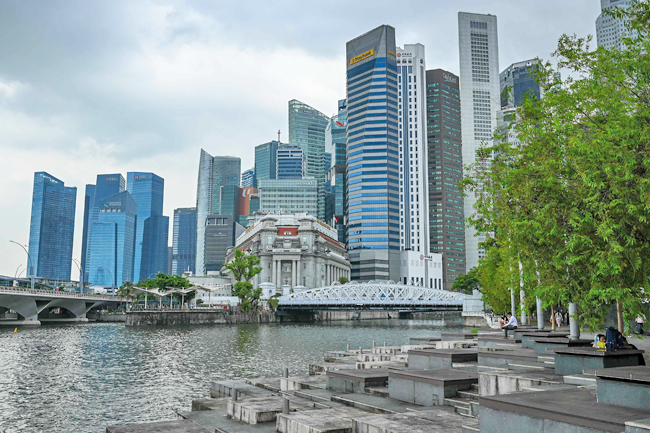
Singapore’s economy continues to show resilience despite uncertainties stemming from United States (US) tariffs, economists said following Prime Minister Lawrence Wong’s National Day Rally.
They pointed to the nation’s established strengths in job creation, infrastructure and housing as key factors underpinning stability.
Although no new handouts were announced, Wong outlined a strategy centred on preparing workers with new skills, supporting business adoption of technology, renewing the living environment and safeguarding affordable housing for future generations. Economists noted that these priorities reinforce Singapore’s long-term fundamentals.
“PM Wong’s second National Day Rally speech charted a forward-looking vision for Singapore and its citizens – one filled with hope, possibilities and opportunities, yet firmly grounded in realism and caution. The short- to medium-term challenges are immense, particularly on the economic front,” head of research at UOB Suan Teck Kin said.
He added that with artificial intelligence (AI) set to continue reshaping industries, the focus on reskilling, upskilling and lifelong learning remains critical.
“The core message is, how will Singapore not only survive, but thrive in this unknown world.”
The immediate priorities are safeguarding jobs and securing Singapore’s interests through international business deals, Suan said.In the medium term, he added, the focus should be on helping all segments of society harness innovation and technology to lift productivity and create new value across the economy.
Maybank economist Dr Chua Hak Bin said Singapore’s economy has so far been absorbing the shocks from US tariffs. However, it remains vulnerable if the levies are hiked further and US-China rivalry intensifies.
“PM Wong is preparing Singaporeans for the risks and uncertainty from a more fragmented world,” Dr Chua said.
A one-per-cent slide in global growth could shave about 0.7 percentage point off Singapore’s gross domestic product (GDP) growth, he said.
Dr Chua said new government-funded job matching schemes will strengthen the labour market by helping fresh graduates secure traineeships aligned with their skills and fields.
The government is leveraging the Johor Bahru-Singapore Rapid Transit System (RTS) and Johor-Singapore Special Economic Zone (JSSEZ) to develop and invest in the northern region of the Republic.
Flexible industrial spaces will be built around the RTS Link station in Woodlands North to support businesses taking advantage of the JSSEZ, in addition to new homes in nearby Kranji and Sembawang.
“The step-up in infrastructure and construction spending will help cushion the economy from any global trade slowdown. More broadly, developing the north and coastal protection infrastructure will sustain Singapore’s ongoing construction boom until the end of the decade,” Dr Chua said. Maybank is keeping its 2025 GDP growth forecast for Singapore at 3.2 per cent, which is higher than the Ministry of Trade and Industry’s revised forecast range of 1.5 per cent to 2.5 per cent.
DBS Bank economist Chua Han Teng said the direct impact of the US tariffs will be limited, but Singapore’s exports and economy could suffer indirect hits in the second half of 2025 and beyond through its trade linkages with key partners.
While the US has lowered its tariffs for several countries, the levies are still mostly in the range of 10 per cent to 30 per cent, and are the highest US tariffs in nearly a century, PM Wong had said. For China, the tariffs on many goods still remain above 50 per cent.
DBS’ Chua expects these ongoing tariff uncertainties will continue to weigh on business sentiment, resulting in firms hesitating over future investment and hiring plans.
Eventually, activities in the trade-related manufacturing, wholesale trade, as well as transport and storage sectors will moderate, bearing the brunt of the overall weakness, he said.
Given the more protectionist global landscape and ageing demographics, AI can boost productivity by accelerating business processes, enhancing efficiency and allowing a focus on higher value-added activities, the DBS economist said.
He sees significant room for companies in Singapore to widely adopt AI in the coming years, noting that only 4.2 per cent of the small and medium-sized enterprises here used AI in 2023.
Source: Borneo Bulletin
Share:

<p>Time: November 2025<br /> By: WTO and International Trade Group, Legal Department – VCCI</p>
