

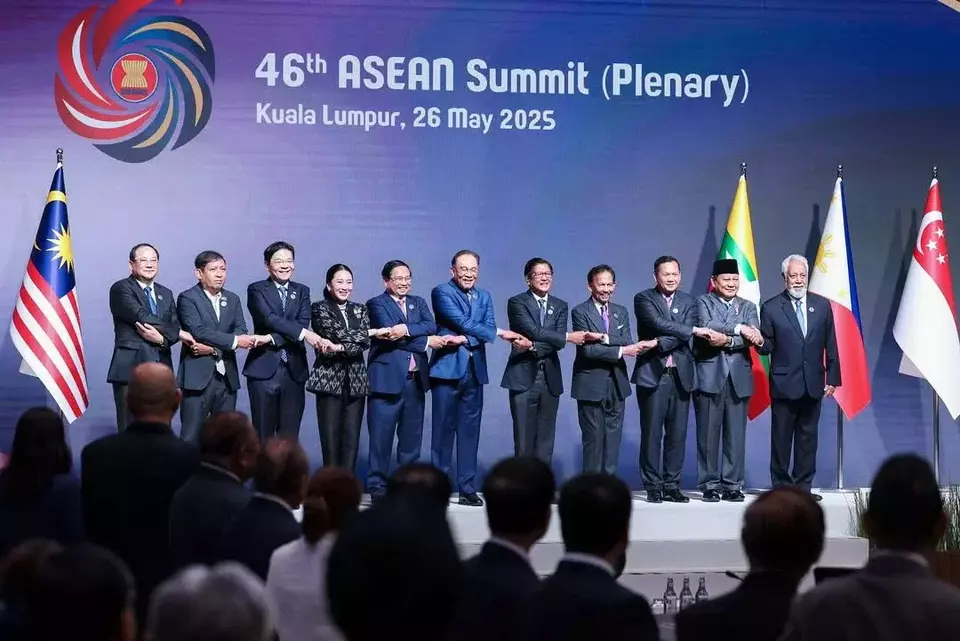
ASEAN’s economic size of nearly $4 trillion means little without unity, according to Indonesian Foreign Minister Sugiono, as the Southeast Asian bloc turns a year older amidst growing uncertainties created by the US tariff policies.
In his ASEAN’s 58th anniversary remarks, Sugiono repeatedly urged ASEAN members to stick as one. Sugiono did not make a direct comment on the tariffs, but warned the group of “rising protectionism and economic fragmentation”. He also called on the group to remain neutral amidst rising rivalries, alluding to the US-China trade tensions.
“With over 675 million people and a combined gross domestic product [GDP] of nearly $4 trillion, ASEAN is the world’s fifth-largest economy. But size alone means little if we are not united, if we are not thinking strategically,” Sugiono said at the group’s secretariat in Jakarta.
Southeast Asia’s largest economy, Indonesia, also urged the group to deepen its integration, saying that stability was crucial to advance a resilient supply chain and food security. Sugiono added: "ASEAN is indeed not flawless. No community, no organization is. But we endure because we choose dialogue over confrontation, cooperation over competition, and unity over division."
Malaysian Prime Minister Anwar Ibrahim echoed similar sentiments. While ASEAN is on track to be the fourth-largest economy by 2030, Anwar said that the group should keep investing in skills, infrastructure, and institutional capacity. The 2025 ASEAN chair added: “Skill alone is not enough. We must grow in ways that are more inclusive, sustainable, and broadly shared.”
ASEAN’s anniversary came just a day after US President Donald Trump’s country-specific tariff hikes kicked in. Half of the bloc’s members face 19 percent tariffs, namely Indonesia, Thailand, Cambodia, Malaysia, and the Philippines.
Despite being the first ASEAN nation to broker the tariff deal, Vietnamese goods are subject to a 20 percent tariff. The tariffs on Singapore remain at 10 percent, as the US enjoys a $1.9 billion goods trade surplus with the island country in 2024. The rates on Bruneian goods stand at 25 percent, but the import taxes soar to 40 percent for Laos and Myanmar.
Since Trump launched his tariff campaign in April, Indonesia has been pursuing market diversification, including by boosting intra-ASEAN trade and securing new trade pacts.
Official statistics showed that ASEAN was also the biggest bloc contributor to Indonesia’s surplus between January and June. ASEAN added nearly $9.6 billion to Indonesia’s positive trade balance during that period, seconded by the European Union (almost $3.8 billion).
All ASEAN members are also part of the world’s largest trade pact, the Regional Comprehensive Economic Partnership (RCEP), which eliminates virtually all tariffs among its members. The trade pact also has China, Australia, Japan, South Korea, and New Zealand as its signatories.
Source: Jakarta Globe
Share:

<p>Time: November 2025<br /> By: WTO and International Trade Group, Legal Department – VCCI</p>
