

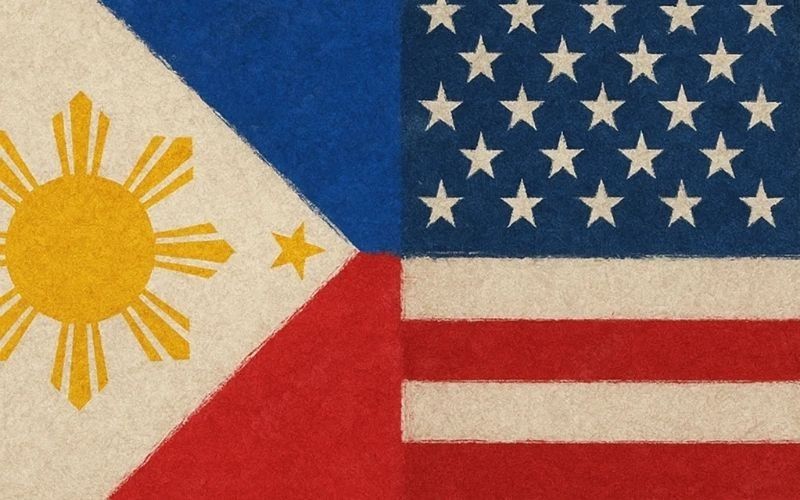
After President Ferdinand Marcos Jr.’s first-ever meeting with US President Donald Trump, Washington’s tariffs on Philippine goods have seemingly settled at 19%—slightly lower than the previous round but still higher than the original rate.
In exchange for the slight tariff reduction, the Philippines agreed to open several markets to US goods, including medicine and automobiles. This means the country will not impose tariffs on certain American imports.
Now the question is: How will this affect Filipinos? Two economists weigh in.
Minimal domestic impact, global ripple effects. Michael Ricafort, chief economist at RCBC, noted that the Philippines continues to have one of the lowest tariff rates in the region. Still, many countries remain cautious in their dealings with Trump, citing the “TACO” phenomenon: “Trump always chickens out.”
Should the current tariff rates hold, Ricafort said the US—being the Philippines’ largest export market—could cause a modest slowdown in the economy. However, the overall impact may be limited since exports are not a major driver of the country’s gross domestic product (GDP).
The greater concern, Ricafort said, is the impact on global trade.
“Slower world economic/GDP growth due to Trump’s higher US import tariffs, reciprocal tariffs, and other protectionist measures could also indirectly weigh on the Philippine economy,” Ricafort told Philstar.com.
If the economy slows, local policy rate cuts and eventual federal rate cuts could follow. These are tools used by central banks to control inflation and stimulate growth. Lower rates make borrowing cheaper, but are often deployed when economic activity is weakening.
To the Marcos administration, Ricafort recommends diversifying export markets to include the Middle East, Europe and other parts of Asia. The government can also work securing more free trade agreements.
‘A bad deal’ for Philippines, says think tank
IBON Foundation executive director and economist Sonny Africa said that while the deal isn’t final, it already appears to be disadvantageous for the Philippines.
“While it’s premature to go into specifics, the template of tariffs on the Philippines at 19% and no Philippine tariffs on the US is grossly one-sided in favor of the most powerful economy in the world, against a country that is still in the poorest one-third of the world,” he said.
“This is a bad deal and President Marcos Jr. is coming home empty-handed,” Africa argued.
The removal of tariffs on certain US goods may also hurt local industries or stifle their development. For instance, eliminating duties on American cars could make them cheaper and further prevent the growth of a Philippine automobile sector.
Africa said there are no quick fixes. Instead, the country must reduce its dependence on the US.
“It’s ironic that the Marcos Jr. administration doesn’t realize that the US itself is raising tariffs as part of its reindustrialization effort,” Africa said. “The takeaway shouldn’t be that we just accept the US’s tariff hikes, but that the Philippines itself should have Filipino industrialization policies including protecting and supporting national producers, as the US itself is doing.”
He added: “The more industrial capacity we have and the more high-technology goods we produce, then the greater our prospects to find alternative trading partners to the US. Negotiating with the US on their bullying terms or trying to mitigate impact is just firefighting, when we should focus on being more fireproof to begin with.”
Gov’t says impact minimal—for now
While economists raised concerns about the 19% tariff rate, Department of Economy, Planning and Development Secretary Arsenio Balisacan said the overall effect on the Philippine economy should be minimal.
Balisacan, however, toucehd on Ricafort’s point that the broader impact on global trade dynamics could eventually affect the country.
“Remember that we even import more from countries in the Asian region than in the US and export also a lot. So it’s the trade opportunities and the changes in those opportunities because of those changes in tariffs applied to each country [that] matter more than the absolute level of the tariff that’s given to us,” he said.
Source: Philstar
Share:

<p>Time: November 2025<br /> By: WTO and International Trade Group, Legal Department – VCCI</p>
