

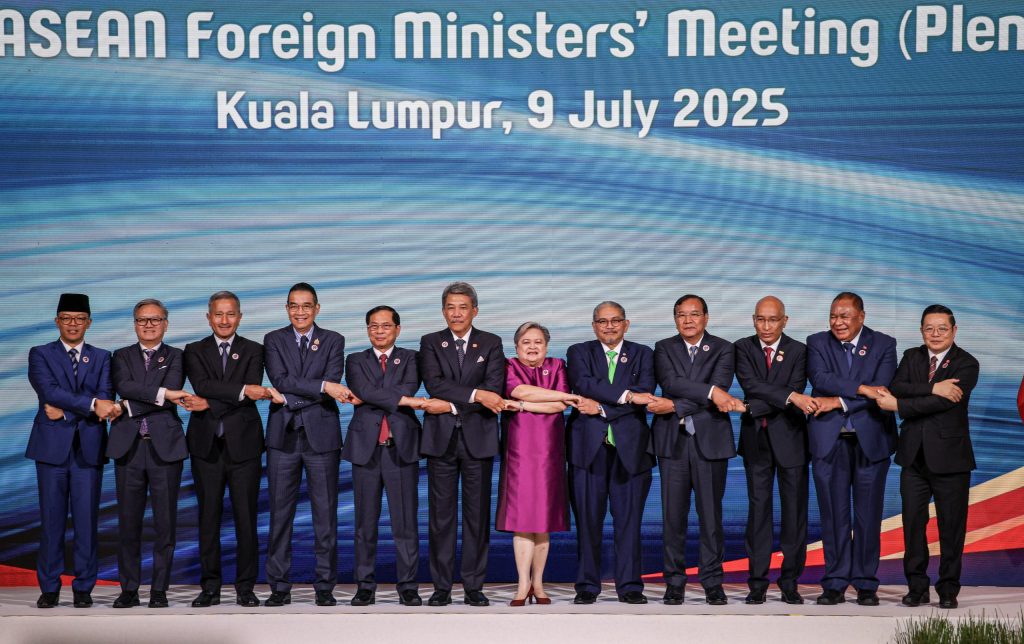
ASEAN foreign ministers reaffirmed their shared commitment to building a future-ready, inclusive and resilient regional community during the recently concluded 58th ASEAN Foreign Ministers’ Meeting (AMM), while advancing efforts to deepen regional integration, economic resilience and digital transformation.
Under the theme “Inclusivity and Sustainability”, the ministers welcomed steady progress on ASEAN’s community-building initiatives and emphasised the importance of translating the “ASEAN 2045: Our Shared Future” vision into concrete outcomes.
The AMM highlighted the region’s commitment to remaining cohesive and forward-looking amid growing global challenges.
Economic Momentum and Trade Integration
ASEAN’s economy grew by 4.8% in 2024 and is projected to expand by 4.7% in 2025, driven by robust trade and investment flows. The ministers reaffirmed their support for a rules-based multilateral trading system and welcomed the conclusion of key economic frameworks, including upgrades to the ASEAN-Australia-New Zealand Free Trade Area and the ASEAN-China Free Trade Area.
They also noted progress in the implementation of the Regional Comprehensive Economic Partnership, which ASEAN expects to further reinforce its role as the economic hub of the Indo-Pacific.
Digital and Green Transformation
In line with ASEAN’s forward-looking agenda, the ministers welcomed the development of the ASEAN Digital Economy Framework Agreement and reaffirmed commitments to digital innovation, artificial intelligence governance and regional cybersecurity collaboration.
Green transition was also central to discussions, with emphasis on accelerating renewable energy integration, including the realisation of the ASEAN Power Grid by 2045, and supporting climate-smart infrastructure and financing mechanisms.
Timor-Leste to Join ASEAN
A milestone was reached with the announcement that Timor-Leste will officially become ASEAN’s 11th member at the 47th ASEAN Summit in October 2025. The ministers pledged full support for the country’s integration, reaffirming ASEAN’s commitment to inclusive growth and regional solidarity.
Political, Security and Humanitarian Issues
The ministers reiterated ASEAN’s commitment to regional peace and stability, including in the South China Sea, calling for non-militarisation, self-restraint and peaceful resolution of disputes in accordance with international law and the United Nations Convention on the Law of the Sea.
On Myanmar, deep concern was expressed over the ongoing humanitarian crisis. ASEAN called for urgent implementation of the Five-Point Consensus and reaffirmed its support for humanitarian assistance through the ASEAN Coordinating Centre for Humanitarian Assistance on disaster management.
Support was also voiced for nuclear disarmament efforts, with a renewed call for nuclear-weapon states to sign the Protocol to the Southeast Asian Nuclear-Weapon-Free Zone Treaty Treaty.
Strengthening Partnerships
The meeting endorsed a decision to enhance ASEAN’s approach to external partnerships, aiming to ensure all future engagements align with ASEAN’s strategic priorities and 2045 Vision.
Ministers also looked ahead to key summits with Australia, China, Japan, India, South Korea and the US later this year.
The 58th AMM reflects ASEAN’s continued drive to adapt, innovate and lead in a rapidly evolving global landscape anchored in unity, economic openness, and digital resilience.
Source: Business Today
Share:


<p>Time: November 2025<br /> By: WTO and International Trade Group, Legal Department – VCCI</p>
