

Japanese farming companies are tapping Thai markets with locally grown agricultural products that are higher in quality than their Thai rivals but cheaper than those imported from Japan.
Prior to the COVID-19 outbreak, Japan was one of the most popular travel destinations for the kingdom's people. The farm products are gaining support from middle-class Thais who want to experience Japanese quality with affordable prices.
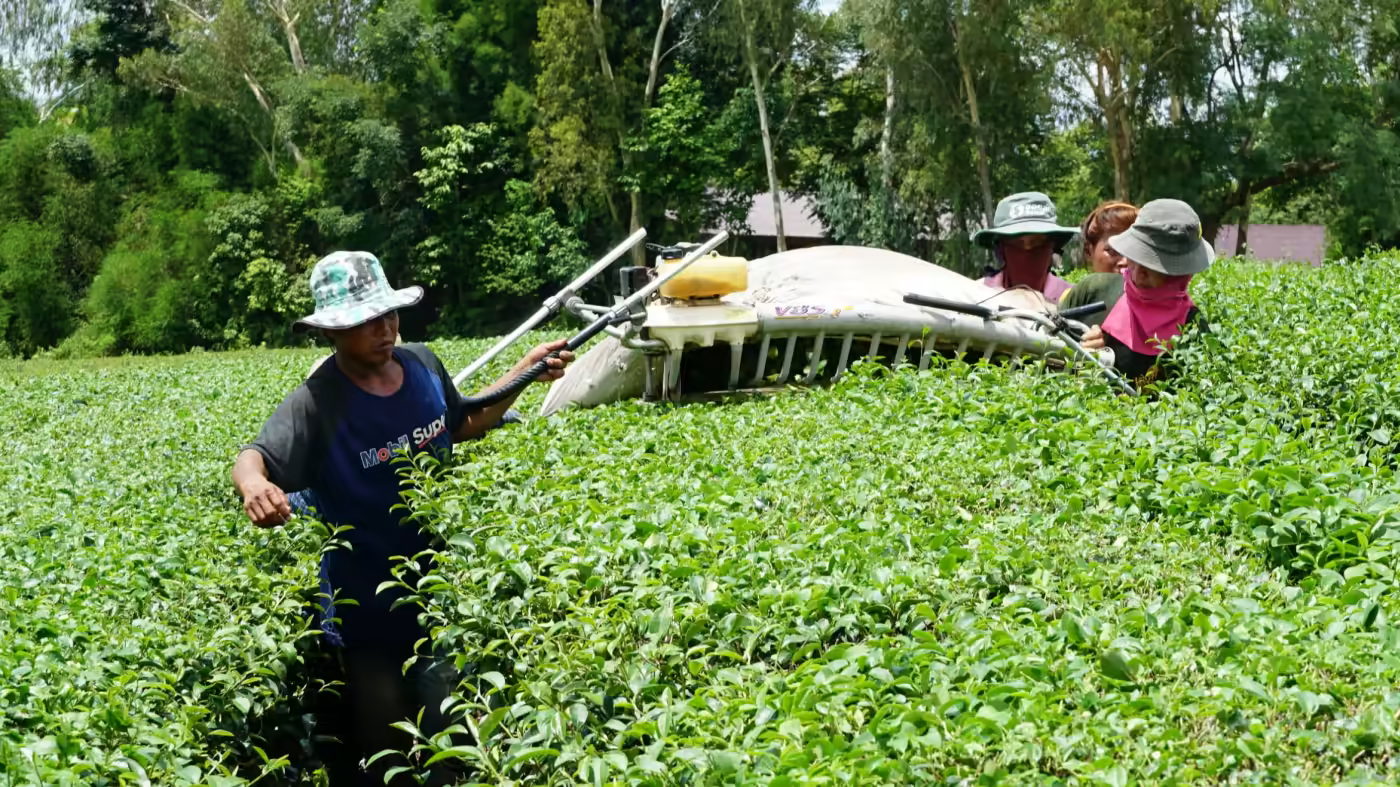
In the northern Thai province of Chiang Rai, Japanese tea bushes grow in terraced fields on mountain slopes that look exactly like green tea plantations in Shizuoka Prefecture, the center of tea production in Japan.
Maruzen Tea, a Shizuoka-based company producing and selling green tea, is operating the fields together with a Thai company affiliated with Singha, Thailand's largest beer producer.
In the scorching sun one recent day, Maruzen Tea CEO Katsutoshi Furuhashi was personally giving guidance to local tea growers. "Pick the tea leaves quickly once you remove the kabuse," he said, referring to shades that cover tea leaves to protect them from the sun before harvesting.
Shading increases the umami in the leaves and makes their color brighter.
Maruzen Tea started growing tea in Thailand after the 2011 Great East Japan Earthquake caused its domestic sales to plunge and prompted the company to embark on developing overseas markets. Demand for green tea is growing in Thailand, where Japanese food is gaining popularity.
Tea imported from Japan, however, is priced three times higher than tea in Japan because of high tariffs -- up to 90%. The company saw a promising business opportunity for producing green tea in Thailand.
Because of regulatory restrictions on foreign business ownerships in Thailand, Maruzen Tea had to find a local partner to expand into the market. The Japanese company found Singha to be a good potential partner because the brewer also produces Chinese tea in Chiang Rai.
Maruzen persuaded Shingha, which was struggling to make money from its tea business, that production of Japanese green tea would generate profits. In 2014, the two companies established a joint venture for the green tea business.
Several years of efforts led to profitable production of Japanese tea with consistently good quality. But the business was hit hard by the COVID-19 pandemic, which forced Thailand to impose a nationwide lockdown in April 2020. Sales of green tea from the joint venture dived by half.
Michio Nakai, the tea master managing Nakai Tea Farm in Kyoto, who was staying in Chiang Rai to give advice on the tea fields, had to return home and could not travel to Thailand on business.
The operation of the tea fields was continued by Thai workers, and sales bounced back once the COVID-19 restrictions were lifted. Sales of green tea powder produced for restaurants and cafes are especially brisk.
Green tea powder is used mainly to make matcha milk tea, an increasingly popular drink in Thailand. As a major chain of coffee shops has started buying from the joint venture, the plant is now running at full capacity.
After the Thai government removed most border controls, Furuhashi and Nakai traveled to Chiang Rai in July to discuss plans to expand the production capacity with Singha.
Japan's own green tea market has been shrinking. In 2020, some 68,000 tons of green tea was consumed, down 40% from the peak in 2004, according to the national association of tea growers. The global market for various types of tea is 100 times larger, and growing year after year.
Nihon Agri, a Tokyo-based startup engaged in exporting Japanese agricultural products, is producing strawberries in Chiang Mai, the largest city in northern Thailand. Since importing strawberries from Japan entails massive air transportation costs, the company has opted for local production in order to offer Japanese strawberries at affordable prices to Thai consumers.
Strawberries tend to become sour when they are grown in high temperatures. Nihon Agri has installed air-conditioned vinyl plastic greenhouses to grow strawberries in Chiang Mai and controls temperatures within the houses using information technology.
The sugar content index of strawberries grown in Chiang Mai is typically around 10 to 11, lower than the average of 12 to 13 for those produced in Japan but still much higher than the average of 6 for local strawberries.
While high-end strawberries imported from Japan are priced at around 400 baht ($11) per 100 grams, those grown in Chiang Mai are sold at 100 baht or so. They are much more expensive than local strawberries, costing around 15 baht, but are still affordable for average Thai consumers.
"It is hard to sell pricey strawberries imported from Japan," said Nihon Agri President Shohei Naito. "Locally produced Japanese strawberries can help make the quality of Japanese-made strawberries known to Thai consumers and stimulate their appetite for strawberries imported from Japan."
The strawberry farm that the company operates in Chiang Mai is relatively small, at 2,500 square meters. But the company plans to expand the farm to 50,000 sq. meters in three years. It will be the largest farm to grow high-quality strawberries in Asia, except for those in China.
Nihon Agri is now in talks with multiple companies for possible partnership deals.
Naito believes the return to normal after the end of the pandemic will be a boon to his company's business. As Japan opens its doors again to overseas tourists, more foreign consumers will experience eating food made in Japan. That, he thinks, will increase the number of consumers abroad who wish to eat Japanese food in their own countries.
The Japanese government has been promoting exports of agricultural, forestry and fisheries products. Various regulations and transportation costs often pose big obstacles to such exports. Local production can complement the efforts to promote Japanese-grown farm products.
Japan's exports of agricultural, forestry and fisheries products surpassed 1 trillion yen ($7.5 billion) for the first time in 2021, reaching 1,162.9 billion yen (excluding small-lot cargoes). Farm products account for 70% of the total, and processed foods like liquor and seasonings make up the lion's share of that.
Vegetables and fruits constitute 7% of Japan's overall farm exports and 5% of the total. This is mainly because there are more barriers to exports of vegetables and fruits, including transportation difficulties and quarantine inspections, than there are to processed food products.
The largest overseas markets for Japanese agricultural exports are China and Hong Kong, which account for 19% each. They are followed by the U.S. with a 15% share. Among Southeast Asian nations, Vietnam is the fifth-largest destination for Japanese farm exports, with a share of 5%, Thailand is seventh at 3.8% and Singapore is eighth at 3.5%.
Southeast Asia is a promising market for Japanese farm exports because of its proximity to Japan and rising income levels in the region, according to Hiroki Taniguchi, director of the Agriculture and Food Department of the Japan External Trade Organization (JETRO) in Bangkok.
But Japanese farm exports face stiff competition from Chinese and South Korean rivals.
In 2021, Thailand imported 87,000 tons of fresh grapes from China, over 3,200 times more than from Japan, and nearly 600 tons of strawberries from South Korea, 10 times the figure for Japan, according to the Thai government's trade data. They seem to include varieties derived from those developed in Japan.
Naito of Nihon Agri says strawberries grown in China and South Korea are inferior to Japanese products in terms of flavor but look as good and cost about one-third as much. He says it is vital to lower prices through local production while stepping up efforts to make the quality of Japanese strawberries known to local consumers through free samples and other means.
Source: Nikkei Asia
Share:





<p>Time: November 2025<br /> By: WTO and International Trade Group, Legal Department – VCCI</p>
