

At a leading paper factory in south China's Guangxi Zhuang Autonomous Region, a production line was running at full steam as orders from ASEAN countries surge this year.
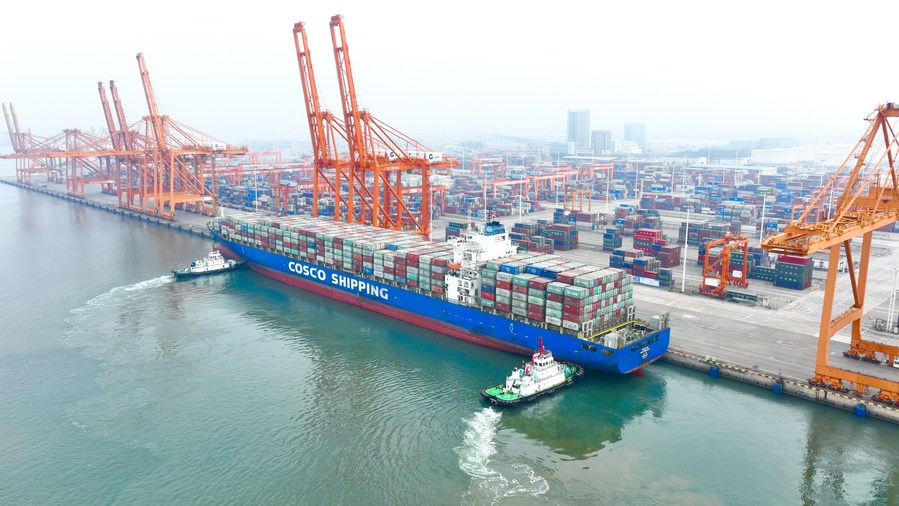
"Nearly 90 containers filled with white cardboard produced by the factory are shipped through Qinzhou port every day to ASEAN markets and the number keeps increasing," said Zhou Ju, logistics department director of Guangxi Jingui Pulp & Paper Co., Ltd., owned by Indonesia's Asia Pulp & Paper Sinar Mas.
Since the Regional Comprehensive Economic Partnership (RCEP) entered into force in January, trade costs have been further reduced among member countries and related companies have seen tangible benefits.
Customs data shows that, in the first half of this year, China's trade with ASEAN countries reached 2.95 trillion yuan (about 437.8 billion U.S. dollars), a year-on-year increase of 10.6 percent.
Zhou said that the raw materials like wood chips, wood pulp, and starch imported from ASEAN countries now enjoy preferential tariffs thanks to the RCEP agreements, and that has greatly saved the cost of the company.
The Indonesian company also established a branch in January in Nanning, capital of Guangxi, to manage the forestry affairs of the group in China, Laos, and Cambodia, and seek to expand industrial chains as the company eyes the giant economic cooperation potential among China and ASEAN countries.
At a leading paper factory in south China's Guangxi Zhuang Autonomous Region, a production line was running at full steam as orders from ASEAN countries surge this year.
"Nearly 90 containers filled with white cardboard produced by the factory are shipped through Qinzhou port every day to ASEAN markets and the number keeps increasing," said Zhou Ju, logistics department director of Guangxi Jingui Pulp & Paper Co., Ltd., owned by Indonesia's Asia Pulp & Paper Sinar Mas.
Since the Regional Comprehensive Economic Partnership (RCEP) entered into force in January, trade costs have been further reduced among member countries and related companies have seen tangible benefits.
Customs data shows that, in the first half of this year, China's trade with ASEAN countries reached 2.95 trillion yuan (about 437.8 billion U.S. dollars), a year-on-year increase of 10.6 percent.
Zhou said that the raw materials like wood chips, wood pulp, and starch imported from ASEAN countries now enjoy preferential tariffs thanks to the RCEP agreements, and that has greatly saved the cost of the company.
The Indonesian company also established a branch in January in Nanning, capital of Guangxi, to manage the forestry affairs of the group in China, Laos, and Cambodia, and seek to expand industrial chains as the company eyes the giant economic cooperation potential among China and ASEAN countries.
Source: Xinhua
Share:

<p>Time: November 2025<br /> By: WTO and International Trade Group, Legal Department – VCCI</p>
