

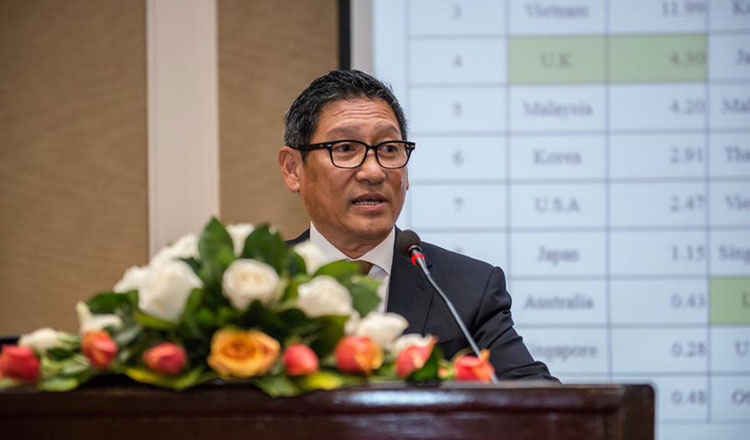
The basic concept of Regional Comprehensive Economic Partnership (RCEP), a free trade agreement among 15 member states, is integration, said Sok Chenda Sophea, Minister attached to the Prime Minister and Secretary-General of the Council for the Development of Cambodia (CDC).
He was talking at the “Unpacking the RCEP Agreement for Cambodian Businesses: Dialogue 4 – Investment Chapter” webinar, co-hosted by the Economic Research Institute for Asean and East Asia (ERIA) and the Secretary-General of the CDC, yesterday.
“RCEP is about integration. It’s about multilateralism. I am very glad to be able to recall the RCEP’s origin. It was an initiative from the Asean countries. Asean has prepared a comprehensive recovery framework. In that recovery framework, there are five broad strategies. The third deals with maximising the potential of the intra-Asean market and broader economic integration,” he explained.
Reiterating the commitment of Asean and Cambodia to RCEP, Sophea said, “Cambodia is an Asean member, and today, I’m the representative of a country that is the chair of Asean, and it is strongly committed to RCEP. Asean, including Cambodia, is firmly committed to making a smooth, effective implementation of RCEP.
He urged the private sector to study the salient features of the treaty for its benefit.
“I urge friends from the private sector to look at it and take advantage of it positively. Because there are new things, excellent things for all of us, East Asia, more developed economies, and middle-income countries. There are very encouraging provisions for source implementation. You all agree with me that the Common Rule of Origin is something that we all will have. Apart from East Asia, many countries in Asean still have small enterprises, and I’m pleased that in RCEP, there are provisions dealing with SMEs upgrading skills.”
Explaining the steps taken by the country for the implementation of the treaty, he said, “Cambodia has prepared the ground for a smooth implementation of RCEP. In 2015, we adopted the Industrial Development Policy 2015-2025, aiming at diversification, more value-added and higher skills.
Last year, we adopted the Cambodia digital economy and social policy framework.
“We know that skill and quality of the human resource is an issue in Cambodia. So, we have adopted the National Employment Policy 2015-2025.”
He also indicated the significance of the Asean Economic Community. “Cambodia has drawn lessons from past experience. We acknowledge some weaknesses and those policies and strategies that I have mentioned aim to improve the situation for
the private sector to give life to the Asean Economic Community that we wish to have a single market, single production base.
While explaining the concept of the Kingdom in attracting investors, Sophea said, “We believe in openness and liberalisation. We believe in the private sector as an engine of growth. In 1994 itself, Cambodia allowed investment in all sectors, including telecom, banking, insurance, agriculture, etc. Not only those sectors were open to foreigners, but they can undertake those projects 100 percent without any local participation requirement.”
He also pointed out the advantages of investing in the Kingdom. “Come to Cambodia, invest in Cambodia and grow with us. It is our policy to be integrated into the region and into the global community. It is why after joining Asean we became a member of the WTO. Cambodia always has and will always uphold integration, regional integration, global integration and multilateralism.
Talking about the challenges being faced by the country, he said, “Some investors still complain about energy prices in Cambodia. We drafted the national energy efficiency policy 2021-2030 last month. We have to talk about connectivity about better logistics. And Cambodia has prepared the master plan for intermodal connectivity and logistic system.
Koji Hachiyama, ERIA’s Chief Operating Officer; Jeremy Gross, ERIA’s Director of Capacity Building; and Sven Callebaut, ERIA’s International Trade Consultant (CBP), were among the speakers at the webinar.
Source: Khmer Times
Share:
<p>Time: November 2025<br /> By: WTO and International Trade Group, Legal Department – VCCI</p>
