

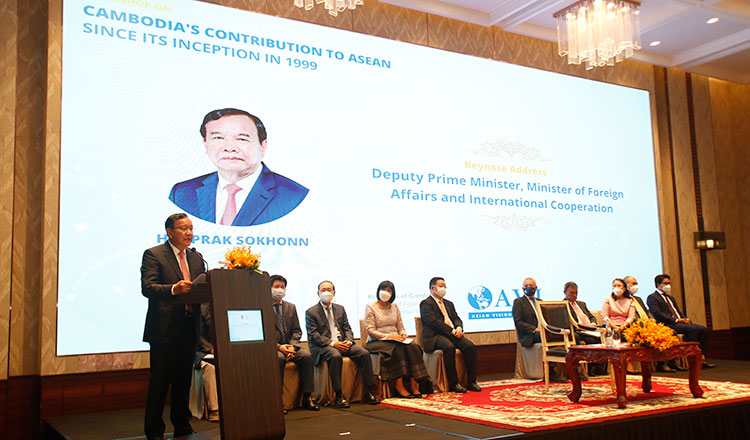
As Cambodia assumed the rotating chairmanships of Asean this year, the third time since joining the group 23 years ago, the country has gone a long way along with other neighbours in its efforts to ensure peace, stability and economic growth in the region.
The contributions of Cambodia to Asean figured during a discussion at an eminent gathering of ministers, ambassadors and public policy strategists yesterday during a workshop organised by the Asian Vision Institute.
Presenting his keynote address at the workshop on “Cambodia’s Contribution to Asean Since Its Inception in 1999” at Hyatt Regency Hotel, Phnom Penh, Foreign Affairs Minister Prak Sokhonn said that Cambodia’s decision to join Asean was guided by the group’s core principles of mutual respect for the independence, sovereignty, territorial integrity and equality of all member countries.
The minister noted that when Cambodia first assumed the chairmanship of Asean in 2002, within three years of joining the regional group, the country contributed to the easing of tensions in the South China Sea with the successful conclusion of the Declaration of Conduct of the Parties in the South China Sea (DOC) which is a milestone in ensuring the collective commitment of Asean and China to promote peace, stability and trust in the region.
The 2002 term also saw Cambodia convening the first Greater Mekong Sub-region (GMS) summit to enhance cooperation and hosting the first Asean-India summit.
Among the achievements of Cambodia during the country’s second chairmanship of Asean in 2012 was its success in launching the negotiations for the Regional Comprehensive Economic Partnership (RCEP), the world’s largest trade pact.
Cambodia’s third chairmanship was kick-started this year with the visit of Prime Minister Hun Sen to Myanmar in January which paved the way for the implementation of the Five-Point Consensus reached earlier by Asean leaders in solving the crisis in Myanmar, Sokhonn said.
Kao Kim Hourn, Minister Delegate Attached to the Prime Minister, said that the regional group had proved to be a building block for progress for all the member countries. “The ongoing economic integration has benefitted all members. For example, in the case of Cambodia, our trade with Thailand and Vietnam has doubled,” he said.
The minister pointed out that the prosperity of the region would depend on the momentum in the development of human capital and the transformation towards a digital economy. He added that Asean was expected to become the fourth-largest economy in the world by 2030.
Chhem Kieth Rethy, Minister Delegate Attached to the Prime Minister, said the growth of any economy is directly linked to the developments of infrastructure and science and technology these days while stressing the need for Cambodia to step up efforts to raise investment in these sectors.
“The Covid-19 pandemic showed us that without Internet we had no means to reach out to one another. But the major challenge is the removal of the digital divide in the society,” Chhem said, while participating in a panel discussion on ‘Future Trend of Asean Community Building and Regional Integration’ at the workshop.
Artificial Intelligence (AI) is deployed in many economic sectors these days and smart factories are becoming a reality paving the way for Industrial Revolution Four.
Source: Khmer Times
Share:

<p>Time: November 2025<br /> By: WTO and International Trade Group, Legal Department – VCCI</p>
