

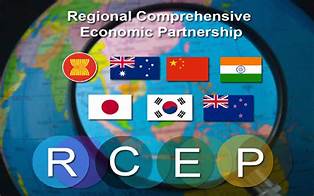
FOREIGN business chambers on Monday again urged the Senate to ratify the Regional Comprehensive Economic Partnership (RCEP) agreement before a new set of legislators takes office in July.
"In doing so, the 18th Congress will build on its remarkable record of approving new laws of immense benefit to the national economy...," the JFC said in a statement.
The RCEP, signed in November 2020, comprises the 10-member Association of Southeast Asian Nations (Asean); Asean+3 partners China, Japan and South Korea; and New Zealand and Australia. The deal has been ratified by all signatories except Indonesia, Myanmar and the Philippines.
President Rodrigo Duterte ratified the pact last September but Senate concurrence is required for it to take effect. The JFC earlier called for ratification in January and this month the Trade department also urged the Senate to do so.
The 18th Congress resumed its third and final session on Monday following a three-and-a-half month break. Its focus will be on the canvassing of last month's election results, after which it will adjourn sine die beginning June 3. Failure to act on the RCEP means that ratification will be the incoming Senate's responsibility once it takes over on July 25.
"The Philippines cannot afford to leave itself out of the bloc since being a member will bring economic benefits that will hasten recovery from the scars, higher debt and other damage caused by the ongoing Covid-19 pandemic," the JFC said in the statement.
"Studies show the Philippine economy will grow at a slower pace without membership in RCEP. Nobody wants this to happen," it added.
The RCEP is expected to lead to a net trade balance gain of as much as $128.2 million for the Philippines, increase overall welfare by $541.2 million, contribute to a 1.93-percent economic growth and lower poverty by 3.62 percent by 2031.
"Honorable members of the Senate, we appeal to you to vote to approve the RCEP agreement when you return to session this week," the JFC said.
The foreign business chambers noted that in addition to having a large workforce and an advantageous geographical location, foreign investors set up shop in the Philippines due to the access they can enjoy under the country's trade agreements with its neighbors.
"RCEP also offers other new advantages for exporters located in the Philippines that will benefit our member companies," they pointed.
The JFC comprises the American, Australian, New Zealand, Canadian, European, Japanese and Korean business chambers; and the Philippine Association of Multinational Companies Regional Headquarters Inc.
Meanwhile, the Philippine Exporters Confederation Inc. (Philexport), an umbrella group of Philippine exporters, also called for the immediate ratification of RCEP.
"There are concrete benefits to the Philippines being part of RCEP that we cannot dismiss such as the harmonized rules of origin and modern origin certification procedures under RCEP. This is a key takeaway for our members that do business in the RCEP countries as it is expected to reduce administrative cost and facilitate the movement of our exports in the region," Philexport President Sergio Ortiz-Luis Jr. said in a separate statement.
In a recent briefing, Shiro Armstrong, an associate professor at the Australian National University also highlighted the importance of RCEP which he said, will usher in a new era of East Asian economic cooperation.
Armstrong said the trade agreement also brings China, Japan and South Korea into an agreement for the first time despite the political ups and downs between Japan and China, and Japan and South Korea.
The expert added that the agreement can also accelerate capacity building, technical cooperation, experience sharing and political cooperation.
"The experience sharing, the cooperation can over time deepen reform and tackle behind-the-border issues," Armstrong said.
If the economic framework is implemented properly, it likewise gives the opportunity to negotiate new rules and offers a way for countries to build trust, understanding and confidence in cooperation toward further market opening, while providing a platform for concerted unilateral action, he added.
Armstrong said that looking ahead, Covid recovery coordination relating to travel and vaccine protocols, digital economy compatibility and multilateral principles, energy transition particularly regarding financial coordination and cooperation, and infrastructure investment principles and dispute mediation should be tackled under the economic cooperation agenda.
"Going forward, implementation is going to be very important for RCEP, but for this grouping, the weight and scale and the diversity in interests suggest that this is an excellent framework for projecting Asia's multilateral interests globally," said Armstrong.
Source: The Manila Times
Share:




<p>Time: November 2025<br /> By: WTO and International Trade Group, Legal Department – VCCI</p>
