

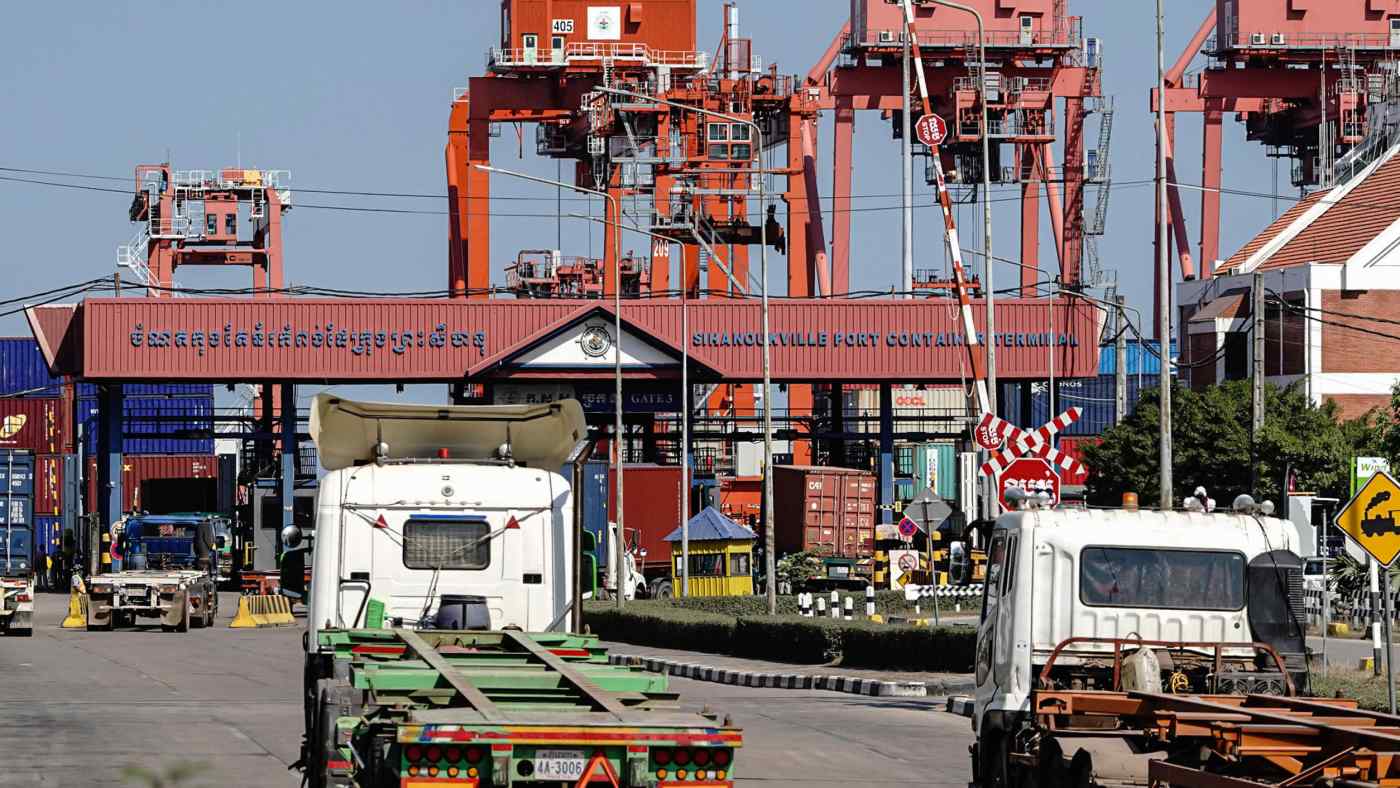
Cambodia faces a potential hammer blow after the U.S. said it will review the country's eligibility for a trade preference scheme vital to its export-reliant economy.
A loss of favorable trade status would be disastrous for the country, particularly after the European Union, its second-biggest market, levied trade sanctions against Cambodia in 2020 over human rights abuses.
The U.S. on Wednesday issued a scathing assessment of the Southeast Asian nation led by strongman Prime Minister Hun Sen, whose deepening ties with Beijing have strained relations with Washington.
In a business advisory, the U.S. cautioned investors operating, or considering operating, in the country, pointing to "systemic corruption, transnational organized crime, and human rights abuses," which it said threatened "U.S. national security interests," and "the fundamental freedoms of people in Cambodia."
The statement, released jointly by the State Department, the Treasury Department and the Department of Commerce, highlighted the risk of exposure to illicit financial activities in the real estate, casino and infrastructure sectors. It also warned U.S. companies about entanglements with Cambodian entities involved in the trafficking of people, wildlife and drugs.
Parts of the manufacturing and timber sectors also posed risks, according to the advisory.
"U.S. officials have regularly raised these concerns with Cambodia's leaders, but regrettably there have been no meaningful changes," it read.
Potentially far more consequentially, the statement also noted that the U.S. Trade Representative will conduct an assessment of Cambodia's Generalized System of Preferences (GSP) eligibility as part of a broader GSP evaluation.
"This assessment will be conducted following reauthorization of the program benefits and will include any new or amended eligibility criteria established by Congress," the statement read.
The GSP allows certain manufactured goods to enter the U.S. duty-free and has been central to the U.S. becoming Cambodia's largest market for its garment and apparel exports.
The EU's partial suspension of Cambodia's trade preferences under the "Everything But Arms" scheme, which came into effect in August 2020, pushed apparel and footwear exporters to shift markets to the U.S. -- a trend that cushioned the blow.
According to the World Bank, shipments of garments, footwear and travel goods (GFT) from Cambodia to Europe contracted by 35% in 2020, but grew almost by 4% to the U.S. despite the pandemic. The American market accounted for 36.7% of Cambodia's GFT exports and were worth around $3.5 billion.
Cambodia's total exports to the U.S. hit $6.6 billion in 2020, a 23% rise, year-on-year. Of these, some $2 billion were sent under the GSP.
The review is the latest sign of deteriorating U.S.-Cambodia relations, as the latter has moved closer to Beijing in recent years.
A flashpoint has been the Ream Naval Base on Cambodia's coast, which is being upgraded with support from China. U.S. officials have warned the base could be used to host Chinese military assets, a claim both Cambodia and China have rebutted.
On Wednesday, the U.S. Treasury announced sanctions against two senior Cambodian military officials for "conspiring to profit" from Ream's upgrade by inflating the costs of facilities and skimming funds.
The individuals named were Tea Vinh, the Royal Cambodian Navy commander and brother of Defense Minister Tea Banh, and Chau Phirun, director-general of the Defense Ministry's material and technical services department.
The measures freeze any U.S. assets owned by the pair or their immediate families. It also generally prohibits American citizens from engaging in transactions with them.
Source: Nikkei
Share:

<p>Time: November 2025<br /> By: WTO and International Trade Group, Legal Department – VCCI</p>
