

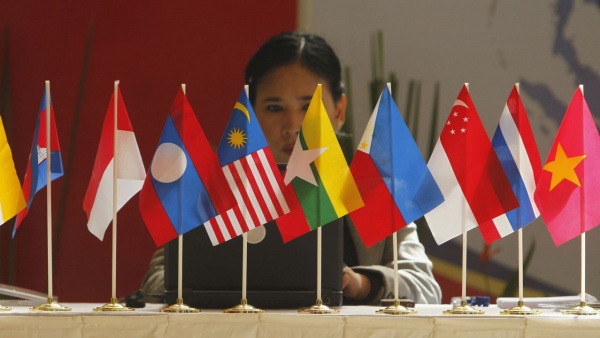
European Union Ambassador to ASEAN Francisco Fontan will complete his tenure in Jakarta in July. The Jakarta Post’s Dian Septiari sat down with him recently to discuss key issues between the two regional blocs. Below are excerpts from the interview:
Question: What flagship cooperation initiatives has the European Union achieved with ASEAN?
Answer: We have 200 million euros (US$222 million) in cooperation with the ASEAN Secretariat — those are the projects we carry out with the ASEAN Secretariat and ASEAN member states.
One-third of it is essentially on biodiversity. We started three years ago with 10 million euros to support the ASEAN biodiversity center in Manila, but this year we have launched a peatland project worth 20 million euros to preserve peatland in ASEAN.
Another third deals more with underpinning the ASEAN Economic Community. Europe is the largest investor in ASEAN, we invest more than the United States, Japan and China put together.
[...] So, for us, it is extremely important that ASEAN has success with the ASEAN Economic Community, because it means more facilities for our businesspeople to do business here.
The last third of our cooperation deals with dialogue. This year we are launching a new high level dialogue between the EU and ASEAN on environment and climate change. We also have the EU-ASEAN dialogue on human rights.
We’ll start, hopefully this year, a 10-million-euro program with the AHA Center [ASEAN’s Humanitarian Assistance on Disaster Management Agency], with a component of civil protection to bring European civil protection experts to work together with AHA and its ERAT [emergency response team].
We are also negotiating CATA — the civil aviation transport agreement. It is almost agreed. There are still some ASEAN members who say that they are dealing with things internally, but this would be a very important [agreement] in terms of connectivity and business.
At the ASEAN Summit last month, regional leaders adopted the ASEAN Outlook on the Indo-Pacific. How does the EU view this strategy?
My colleagues in Brussels are still digesting the outlook but what I am telling Brussels is that this is a very interesting development. I think the agenda is extremely similar to the EU with its peace, prosperity [... and] rule of law.
We have a Europe Asia strategy and Europe Southeast Asia strategy, and we have a strategy for the Pacific. So, suddenly it looks like many of those strategies are put together in this outlook, so we’re going to have to see how the [ASEAN] Outlook for the Indo-Pacific is going to impact our strategies.
If we talk about connectivity, for instance, ASEAN has its own connectivity master plan, and our 200 million euros cooperation with ASEAN also looks into that strategy [...] and we are working on concrete measures to support the pipeline of projects.
But if that pipeline of projects looking at ASEAN connectivity actually becomes expanded into Indo-Pacific connectivity, then we will also have to readapt our initiative and not just look at Southeast Asia but at the Indo-Pacific with ASEAN at the center. That would mean wanting to see larger projects.
While the EU and the United Kingdom have been trying to conclude and deliver Brexit, London has made a simultaneous push for greater cooperation with ASEAN. Can we expect some similar energy from Brussels this year?
The UK has to solve Brexit, they have to decide what they want to do with their life in relation to the EU and we are in no way waiting for them when it comes to working with our partners.
We signed a free trade agreement with Vietnam. We also signed an FTA with Mercosur, which is Brazil, Argentina, Uruguay and Paraguay, two of them are very important G20 members and very large economies. A few months ago, we signed an FTA agreement with Singapore, another important member of ASEAN. We also signed an FTA with Japan, a very important country in the region, and I could really go on.
Our level of engagement with the world and with Asia and ASEAN has nothing to do with Brexit, and we are not waiting for anything.
How is progress on the planned upgrade of the EU’s strategic partnership with ASEAN?
In January, together with ASEAN at the ministerial level, they have agreed on a strategic partnership. But when it’s going to start that has to be decided.
The strategic partnership is very important because if you have heads of state meeting each other then you have a high level agenda; because right now our agenda stops at the ministerial level. There is a potential that is not being exploited because we do not have the heads of state sitting with each other.
Europe is more than ready to discuss with ASEAN on when to have the first summit and under what conditions, and I hope we will have the discussion at the senior officials meeting in August in Bangkok.
Have tensions over palm oil or other issues with ASEAN countries hampered the process?
There is one thing that is very important, ASEAN and the EU have a commonality of agendas that is extremely important. ASEAN and the EU stand strongly behind the multilateral system, free and fair trade — this is something that is important in a world where protectionism and unilateralism are rising.
It is important that the EU and ASEAN and others speak with a strong voice of support for multilateralism and rule of law.
We need to be very careful to keep bilateral relationships from bi-regional relationships and not let the EU’s bilateral relationship with a country in ASEAN stop region-to-region relations.
Is it normal for ASEAN member states to put a lot of emphasis on onebilateral issue they have with one normal dialogue partner? Yes, but when you have 28 countries on one side and 10 on another, the possibilities of having issues multiplies and it is mathematically more complex.
When we have European member states bring up a problem about ASEAN, for example, a country faces difficulties in selling cars to a country, we will deal with a trade agreement, we are not going to stop ASEAN-EU relations, and we expect the same thing from ASEAN.
Whatever trade issues there are between one ASEAN member state and the EU should be dealt with between them but do not take the whole relationship hostage.
Source: The Jakarta Post
Share:
<p>Time: November 2025<br /> By: WTO and International Trade Group, Legal Department – VCCI</p>
