

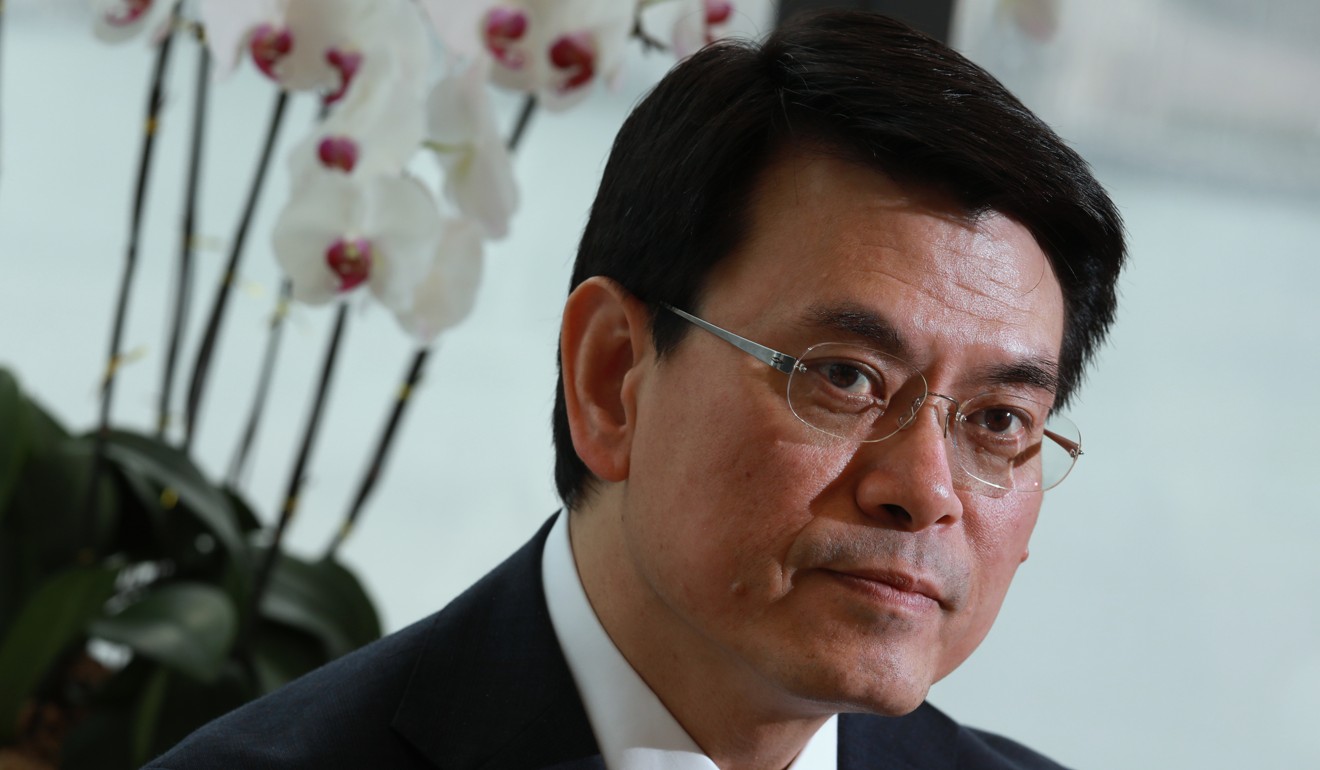
The intensifying US-China trade warhas battered Hong Kong, prompting it to look to new markets and trade mechanisms such as those presented by the upcoming free-trade deal with Asean, the city’s commerce minister has told the Post.
Edward Yau Tang-wah, secretary for commerce and economic development, said in an exclusive interview that the pact with the 10-member Association of Southeast Asian Nations would be a crucial alternative for Hong Kong companies that rely on traditional markets, such as the United States and European Union.
Yau also said the government had provided billions of dollars in funding to subsidise ventures by local small and medium-sized enterprises (SMEs) into new markets, including mainland China and countries with which Hong Kong has a free-trade agreement.
“The free-trade agreements have material and virtual impact that, for example, give Hong Kong companies business links and new business positioning,” he said. “We have seen SMEs dip into the funds to expand into the Asean markets, which are preparing for the stormy weather.”
Five Asean countries – Singapore, Thailand, Vietnam, Laos and Myanmar – have their free-trade deals with Hong Kong take effect on Tuesday. Bilateral investment agreements with the five nations come into force on June 17.
Similar agreements with the rest of the bloc’s members – Brunei, Cambodia, Indonesia, the Philippines and Malaysia – will take effect on dates to be announced later.
The Asean free-trade arrangement, signed in September 2017, will allow Hong Kong firms access to 10 markets for goods, services, investments, economic and technical cooperation and dispute settlement.
The regional bloc was Hong Kong’s second-largest trading partner in 2018, after mainland China.
In the latest wrangling from the US-China trade war,
President Donald Trump on Thursday threatened to slap 25 per cent tariffs on US$300 billion (HK$2.3 trillion) worth of untaxed Chinese imports after he meets with his Chinese counterpart, President Xi Jinping, at the G20 Summit at the end of this month.
Trump said he would make a decision “over the next two weeks, probably right after the G20”.
If the new tariffs become reality, all consumer goods made in China would be taxed as they enter the US. The effect would be to further hammer Hong Kong’s exports, which shrank 2.5 per cent in the first four months of 2019 from the same period last year. Chinese exports to the US via Hong Kong accounted for 7 per cent of the city’s total exports in 2018.
Eva Leung Fung-wah is a director for Winsonic Electric, a Hong Kong company that makes charging cables and power banks in Dongguan, Guangdong. She said her company’s orders were cut in half in the first quarter of this year, year on year, after Trump’s tariffs convinced some American clients to source products outside China.
“Our customers stocked up heavily before the Lunar New Year and will not order again until they run out of stock,” she said. “Even when customers place orders, they tend to procure only one-tenth of the quantity they used to procure.”
Leung conceded that it was difficult for the company to make an abrupt switch to a new market after dealing with the US market for years.
“The specifications of products and price ranges are different between the US and Asean markets,” she said. “We have no idea how to start in a totally new market.”
Jimmy Ng Wing-ga, an industrial lawmaker affiliated with the Chinese Manufacturers’ Association, said SMEs should not try to break into new markets alone.
“It is more viable to go in a group and take part in trade shows to reach out to buyers,” he said. “As far as the free-trade deals are concerned, it is better than nothing.”
But Felix Chung Kwok-pan, a lawmaker for the textile and garment industries, said the more free-trade deals, the better.
“The Asean markets are mostly developing countries, except Singapore,” he said. “It appears Vietnam, Myanmar and Indonesia are more [suitable] for manufacturing and these consumer markets are not yet ready.”
The Legislative Council recently approved the government’s 2019-2020 budget, which pumped HK$1 billion into a dedicated fund for local companies to use for branding, upgrading and domestic sales. The BUD Fund, as it is known, came on top of a HK$1.5 billion injection last year.
The fund will allow a company to apply for up to HK$2 million in funding to explore markets with which Hong Kong has a free-trade deal. It provides HK$1 million for ventures in the mainland market.
As of February, the Hong Kong Productivity Council, which manages the fund, had received about 177 applications for Asean markets – about 24 per cent of the total applications. The rest were for the mainland market.
Source: South China Morning Post
Share:
<p>Time: November 2025<br /> By: WTO and International Trade Group, Legal Department – VCCI</p>
