

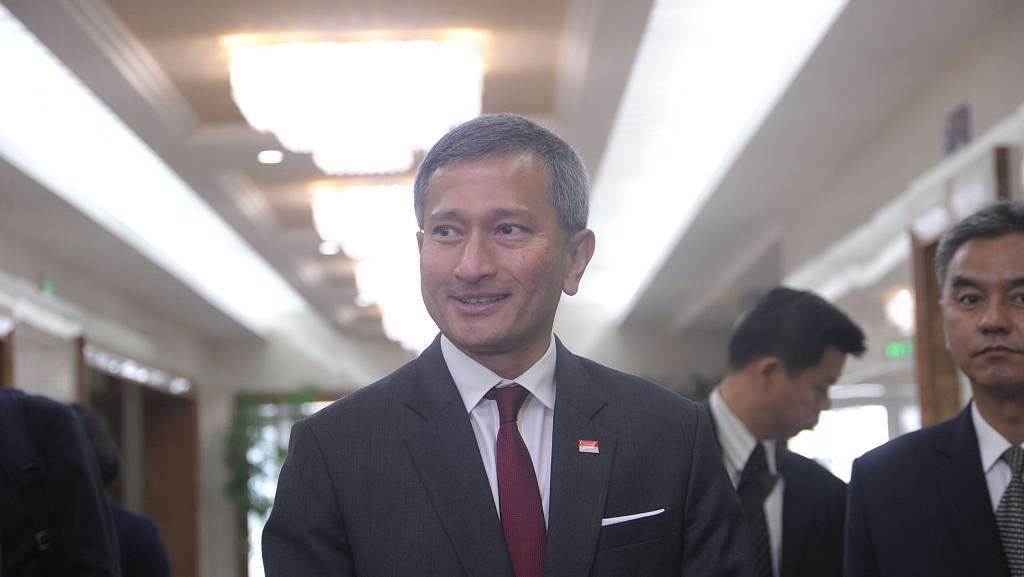
In the aftermath of Trump's dramatic escalation of the dispute between China and the United States, with the president increasing tariffs on imports on Beijing and moving to blacklist Huawei, the foreign minister of Singapore, Vivian Balakrishnan, urged Washington to exercise restraint in its approach and permit China to "assume its rightful place as it develops."
He further emphasized that Singapore, a city-state which relies on friendly relations with both countries, would suffer from a growing confrontational scenario and would not want to be "forced into making invidious choices."
In turn, he urged the two countries to cooperate constructively and respect each other's interests, noting that China has a right to exercise its interests legitimately within the global order.
Singapore's position is reflective of the stance of many countries within the ASEAN region. That is, the goal of sustaining an independent foreign policy by pursuing strategic balance in ties between Washington and Beijing, then aligning with neither.
As a result, confrontational and zero-sum policies pursued by the White House towards China are not welcome in the region as they pose a direct threat to the area's stability and economic prosperity, as reflected in Balakrishnan's comments.
Thus, the remarks are a reminder that the United States is largely alone in its crusade against China, and that the rest of the world does not welcome intrusive and unilateral moves from the presidency which undermine their own foreign policy interests.
Singapore's foreign policy is conditioned on the logic that it is a city-state surrounded by giants. Continually under a de facto threat of being dominated or out-muscled by others, the state strives to create political space for itself by pursuing friendly and open ties with a number of countries, integrating itself into a broader multilateral framework of regional interests. Inevitably, this results in a diplomatic strategy which courts both China and the United States.
Beijing is valued for its economic contributions, the country have joined a free trade agreement with China in 2008; Washington, on the other hand, is favored for its strategic support, with Singapore vesting itself within America's maritime rules order, thus, while being officially allied with neither power, Singapore is nevertheless open towards both of them.
Although Singapore's own geographic and political considerations are unique, this pattern of diplomacy nevertheless reflects throughout ASEAN as a whole since the 1990s. Even if some countries are on paper officially allied with the United States, such as the Philippines, nevertheless the bloc operates with the view to maintaining neutrality, caution and balance, choosing to hedge between than robustly align with either side.
For example, one may note how President Rodrigo Duterte has disputes with China in some areas, while courting and pursuing deeper ties with others. The same is true for Vietnam. Ultimately, diplomacy in Southeast Asia is consequentially not a zero-sum game, but instead a multi-layered structure with a great deal of nuance.
As a result, attempts by great powers to forcefully regress the region into old Cold War style alignments whereby countries are pushed to "take sides" are perceived as contravening to ASEAN interests and in turn, not welcomed.
As the Singaporean foreign minister notes, if the United States continues to weaponize unilateral measures to undermine China's economy and companies, then Singapore themselves and many others within the region have a great deal to lose from that.
Similarly, if Washington pushes too hard and Singapore becomes overwhelmed by the power of the United States, then, in turn, it risks losing its own foreign policy independence. Confrontational policies upset the balance of power within the region; stand to reverse efforts at economic integration and in turn undermine its prosperity.
Therefore, the only way forward in the ASEAN region is for the United States to accept that China will be a significant stakeholder and in turn pursue a policy of cooperation than confrontation.
The two countries will always have their differences, hence why Singapore described the ideal scenario as "constructive competition." Behind it, all sit an abounding fear that the growing cold war mentality within Washington in the pursuit of strictly unilateral interests will pose grave risks for Southeast Asia.
Even if there are so many regional disputes and disagreements, a firm line is being drawn that as key regional player and stakeholder, you simply cannot push China out of the picture. Thus, while ASEAN states want America to play a role, they do not want reckless confrontation.
Source: CGTN
Share:


<p>Time: November 2025<br /> By: WTO and International Trade Group, Legal Department – VCCI</p>
