

One fast-expanding, Indonesian processor of shrimp and other seafood is building new plants and eyeing increased sales to the US market, amid the trade war between the world’s largest economy and China.
Last year, Seka Bumi added breaded shrimp capacity at its Bumi Pangan Utama (BPU) shrimp plant around an hour from Jakarta at the start of 2017, a company spokesperson told Undercurrent News.
“We see a growing demand in breaded shrimp products,” she said, adding the BPU site also has plants for other shrimp products, as well as processed foods and fish sausages, the latter being the most recent addition.
The 10% tariffs on seafood from China in the US include breaded shrimp and could go to 25% on March 2, but present an opening for Seka Bumi and others in Indonesia, she said. China is the main supplier of breaded shrimp to the US. Sources previously told Undercurrent that production for the US market is likely to shift to Indonesia, Vietnam and also India.
“It’s an opportunity that we, as Indonesian players, have to grab. We expect shifting demand [from the US] for Chinese-origin seafood to other countries with abundant seafood supply, like Indonesia,” she said.
She noted “big US retailers” have approved the BPU plant. The plant is also four-star Best Aquaculture Practices-approved, she said.
BPU is in Tangerang, roughly an hour west of Jakarta, Indonesia’s capital, but the company is also expanding in other areas of Indonesia. Seka Bumi has also bought a “pretty big area in Lamongan, East Java, for [an] additional processing plant” in the future, she said. Lamongan is around 800 kilometers east of Tangerang, close to Surabaya, the second largest city in Indonesia (see below for where the company's operations are based).
As well as shrimp processing, Seka Bumi plans to use the plant in Lamongan “to import some other seafood species, process them here, and export them back”, she said.
However, this will be in the medium-term. “I don't think the plant will be completed or starting production in 2019,” the spokesperson said.
She declined to say more about the plans with the plant, or about wider strategy for growth for the company.
“There are other investment plans in mind, which we can’t reveal yet for now,” she said. We are planning to expand our processing facilities further into other parts of Indonesia with existing, as well as potential, seafood supply.”
Generally speaking, the company is looking at importing seafood such as king crab and salmon for re-processing, or even local distribution, she said.
Dim sum, fish sausage expansion
As well as adding breading capacity at BPU, Sekar Bumi has also just built a new processed food facility at the BPU Tangerang factory, as well as a fish sausage plant, which is a joint venture with a Japanese firm.
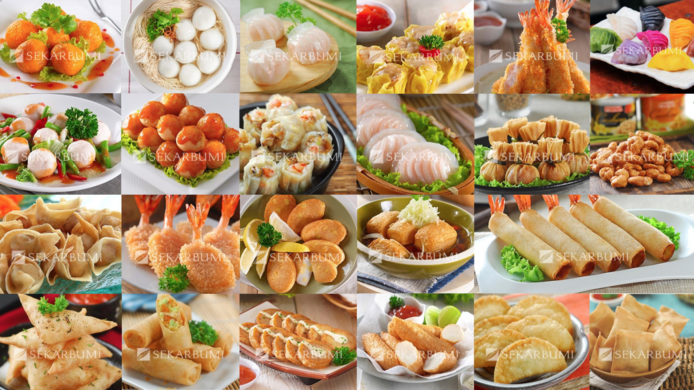
“The new facility will help to increase our production capacity for processed food products, like dim sum -- shiu mai, ha kao, dumpling, money bag, mini wonton and shrimp bombs,” the spokeswoman said. Also, the plant will be used to produce varieties of surimi-based products, such as fish balls, prawn balls, fish tofu and fish cakes.
Then Sekar Seinan Food (SSF), a subsidiary of Sekar Bumi, has inaugurated a plant to produce Japanese-style fish sausages in October last year.
SSF is a joint venture between Sekar Bumi (51%) and Japanese firms Nomura Trading (39%) and Seinan Kaihatsu (10%), a trading company and fish sausage supplier, respectively.
The halal-certified plant has the capacity to produce 8.6m fish sausages, according to a report from AsianAgribiz.
It is equipped with technology from Japan provided by Seinan Kaihatsu. SSF plans to sell 150m pieces of fish sausages in the first fiscal year, aiming for a 10% domestic market share within two years, Nomura Trading said in a statement.
In total, across its plants for frozen raw, cooked, value-added and breaded shrimps; frozen fish; fish sausage, and frozen processed food products, the total capacity of the BPU plant is 30,000 metric tons.
BUP plant drives sales growth
The addition of the BPU plant is the main driver of the company’s sales growth.
In 2017, the company sales surged 23% year-on-year, to IND 1.84 trillion ($130.22 million), with net profit up 15% y-o-y, to IND 25.88bn.
“As BPU continues to perform and grow, we expect to increase our total sales this year,” she said.
Sekar Bumi has been doing even better this year, according to an article from IDN Financials, from September last year.
The company reported comprehensive income for the first half of its financial year of IND 18.83bn, compared to a loss of IND 1.91bn in the same period of 2017. First-half sales were IND 927.16bn, up 2% y-o-y.
The largest contributor to the revenue came from frozen value-added seafood at IND 872.02bn, followed by frozen processed food at IND 31.76bn, and other products IND 43.50bn. In the first semester of 2017, frozen value-added seafood contributed IND 855.10bn, frozen processed food IND 34.47bn, and other products IND 37.59bn.
Shrimp farming expansion
As well as increasing its shrimp processing capacity, Sekar Bumi is looking to build up its farming business, a trend which can be seen in Indonesia generally.
Depending on who is presenting the data, Indonesia produces 400,000t of shrimp, to as much as 550,000t. The general consensus, however, is production is growing. BPU is bullish on the outlook for the development of the Indonesian shrimp sector, as well as the wider seafood industry.
“We are pretty confident that we can continue to grow in production and exports. Firstly, Indonesia’s coastline is the 2nd longest in the world,” she said. Secondly, as the country is an archipelago with more than 17,000 islands, disease outbreaks in shrimp have largely been prevented, as farming production is not concentrated on one or two areas.
BPU has its own farms in Sumbawa, in the eastern part of Indonesia, to these supply its factories in East Java; while the BPU plant is getting its supply from farmers “with whom we have strong relationships”, the spokeswoman said.
“The farming side of the business has so much potential, especially in an archipelago country like Indonesia. Many areas are still untapped and have a lot of potential for farming. We are definitely looking to grow this business, in addition to expanding our processing,” she said.
“We are blessed with abundant natural resources and long coastline to grow our farming, hence Indonesia will continue to grow as a big seafood player, globally. Besides, we are seeing positive development in the infrastructure sector, which can help to reduce logistics cost from farming areas. This will trigger development and expansion in cultivation areas. The hatchery and feed business will grow following this growth in the farming business,” she said.
The increase in shrimp production seen in Indonesia and other countries means prices have come down. However, Sekar Bumi does not see this as a bad thing, as demand will grow.
"We see the shrimp prices have become more stable, to an acceptable market level. Therefore, we expect to see an increase in global consumption," the spokeswoman said.
Source: Undercurrent News
Share:

<p>Time: November 2025<br /> By: WTO and International Trade Group, Legal Department – VCCI</p>
