

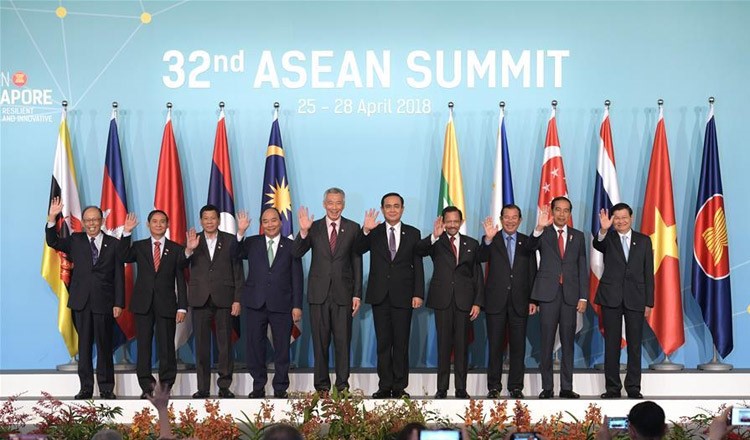
For almost a decade, the basic strategic issue for Asean has been how to position itself as the US and China grope towards a new modus vivendi. This is still the main challenge. But it is not business as usual. US-China relations have now entered a new phase of heightened long-term competition. Although competition has always been an inherent part of the relationship, from 1972 to circa 2010, the overall emphasis of US-China relations, despite some tense episodes, was on engagement.
The US and China are not natural partners, nor are they inevitable enemies. Post-Cold War US-China relations are characterized by deep strategic mistrust coexisting with interdependence of a new and historically unprecedented kind. The US and China simultaneously cooperated, while competing. Engagement and cooperation will not entirely cease. But the overall emphasis has now clearly shifted to competition. Lest there was any doubt, US Vice-President Mike Pence’s speech on October 4 was a clear and unambiguous signal of the new emphasis.
The most obvious manifestation of the new approach is US President Donald Trump’s ‘trade war’. The term is something of a misnomer. Trade is the instrument; the objective, as the Trump administration’s National Security Strategy (NSS 2017) published in December 2017 and its National Defense Strategy (NDS 2018) published in January 2018 make clear, is strategic competition. China accuses the US of using trade to hamper and constrain its development. China is not wrong, although it conveniently skirts over its own responsibility.
Most attention has focused on the tit-for-tat imposition of tariffs. This must eventually end, although no one can at present predict when, or at what cost, or with what implications for international order. But the more significant aspect is new US legislation to limit technology transfers to China: FIRRMA (Foreign Investment Risk Review Modernisation Act) and the National Defense Authorisation Act passed with strong bipartisan support in August 2018. The new legislation defines a new statutory framework for US relations with China. This is not going to be easily changed by successor administrations.
The US and China will not quickly or easily reach a new modus vivendi; neither is likely to get everything they want from each other. This implies that Asean will have to navigate a prolonged period of more than usual messiness and more than usual uncertainty.
War by design is improbable. China must fight only if the US supports Taiwan independence. This is unlikely. If an accident should occur in the South China Sea or elsewhere, both sides will probably try to contain it. Asean ought to be able to cope with situations short of a US-China war. Asean has managed far more complicated and dangerous circumstances in the past. But this will require greater agility, unity and resolve than Asean has shown in recent years.
Some analysts have speculated that there may be short to medium term opportunities for Asean if foreign companies shift production out of China into Southeast Asia. This is possible but short-sighted. Shifting production out of China is easier said than done and no one, trade war notwithstanding, will forgo the Chinese market, although new and up-graded investments will probably be postponed.
A prolonged trade war is likely to fundamentally change supply chains. This process could be accelerated if the accusation that China had planted spy microchips in motherboards used by major US companies and CIA and Pentagon servers is proved. Shifts in supply chains could derail or seriously complicate efforts by Asean members to move up the value chain. Asean members must in any case resist the temptation to act as a back-door into the US for Chinese companies.
Hedging against the long-term uncertainties and taking advantage of whatever opportunities may exist, requires Asean to move boldly on the second phase of economic integration which aims at creating a common market and common production platform in Southeast Asia. Here the key success factors are the domestic politics of Asean member states; that is to say in our own hands and not in the policies of China or the US.
Source: Khmer Times
Share:

<p>Time: November 2025<br /> By: WTO and International Trade Group, Legal Department – VCCI</p>
