

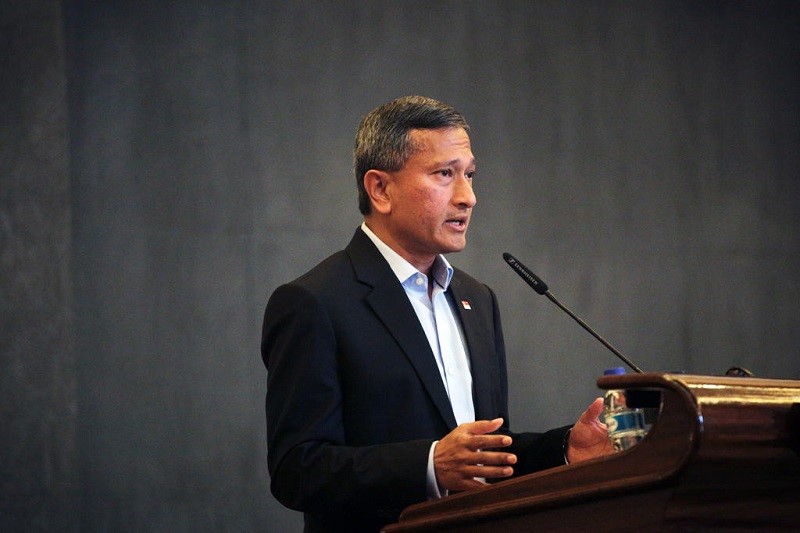
NEW YORK, Sept 28 — The Asean community’s 10-member states are “deeply worried” that the ongoing tit-for-tat retaliatory tariffs imposed by the United States (US) and China on each other’s products could escalate into a full-fledged trade war that could hurt the economies of Asean countries, Singapore’s top diplomat said at the Asia Society on Wednesday night.
Vivian Balakrishnan, who is visiting New York to attend the ongoing 73rd United Nations General Assembly session, described the ensuing trade war between the two as “serious”.
Addressing a packed Asia Society auditorium, he said the trade war between the two was a “source of great concern” for the Asean member states, considering that by reducing the volume of trade or merely increasing the risks connected with trade eroded the significance of hubs like Singapore, and hoped “cool heads (would) prevail”.
The Asean member countries, with a collective GDP of US$2.4 trillion, depended on good trading relationship between the US and China.
Singapore’s foreign minister pointed out that “we are one of the chief beneficiaries of a world where the US and China get along, trade with one another, (and) allow investments to flow between them”. He said Singapore supported multilateral trade agreements, like the Trans Pacific Partnership (TPP), from which the US backed out in 2017 after it was signed during the Obama administration.
Asked if Singapore believed if the US would return to the TPP, Balakrishnan told Bernama that “we were disappointed when America pulled out we have left the door wide open for America (to return)”. “I hope after a period of time, we will see value in this multilateral trade pact,” he said.
Tiny Singapore, which relies on trade with both the US and China, is dependent on maintaining good and healthy relations with both countries, with China being an important trading partner of Singapore and also a source of investments with strategic interest in the Southeast Asian region.
Balakrishnan, who was speaking on the theme, ‘New Realities for Southeast Asia’ at the Asia Society, was quizzed by former Australian prime minister Kevin Rudd who is, presently, the President of the Asia Society Policy Institute.
He said that globalisation, free trade and economic integration — the three pillars on which the superpower US had built the edifice of peace and prosperity for all those who jumped on the bandwagon since the end of World War II — had also contributed to the emergence of a multipolar world.
Balakrishnan stepped on the caution brake and questioned if this transition to a multipolar world could be “managed” peacefully. — Bernama
Source: Malay Mail
Share:

<p>Time: November 2025<br /> By: WTO and International Trade Group, Legal Department – VCCI</p>
