

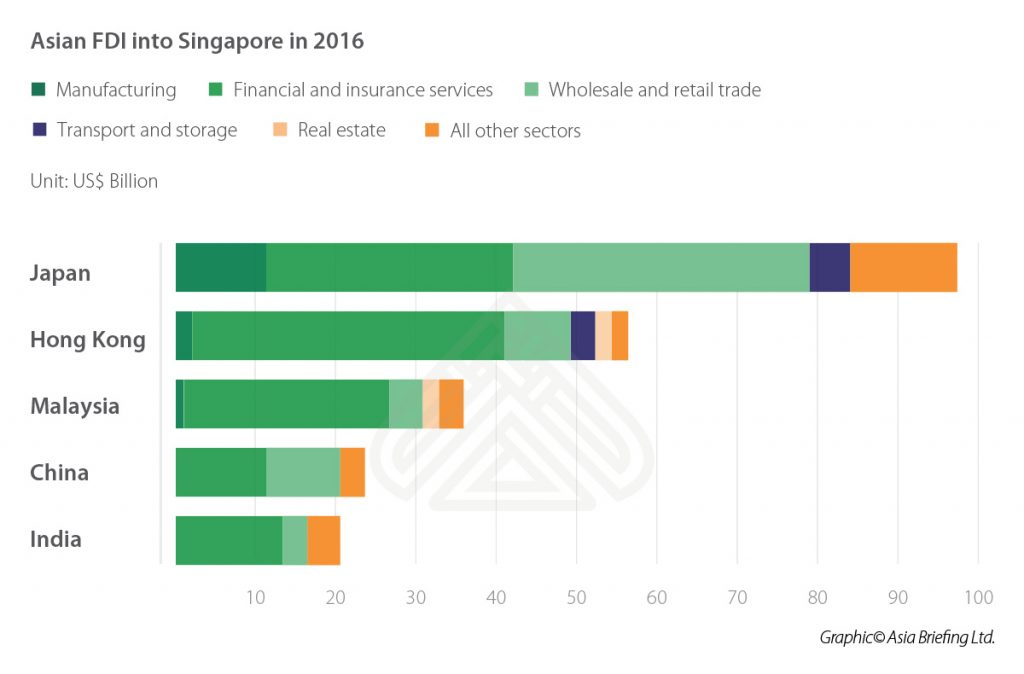
India’s Prime Minister Narendra Modi made a three day official visit to Singapore late last month. The trip was his first since November 2015, and followed quick visits to Indonesia and Malaysia.
The three-nation tour, touted to be part of India’s Act East Policy, laid clear emphasis on closer Southeast Asian trade and business ties.
The bilateral visit touched on discussions surrounding defense, space, and skill development as well as attracting greater investments from Singapore-based companies.
Modi also attended an India-Singapore Enterprise event organized by Enterprise Singapore, a government body promoting the establishment of companies in Singapore.
Regional hub for Indian businesses
The interaction with the owners of Indian businesses assumes significance as an estimated 8,000 Indian companies have registered in Singapore since 2000.
Large business groups in India set up holding companies in Singapore to manage their Asian and international investments; the country is an international financial center and provides easier financing and refinancing schemes.
Singapore FDI into India
According to the Department of Industrial Policy and Promotion (DIPP) – foreign direct investment(FDI) inflows from Singapore contributed 17 percent of the total FDI in India since 2000.
This includes investments made by domestic companies as well as Singapore registered entities, most of which are regional operations of Indian firms.
Data from Singapore, on the other hand, shows the FDI inflow to be half this estimate – it does not include investments routed through holding companies based in the country.
Moreover, Singapore calculates its overseas investment based on a minimum 10 percent direct ownership of shares or voting power by a Singapore investor.
Major sectors in India that receive FDI inflow from Singapore are: financial services, telecommunications, drugs and pharmaceuticals, computer software and hardware, and trading. The balance – about 48 percent – comprise sectors not clarified by the DIPP.
Singapore-India tax treaty, trade pact
To reduce tax liabilities and improve trade flows, both countries have a Double Taxation Avoidance Treaty (DTAA); India and Singapore signed the Comprehensive Economic Cooperation Agreement (CECA) in 2005 and Singapore is also party to India’s trade agreement with ASEAN.
The DTAA targets shell companies to prevent tax evasion and the CECA offers tariff reduction on select products exported from Singapore to India.
Modi’s latest trip followed announcement of further reduction in tariffs and other trade relaxations by Singapore’s Ministry of Trade and Industry.
Indian companies registered in Singapore
Several Indian startups, although operating in India, have registered holding companies in Singapore to benefit from increased funding opportunities, business and tax friendly environment, and stable economic policies.
One of these companies is Flipkart, an e-commerce company that is registered in Singapore as Flipkart Private Limited (FPL).
Founded in 2007, it was registered in Singapore in 2011 as India did not permit 100 percent FDI in the online retail of multi-brand goods and services. This policy was amended in January 2018.
ZipDial (mobile marketing), InMobi (mobile advertising), Capillary Technologies (software products), and Tonbo Imaging (defense) are among several Indian startups that have recently registered in Singapore.
In addition to startups and large business groups, Singapore serves as a hub for several international trading and logistics companies due to its strategic location, excellent shipping connectivity, and low cost trade financing.
For example, Mercator, a large Indian shipping company, registered its coal, dry cargo, and offshore business in Singapore in 2015.
Singapore’s incentives for foreign companies
Singapore functions as a gateway for Indian companies expanding their trade and investment into ASEAN as it is, both, an international financial center and a shipping and aviation hub for the Asia-Pacific.
Here we lay out key incentives promoting Indian investments into the Singapore economy.
Source: India Briefing
Share:


<p>Time: November 2025<br /> By: WTO and International Trade Group, Legal Department – VCCI</p>
