

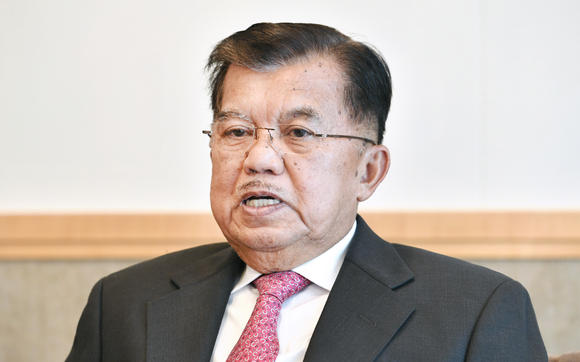
Vice president signals Jakarta is still on board with regional free trade
Indonesia has lost its motivation to join the Trans-Pacific Partnership due to the U.S. withdrawal from the trade pact, the Southeast Asian country's vice president said in an interview.
"The allure of the TPP for Indonesia was the fact that the U.S. was part of the deal," Jusuf Kalla said. "Without the U.S., we feel that the benefits on the trade front for Indonesia are not that big, and we have lost interest."
Indonesia was not among the 12 countries negotiating the TPP, but President Joko Widodo in 2015 told then-U.S. President Barack Obama that his government intended to join once the members ratified and implemented the deal. Now that Washington has pulled out, some of the remaining 11 members are seeking to renegotiate the terms.
"Putting the TPP into effect is also proving to be difficult," Kalla said. "That is why we are leaning toward not joining the deal altogether." He added that his country already has bilateral and multilateral ties with TPP member nations, which also decreases the attractiveness of the deal.
As opposed to the TPP, the vice president said Indonesia remains supportive of the Regional Comprehensive Economic Partnership, or RCEP -- a multilateral trade framework involving China, India, South Korea, Australia, New Zealand, Japan and the 10 members of the Association of Southeast Asian Nations. "RCEP is an ASEAN-led initiative, that is the difference [with the TPP]," Kalla said. "We have not changed our stance on joining the pact."
Despite signaling Indonesia's disinterest in the so-called TPP 11, Kalla told the conference in a speech and Q&A session that the country recognizes the importance of the accord in making "Asia more investment grade." He added that the region has gained a great deal from open trade. "Over the last two decades, hundreds of millions of Asians have been lifted from poverty. ... Our decision to promote economic openness has enabled us to harvest the fruit of globalization."
Expressing concern about protectionist impulses, Kalla said international trade, "as the main feature of globalization, is in limbo." He added that globalization is "irreversible" by nature, but warned that if countries do not address the inequality that accompanies it, pressure to turn back the tide will grow.
This would be "bad news for Asia," he said, calling for greater inclusiveness and better education to ensure citizens have the skills they need for the future.
Source: Nikkei Asean Review
Share:



<p>Time: November 2025<br /> By: WTO and International Trade Group, Legal Department – VCCI</p>
