


The artificial intelligence boom is accelerating economic integration across Southeast Asia, China, Japan and South Korea, the head of the ASEAN+3 Macroeconomic Research Office (AMRO) said, stressing that the technology will boost intra-regional trade and investment.
"Every new technological wave, whether AI, robotics or advanced manufacturing, creates opportunities to reshape industrial ecosystems," AMRO Director and CEO Yasuto Watanabe said in an interview with Nikkei Asia in Bangkok last month. "This new wave could provide momentum for a further round of regional integration."
Singapore-based AMRO is an economic surveillance organization covering the ASEAN member states plus China, Japan and South Korea. The international organization was jointly established and funded by the governments of these countries. Watanabe, who took office in 2025 after serving as Japan's senior deputy vice minister of finance and as a director general at the Asian Development Bank, was in Bangkok for the annual meetings of the International Monetary Fund and World Bank.
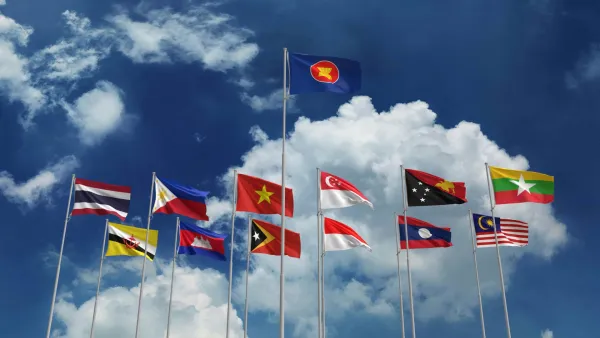
Asian countries have been working to deepen economic integration, including through the Regional Comprehensive Economic Partnership (RCEP) trade pact that took effect in 2022, while protectionist trade policies emerge elsewhere in the world.
"What makes me optimistic is that there is still significant room for deeper integration in ASEAN+3," especially when compared with Europe, Watanabe pointed out. He explained that intra-regional trade remains much lower, which means there is considerable untapped potential.
At the same time, "ASEAN's economy is growing rapidly and is now comparable in size to Japan's," he said.
In its latest economic outlook report published last month, AMRO projected ASEAN+3 growth of 4.1% in both 2026 and 2027. While the 2026 forecast was unchanged from July, the 2027 forecast was raised by 0.1 percentage point, reflecting stronger-than-expected AI-related exports and investment.
Watanabe said that across ASEAN, China, Japan and South Korea, AI-related goods accounted for more than two-thirds of merchandise export growth in the first half of the year.
Such data highlights "the region's importance" in the AI manufacturing supply chain, he said.
The AI story is "not limited to Japan, China and South Korea," he said, but also spans economies such as Malaysia, Singapore and Vietnam that have significant exposure through semiconductors and electronics manufacturing.
"Data center investment in countries including Malaysia, Thailand and Indonesia has also been a major source of support," he noted.
While demand tied to AI is expected to support regional growth despite continued pressure from energy costs, AMRO cautions that the outlook remains particularly sensitive to AI-related demand.
Watanabe warned that a sharp correction in AI-related investment could trigger capital outflows, currency weakness and tighter financial conditions, particularly in economies dependent on both technology-related growth and foreign capital.
At this stage, however, "we are still observing robust economic growth and good policy framework," he said, adding that the economies of ASEAN, China, Japan and South Korea are far more resilient than they were during the Asian financial crisis.
"Financial regulation has strengthened significantly, the financial sector has become more robust, and policymakers have worked to reduce excessive reliance on the U.S. dollar by promoting greater use of local currencies in cross-border transactions," he said. "Together with deeper regional cooperation and integration, these improvements have enhanced the region's resilience to external shocks."
The AMRO director also emphasized that the fast-moving private sector will drive this integration across AI, trade and markets.
"Businesses tend to move first, while the public sector's role is to facilitate and support that process," he said, adding that governments can help by updating regulations, making cross-border business activities easier, and creating frameworks that encourage cross-border investment and capital participation by banks and companies.
"These kinds of policy measures are important to support deeper regional integration," Watanabe said.
Regarding the region's relationship with China, Watanabe said, "What we see on the ground is that the private sector tends to take a more pragmatic and practical approach."
Despite tensions between China and Japan, "businesses are focused on commercial opportunities and mutual benefit, rather than geopolitical considerations," he said.
"In many cases, companies do not view national borders in the same way that governments do," Watanabe said. "As a result, mutual interests and economic cooperation often become more important drivers of business decisions than diplomatic tensions."
Source: Asia Nikkei
Share:
<p>Time: November 2025<br /> By: WTO and International Trade Group, Legal Department – VCCI</p>
