

Economic and trade ties between China and ASEAN are deepening rapidly, underpinned by tighter integration across industrial and supply chains, alongside expanding commercial opportunities for the business community.
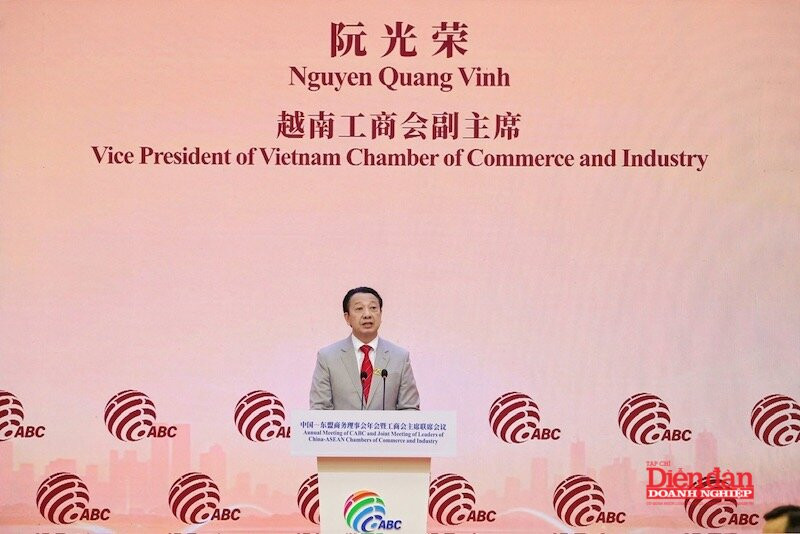
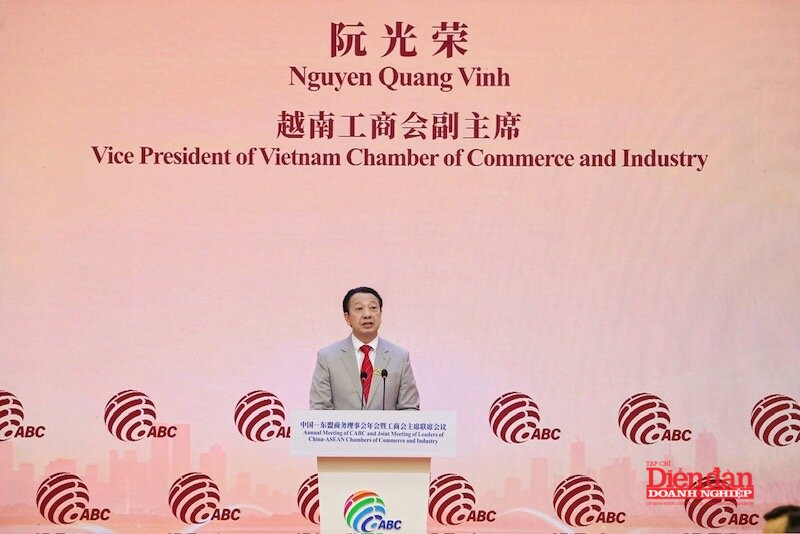
Speaking at the Annual Meeting of China–ASEAN Business Council and the Joint Meeting of Leaders of China–ASEAN Chamber of Commerce and Industry in Nanning, China, Mr Nguyen Quang Vinh (MBA), Vice President of the Viet Nam Chamber of Commerce and Industry (VCCI), emphasised that the scale of China–ASEAN economic cooperation is expanding at pace and embedding itself across the region.
Bilateral trade between Viet Nam and China alone surged to $256.4 billion in 2025, marking a 24.8% increase year-on-year. This cements Viet Nam’s position as China’s largest trading partner within ASEAN for a tenth consecutive year.
According to the VCCI Vice President, whilst these figures highlight the immense potential of ASEAN–China relations, the pivotal question now is how to translate sheer scale into tangible, on-the-ground opportunities for enterprises.
From this perspective, Mr Nguyen Quang Vinh identified the upgraded China-ASEAN Free Trade Area (CAFTA 3.0) as a key catalyst. Cooperation between China and ASEAN must look beyond conventional trade in goods to encompass broader supply chain integration, digital economy, green transition, logistics, e-commerce, and innovation.
He outlined the imperative to fortify regional supply chain resilience, urging business communities from both sides to forge deeper synergies in manufacturing, supporting industries, logistics, agriculture, electronics, and emerging sectors. The primary goal should focus on joint investment, supplier development, and the co-creation of robust regional value chains.
Simultaneously, greater efforts are needed to streamline market entry, particularly for small and medium-sized enterprises (SMEs). Chambers of commerce and business associations are uniquely placed to offer practical support by providing intelligence on market trends, regulatory standards, and administrative procedures, alongside facilitating targeted business matching.
Especially, artificial intelligence (AI), digital technology, and innovation were singled out by the VCCI Vice President as critical areas for action-orientated collaboration.
Welcoming a dedicated session on China–ASEAN AI cooperation at the China–ASEAN Business and Investment Summit (CABIS), Mr Nguyen Quang Vinh noted that businesses require more than abstract high-level discussion; they need actionable applications tailored to manufacturing, logistics, e-commerce, marketing, operations, and productivity enhancement. He called for direct bridges between tech innovators and ASEAN’s manufacturing and service sectors.
Green transformation was also underscored as a high-potential domain, ranging from energy-efficient technology and green manufacturing to sustainable logistics, environmental solutions, and the circular economy.
Highlighting the wider ASEAN perspective, Mr Nguyen Quang Vinh stressed the importance of institutional connectivity among chambers of commerce. He advocated for a more regularised collaborative network dedicated to information sharing, industry-specific networking, sourcing concrete projects, and linking enterprises with the right partners.
Mr Nguyen Quang Vinh reaffirmed VCCI’s commitment to working alongside the China Council for the Promotion of International Trade (CCPIT), the CABIS Secretariat, the CABC Secretariat, and ASEAN chambers of commerce to drive these initiatives forward.
He added that upcoming regional milestones – APEC 2026 in China and APEC 2027 in Viet Nam – will provide additional strategic platforms to showcase joint initiatives and deepen cross-border business ties.
“CAFTA 3.0 provides the framework, CABIS creates the platform for engagement, and chambers of commerce serve as the essential bridge converting opportunity into commercial reality,” Mr Nguyen Quang Vinh remarked. He concluded that deeper mutual understanding and decisive action will not only drive trade figures upward but will also unlock greater enterprise potential, accelerate innovation, and deliver a more sustainable economic future.
The 2026 Annual Meeting of China–ASEAN Business Council and the Joint Meeting of Leaders of China–ASEAN Chamber of Commerce and Industry took place on 17 September in Nanning, China. The summit brought together representatives from ASEAN chambers of commerce, ASEAN ambassadors to China, senior trade promotion officials, local liaison offices, and leaders from regional and international business communities.
Delegates spanning all ten ASEAN member states and Timor-Leste gathered to explore practical strategies for deepening bilateral business exchanges, sharing industry insights, and addressing regional needs across industrial cooperation, trade expansion, digital economies, and green development.
The joint meeting has established itself as a premier platform for high-level dialogue between Chinese and ASEAN business leaders. Held alongside the 23rd China–ASEAN Business and Investment Summit (CABIS), this year's event underscored fresh avenues for economic cooperation.
In recent years, the China–ASEAN Business Council has continued to refine its operational mechanisms, including its Presidium, liaison officers, and specialised committees, serving as a key vector for policy dialogue, commercial networking, project matchmaking, and resource sharing across the region.
Source: Business Forum
Share:

<p>Time: November 2025<br /> By: WTO and International Trade Group, Legal Department – VCCI</p>
